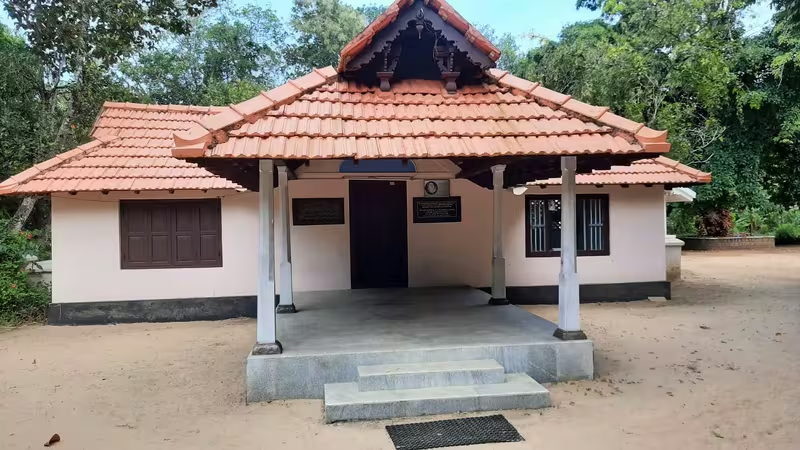
Ayyappan Pillai: The Sage Who Wielded Knowledge as a Sword
In the late 19th century, the princely state of Travancore was a society shackled by one of the most rigid and oppressive caste systems in India. It was a world where social hierarchy was divinely ordained, where knowledge was a jealously guarded monopoly, and where the distance between castes was measured not just in social standing but in physical paces. Into this suffocating atmosphere, on August 25, 1853, was born a child named Ayyappan Pillai, who would grow to become the formidable sage and scholar known as Chattampi Swamikal. A quiet revolutionary, he did not lead processions or found mass movements; instead, he waged a relentless intellectual war against orthodoxy, using the very scriptures that propped up the system to dismantle it from within.
Early Life & A Thirst for Knowledge
Ayyappan was born in Kannammoola, a village near Trivandrum, to Thamarassery Vasudeva Sharma, a Nambudiri Brahmin, and Nangamma Pillai, a woman from the Nair community. This union, crossing the rigid caste divide, was itself a quiet defiance of the era's norms. Raised in humble circumstances, the boy, affectionately called Kunjan Pillai, possessed an intellect that far outstripped his family’s means. Formal schooling was a luxury he could not afford.
Undeterred, the young Kunjan devised his own education. He would stand outside the local school run by the scholar Pettayil Raman Pillai Asan, absorbing the lessons through the open windows. His memory was prodigious, his grasp of complex subjects intuitive. When Raman Pillai Asan discovered the boy’s clandestine learning and tested him, he was so astounded by his brilliance that he not only admitted him to the class but also appointed him as the class monitor, or chattampi. The title stuck, and for the rest of his life, he would be known as Chattampi Swamikal.
His formal education was brief, but his quest for knowledge was lifelong. As a young man, he took on various jobs—a document writer, an accountant, even a manual laborer—which brought him into close contact with the everyday struggles of the common people. This experience grounded his spiritual pursuits in a deep empathy for the oppressed. His true calling, however, was that of a seeker. He embarked on a long period of wandering as a parivrajaka (wandering ascetic), traveling the length and breadth of Southern India.
His journey was an eclectic gathering of wisdom. He sought out gurus from every tradition, absorbing knowledge with an open and critical mind. In Trivandrum, he became a disciple of the great yogi and scholar Thykadu Ayyavu Swamikal, a pivotal figure who also mentored the future social reformer Narayana Guru. It was from Ayyavu Swamikal that both men imbibed the radical idea of a single, unified humanity, encapsulated in the Tamil saying, “Intha ulakathile ore oru matham, ore oru jathi, ore oru kadavul” (One religion, one caste, one God in this world).
Swamikal’s learning was not confined to Hindu traditions. He studied Tamil Vedanta, Siddha medicine, and Yoga. He learned from a reclusive Muslim scholar known as Thangal, absorbing Islamic philosophy. He engaged deeply with Christian priests to understand their theology. This boundless intellectual curiosity shaped him into a sage whose wisdom was not confined to a single dogma but was a synthesis of universal truths.
A Scholar Against Orthodoxy: Major Contributions
After years of wandering and intense spiritual practice, Chattampi Swamikal returned to society not as a reclusive mystic, but as a formidable scholar armed with the intellectual tools to challenge the status quo. He saw that the source of social oppression in Kerala was the spiritual and intellectual monopoly claimed by the Brahminical elite. His mission became the democratization of knowledge.
His contributions were primarily through his powerful writings and his direct influence on other thinkers. He did not establish an organization or an ashram in his name; he planted ideas that would grow into a forest of social change.
Key Works and Intellectual Revolution:
Vedadhikara Nirupanam (A Critique of the Monopoly on the Vedas): This is arguably his most revolutionary work. In a meticulously argued treatise, Swamikal systematically dismantled the centuries-old orthodox claim that only Brahmins had the right to learn and teach the Vedas. He did not reject the scriptures; he reclaimed them. Citing verses and commentaries from the Vedas, Upanishads, and Smritis themselves, he proved that the right to knowledge was a universal human right, not a privilege of birth. He argued that the prohibition on Shudras studying the Vedas was a later, self-serving interpolation, not an original tenet of Sanatana Dharma. This book was an intellectual atom bomb, providing the philosophical justification for non-Brahmin communities to claim their spiritual heritage.
Pracheena Malayalam (Ancient Malayalam): In this historical work, Swamikal took on the foundational myth of Keralan society—the legend of the sage Parasurama creating the land and gifting it to the Nambudiri Brahmins. This myth was used to legitimize the Nambudiris' vast land ownership and social supremacy. Swamikal, through careful research, argued that the land of Kerala belonged to its indigenous inhabitants long before the arrival of the Nambudiris. He presented a powerful counter-narrative that empowered communities like the Nairs to see themselves not as tenants on Brahmin-gifted land, but as the original custodians of the soil. It was a radical act of historical reclamation.
Advaita Chinta Paddhati (A System of Advaitic Thought): While a profound scholar of Advaita Vedanta, Swamikal believed its liberating wisdom should not be trapped in complex Sanskrit jargon. This work was a practical, accessible guide to non-dual philosophy, written in simple Malayalam. It was designed to help the ordinary person understand and practice the core tenets of Advaita, proving that the highest spiritual truths were available to anyone, regardless of their caste or education.
Christhumatha Chedanam (A Refutation of Christian Doctrines): Swamikal was not an enemy of other faiths, but a staunch defender of Advaitic principles. In an era of aggressive missionary activity, he wrote this text as a logical critique of Christian theology from a Vedantic perspective. It demonstrated his deep engagement with the religious pluralism of his time and his ability to debate complex theological points with intellectual rigor.
Influence on Narayana Guru and the Kerala Renaissance:
Chattampi Swamikal shared a deep, abiding friendship with his contemporary, Narayana Guru. While Narayana Guru went on to lead a mass social reform movement, particularly for the Ezhava community, Swamikal remained the scholar-sage, the intellectual powerhouse influencing the influencers. It is well-documented that Swamikal, being slightly older and having mastered certain yogic techniques and philosophical texts earlier, guided Narayana Guru in some of his spiritual inquiries. Their shared vision, nurtured by their common guru Ayyavu Swamikal, was the bedrock of the Kerala Renaissance. While Narayana Guru built the institutional framework for change with the SNDP Yogam, Chattampi Swamikal provided much of the ideological and spiritual ammunition.
Legacy and Enduring Influence
Chattampi Swamikal attained Mahasamadhi on May 5, 1924, at Panmana, in the Kollam district. He left behind no organization, no formal lineage of gurus. His legacy was something far more potent: a fundamental shift in the consciousness of a people.
Vidyadhiraja: The King of Knowledge
In recognition of his unparalleled mastery over a vast array of subjects—from scripture and philosophy to history, medicine, and languages—his admirers bestowed upon him the title Vidyadhiraja, meaning "King among Scholars." He embodied the ideal of knowledge as a liberating force. His life was a testament to the idea that true authority comes not from birth or title, but from wisdom and righteousness.
An Architect of Modern Kerala
Alongside Narayana Guru and Ayyankali, Chattampi Swamikal is revered as one of the great triumvirate of the Kerala Renaissance. While Narayana Guru gave the clarion call of “One Caste, One Religion, One God for Man,” and Ayyankali fought for the educational and social rights of the Dalits, Swamikal laid the intellectual foundation for their movements. He proved that the system of caste hierarchy was not only unjust but also a corruption of true Dharma. He gave non-Brahmin communities the scriptural and historical confidence to demand equality.
Today, the Panmana Ashram, built at the site of his Samadhi, stands as a serene center for spiritual seekers. But his true monument is the transformed society of modern Kerala, where the walls of caste, which once seemed insurmountable, were irrevocably breached by the power of his ideas. He remains a powerful symbol of intellectual courage and a reminder that the most profound revolutions often begin not with a sword, but with a book.