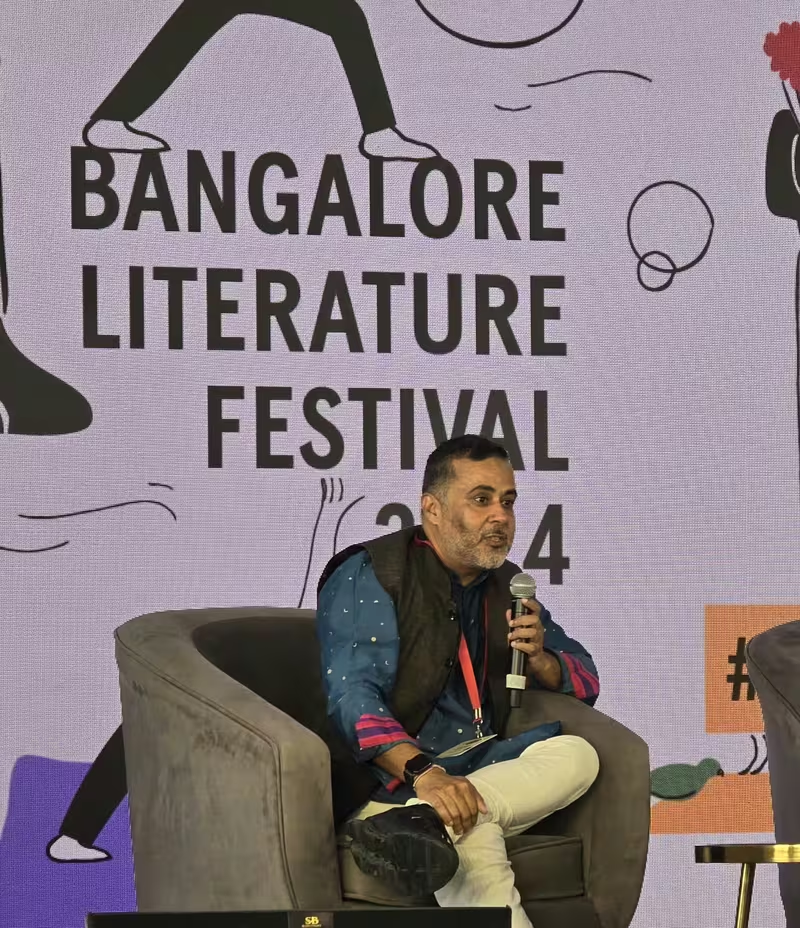
Chetan Bhagat: The Chronicler of New India
In the grand library of Indian literature, a new wing was constructed in the early 21st century. It was not built with the ornate, complex prose of the post-colonial masters, but with the simple, direct language of a generation coming into its own. The architect of this wing, and its most prominent resident, is Chetan Prakash Bhagat. An investment banker turned storyteller, Bhagat (born April 22, 1974) did not just write books; he tapped into the very pulse of a nation in transition. His novels became a mirror for the aspirations, anxieties, and everyday rebellions of India's youth, democratizing English-language fiction and creating a cultural phenomenon that continues to shape the country's literary landscape.
Early Life & Background
Chetan Bhagat was born in New Delhi into a middle-class Punjabi family that embodied the values of hard work and education. His father was a Lieutenant Colonel in the Indian Army, instilling a sense of discipline, and his mother worked as a scientist in the government's agricultural department, representing a commitment to academic pursuit. Growing up in this environment, the path to success was clearly laid out: excel in academics and secure a stable, prestigious career.
Bhagat followed this path with remarkable success. He attended The Army Public School in Dhaula Kuan, a well-regarded institution in the capital. A sharp and diligent student, he set his sights on the pinnacle of Indian undergraduate education: the Indian Institutes of Technology (IITs). In 1991, he cracked the notoriously difficult entrance examination and enrolled in Mechanical Engineering at IIT Delhi.
His years at IIT, from 1991 to 1995, were profoundly formative. The institution was a microcosm of India—a melting pot of brilliant young minds from diverse backgrounds, all under immense pressure to succeed. It was here that Bhagat observed the intense competition, the camaraderie forged in late-night study sessions, and the struggle of students to reconcile their personal dreams with systemic expectations. This experience would later become the raw material for his explosive debut novel.
After graduating from IIT, Bhagat aimed for the next logical step in the ladder of success: a Master of Business Administration (MBA) from an Indian Institute of Management (IIM). He secured admission to what is arguably the most prestigious of them all, IIM Ahmedabad, graduating with his MBA in 1997. The campus, with its distinct Louis Kahn architecture and high-stakes environment, provided another rich tapestry of characters and conflicts that would find their way into his writing. It was also at IIM Ahmedabad that he met his future wife, Anusha Suryanarayanan, a classmate from Tamil Nadu, a relationship that would later inspire one of his most beloved books.
With degrees from both an IIT and an IIM, Bhagat was perfectly positioned for a lucrative corporate career. He moved abroad and began working as an investment banker, eventually landing a position with Goldman Sachs in Hong Kong. For nearly a decade, he lived the life of a successful expatriate, but the stories he had collected in the hostels of Delhi and Ahmedabad were waiting to be told.
Career & Major Contributions
The transition from finance to fiction was not abrupt but a carefully managed parallel journey. While working long hours as a banker, Bhagat began to write. He channeled his observations of the Indian education system into a manuscript that was reportedly rejected by several publishers before Rupa Publications took a chance on it.
In 2004, Five Point Someone: What not to do at IIT was published. It was not just a book; it was a cultural explosion. The story of three friends—Hari, Ryan, and Alok—struggling to survive the academic pressures of IIT with a grade point average barely above five, resonated instantly with millions of students. Written in simple, conversational English peppered with Hinglish, it eschewed literary pretension for relatability. The book's success was unprecedented. It flew off the shelves in big-city bookstores and small-town railway stations alike, signaling a seismic shift in Indian publishing. Bhagat had proven that a massive, untapped readership existed for stories that spoke their language about their lives.
Building on this momentum, he released One Night @ the Call Center in 2005. The novel captured another defining aspect of early 2000s India: the booming Business Process Outsourcing (BPO) industry. It delved into the nocturnal lives of young call center agents, exploring their dreams and disillusionments, all wrapped in a dramatic plot involving a phone call from God. While not as critically lauded as his debut, it cemented his status as a commercial powerhouse.
Bhagat's subsequent novels continued to mine the landscape of modern India for compelling narratives:
The 3 Mistakes of My Life (2008): Set in Ahmedabad, this novel wove a story of friendship, cricket, and entrepreneurship against the backdrop of real-life tragedies, including the 2001 Gujarat earthquake and the 2002 Godhra riots. It demonstrated Bhagat's growing confidence in tackling more serious, socially charged themes within his accessible framework. The book was adapted into the critically acclaimed film Kai Po Che! (2013).
2 States: The Story of My Marriage (2009): A semi-autobiographical work, this novel humorously and affectionately detailed the cultural clashes and eventual union between a Punjabi boy and a Tamil girl. It struck a chord with a generation navigating inter-community relationships and became one of his most successful books, later adapted into a blockbuster film of the same name in 2014.
Revolution 2020: Love, Corruption, Ambition (2011): This book tackled the pervasive issue of corruption in India's private education sector, telling the story of two friends who take different paths—one of idealism, the other of pragmatism—in the holy city of Varanasi.
Half Girlfriend (2014): Addressing the deep-seated class and language divide in India, this novel explored a complex relationship between a Bihari boy with limited English skills and a sophisticated, English-speaking girl from Delhi. It was a commercial behemoth, though it also attracted significant criticism for its portrayal of characters and relationships.
In 2009, the film adaptation of his first book, 3 Idiots, directed by Rajkumar Hirani, was released. The film became one of the highest-grossing Indian films of all time and a cultural touchstone. While there was a public controversy regarding the crediting of his story, the film's success propelled the themes of Five Point Someone into the national consciousness, sparking widespread debate about the Indian education system.
Beyond novels, Bhagat cultivated a significant public profile as a columnist and public intellectual. His columns for publications like The Times of India and Dainik Bhaskar, later collected in non-fiction books like What Young India Wants (2012), saw him opine on everything from politics and economics to social mores and youth culture. He also ventured into screenwriting, co-writing the screenplay for the 2014 Salman Khan-starrer Kick, and became a familiar face on television as a judge for the dance reality show Nach Baliye.
Legacy & Influence
Chetan Bhagat's legacy is complex, significant, and fiercely debated. His primary and undeniable contribution is the democratization of Indian English fiction. Before him, the genre was largely dominated by literary heavyweights whose work, while brilliant, was often perceived as inaccessible to the average reader. Bhagat shattered this paradigm. By writing in simple, unadorned prose about relatable themes—college life, call centers, romance, ambition—he made reading in English a mainstream, aspirational habit for millions in Tier-2 and Tier-3 cities.
This created what is now known as the "Chetan Bhagat phenomenon." His success spawned an entire sub-genre of commercial fiction and opened the floodgates for a host of new authors writing in a similar vein. Publishers, realizing the existence of this massive market, began actively seeking and promoting stories that catered to it. In this sense, Bhagat was not just an author but a market-maker who fundamentally altered the business of publishing in India.
He is often described as the voice of a generation, specifically the one that came of age in the wake of India's economic liberalization in the 1990s. This generation was caught between tradition and modernity, filled with new aspirations fueled by a growing economy, yet constrained by old societal structures. Bhagat's stories gave narrative form to their struggles with career pressure, romantic freedom, and the quest for a unique identity.
However, his influence is not without its critics. The literary establishment has often dismissed his work for its simplistic language, formulaic plots, and lack of stylistic nuance. He has been accused of creating a "fast-food" literature that prioritizes commercial appeal over artistic merit. Furthermore, his public persona and columns have frequently courted controversy. His attempts to write from a female perspective in One Indian Girl (2016) drew accusations of misogyny, and his political commentary is often criticized for being reductive or opportunistic.
Despite these criticisms, Chetan Bhagat's position in modern Indian cultural history is secure. He remains a literary superstar, a brand unto himself, and a figure who commands attention. His books continue to sell in the millions, and his name is synonymous with a particular brand of storytelling that, for all its perceived faults, connected with the heart of a new, confident, and conflicted India. He is remembered not as a master craftsman of the sentence, but as a master storyteller who held up a mirror to a generation and showed them their own reflection.