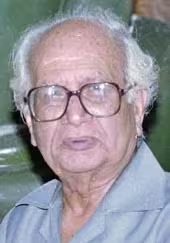
Chintamoni Kar: The Modernist Sculptor Who Won an Olympic Medal
In the annals of both Indian modern art and Olympic history lies a remarkable and often overlooked story—that of a sculptor who stood on the podium, not for athletic prowess, but for artistic genius. Chintamoni Kar (1915-2005) was a visionary artist whose life and work formed a bridge between the ancient traditions of Indian sculpture and the revolutionary currents of European modernism. A master of form, a revered academic, and an unlikely Olympic medallist for Great Britain, Kar carved a unique niche for himself, leaving behind a legacy as profound and enduring as the stone and bronze he shaped.
His journey from the dusty plains of Bengal to the prestigious art salons of Paris and London, and back to the heart of Kolkata's cultural renaissance, is a testament to a restless creative spirit. He was an artist who absorbed the world's influences without ever losing the distinct rhythm of his homeland, creating a body of work that was at once globally relevant and deeply Indian.
Early Life & Background
Chintamoni Kar was born on April 19, 1915, in Kharagpur, West Bengal, then part of British India. He entered a world teeming with the cultural and political ferment of the early 20th century. The Bengal Presidency was the epicentre of a burgeoning nationalist movement, which found a powerful voice in the arts through the Bengal School, a movement seeking to create a distinctly Indian modern art, free from the academic classicism imposed by British colonial rule.
It was in this environment that Kar’s artistic sensibilities were first nurtured. Drawn to art from a young age, he moved to Calcutta (now Kolkata) to pursue a formal education. He enrolled at the Indian Society of Oriental Art, an institution founded by the Tagore family and a bastion of the Bengal School. Here, he came under the tutelage of the movement's luminaries. He learned the delicate art of painting from Nandalal Bose, a direct disciple of Abanindranath Tagore, and studied the rigorous discipline of traditional sculpture under Giridhari Mahapatra, a master craftsman.
This foundational training was crucial. Under Mahapatra, Kar learned the ancient techniques of Oriya temple carving, mastering the flow and dynamism of traditional forms. His education was not merely technical; it was an immersion into an aesthetic philosophy that valued spirituality, lyricism, and a connection to India's rich mythological and cultural heritage. His early works from this period reflect the grace and classicism of the Bengal School, but a desire to explore beyond these established boundaries was already taking root.
In 1938, seeking to broaden his artistic horizons, Kar made a life-altering decision to travel to Paris. The city was then the undisputed capital of the art world, a crucible of avant-garde movements. He enrolled at the Académie de la Grande Chaumière, a famed art school that encouraged experimentation. Here, he was exposed to the seismic shifts of modernism—the structural logic of Cubism, the raw emotion of Expressionism, and the radical simplification of form pioneered by sculptors like Constantin Brâncuși and Henry Moore. This experience was transformative. It did not erase his Indian training but instead provided him with a new vocabulary to reinterpret it.
Career & Major Contributions
Chintamoni Kar’s career was a dynamic interplay of creation, education, and international recognition, marked by a constant evolution of style and medium.
The London Years and an Olympic Triumph
With the outbreak of World War II looming, Kar moved from Paris to London in 1939. He spent the war years and the subsequent decade in Britain, establishing himself as both an artist and an academic. He taught at the University of London and the Regent Street Polytechnic, sharing his unique perspective with a new generation of students. His talent was quickly recognised, and in 1947, he was elected a member of the prestigious Royal Society of British Sculptors.
The most extraordinary moment of his career, however, came in 1948. London was hosting the XIV Olympiad, the first since the end of the war. In a tradition that has since been discontinued, these Games included art competitions alongside the athletic events. Representing Great Britain (as an Indian-born British subject in the year immediately following India's independence), Chintamoni Kar submitted a small but exquisitely crafted boxwood statuette titled "The Stag."
The work captured the fluid energy and graceful form of the animal, blending a modern, simplified aesthetic with a timeless appreciation for nature. In a field of international artists, Kar’s sculpture was awarded the Silver Medal. It was a singular achievement, placing an Indian artist at the pinnacle of a global stage in a category that celebrated the fusion of art and the Olympic spirit. To this day, he remains one of the very few Indians to have won an individual Olympic medal in that era, albeit for a nation he would soon leave.
Return to India and a New Role
Despite his success in Europe, the pull of his homeland remained strong. In 1956, he accepted an invitation from Dr. Bidhan Chandra Roy, the visionary Chief Minister of West Bengal, to return to India and take up the post of Principal of the Government College of Art & Craft in Calcutta. This marked a new and profoundly influential chapter in his life.
For nearly two decades, from 1956 to 1973, Kar helmed one of India's most important art institutions. He was not merely an administrator but a transformative leader. He restructured the curriculum, introducing modern techniques and ideas while ensuring a continued respect for traditional Indian arts. He fostered an environment of creative freedom, encouraging students to experiment and find their own voices. His tenure produced a generation of artists who would go on to shape the landscape of post-independence Indian art. He was a revered 'guru,' known for his discipline, his deep knowledge, and his unwavering support for his students.
The Evolution of an Artistic Vision
Throughout his time as an educator, Kar continued to be a prolific artist. His style had matured into a unique synthesis of his varied experiences. The lyricism of the Bengal School, the formal discipline of temple sculpture, and the abstracting impulse of European modernism all found expression in his work.
He was a versatile master of mediums, working with equal facility in terracotta, wood, stone, and bronze. His sculptures are characterized by a sense of rhythm and movement, a simplification of form that captures the essence of his subject rather than its literal detail. Whether depicting figures from Hindu mythology like Surya or Shiva, the grace of the human form, or the vitality of the natural world, his works possess a powerful, contained energy.
His significant public works include sculptures installed at the Parliament House in New Delhi and various public spaces in Kolkata. His paintings, though less known than his sculptures, carry a similar stylistic signature, marked by bold lines and a harmonious colour palette. His art found a home in prestigious collections across the world, from the National Gallery of Modern Art in New Delhi to the Victoria and Albert Museum in London, cementing his reputation as a key figure in 20th-century sculpture.
Legacy & Influence
Chintamoni Kar passed away on October 3, 2005, in Kolkata, but his influence continues to resonate through his art, his students, and a most unusual living monument.
The Synthesizer of Worlds
His primary historical significance lies in his role as a bridge. He was one of the first Indian artists of his generation to successfully navigate and synthesize the artistic traditions of the East and the West. At a time when Indian art was grappling with its identity in a post-colonial world, Kar demonstrated that it was possible to engage with global modernism without abandoning one's cultural roots. He created a visual language that was both personal and universal, paving the way for future generations of Indian artists to confidently assert their place on the world stage.
Awards and National Recognition
His contributions were widely recognised during his lifetime. The Government of India conferred upon him the Padma Bhushan, the nation's third-highest civilian honour, in 1974. He was also awarded the Deshikottama, the highest honour of the Visva-Bharati University, and was made a Fellow of the Lalit Kala Akademi, India's national academy of fine arts.
The Chintamoni Kar Bird Sanctuary
Perhaps the most unique part of his legacy is not made of stone or bronze, but of trees, birds, and butterflies. In the southern suburbs of Kolkata lies the Chintamoni Kar Bird Sanctuary. This lush, 17-acre urban oasis was originally a sprawling, abandoned mango orchard known locally as 'Kayaler Bagan.' Kar and his wife, recognizing its importance as a habitat for local and migratory birds, purchased the land and dedicated themselves to its preservation.
For years, they fought against the pressures of urbanization and real estate developers who wished to clear the land. Their persistent efforts paid off. In 1982, the West Bengal government officially declared it a sanctuary. After his death, it was renamed in his honour—a fitting tribute to a man whose art was so deeply inspired by the rhythms of nature. The sanctuary stands today as a living, breathing testament to his foresight and his profound connection to the environment.
Chintamoni Kar is remembered today as a pioneering sculptor, a transformative educator, an Olympic hero of the arts, and a quiet conservationist. His life was a journey of continuous learning and creation, a quiet rebellion against narrow definitions of art and identity. He showed that an artist could be rooted in tradition yet open to the world, a master of ancient forms who spoke a modern language, leaving a legacy as multifaceted and enduring as his art.