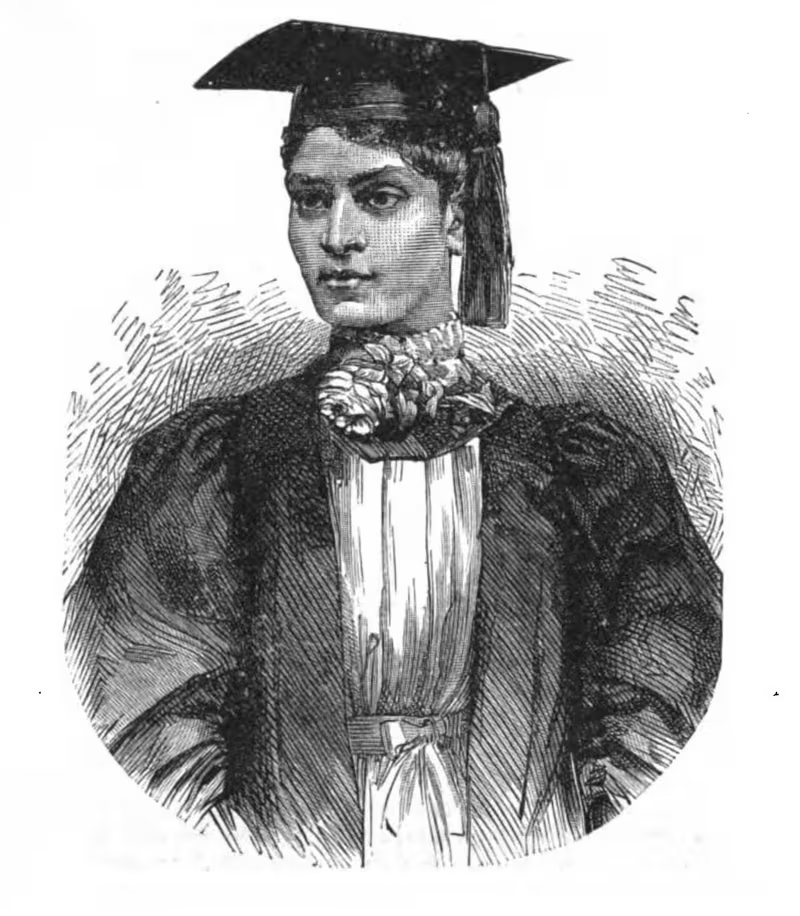
A Solitary Beacon: The Unyielding Spirit of Cornelia Sorabji
In the grand, often turbulent, theatre of late 19th-century British India, where the lines of power were drawn by race, class, and gender, a solitary figure emerged, armed not with a sword, but with a law book and an unshakeable resolve. Her name was Cornelia Sorabji. To call her merely India's first woman advocate is to state a fact while missing the poetry of her struggle. She was a force of nature, a woman who hammered at the granite walls of patriarchy and empire until, inch by painstaking inch, they began to yield. Her life was a testament to the idea that one individual, driven by intellect and empathy, could carve out a space for justice where none existed before.
Early Life & A Legacy of Firsts
Cornelia Sorabji was born on November 15, 1866, in the historic city of Nashik, a place of pilgrimage and ancient tradition. Yet, her upbringing was anything but traditional. She was the daughter of Reverend Sorabji Karsedji, a Parsi who had converted to Christianity, and his wife, Francina Ford, a woman of remarkable fortitude who had been adopted and raised by a British couple. This unique blend of Indian heritage and Western influence created a household that was a crucible of progressive thought.
Her parents were firm believers in the transformative power of education, especially for women. Her father’s conviction and her mother’s pioneering work in establishing several girls' schools in Poona (now Pune) instilled in Cornelia a belief that intellectual pursuit was not a male prerogative. She was one of nine children, and the Sorabji home was a lively centre of learning and debate, a world away from the cloistered existence of most Indian girls of the era.
Cornelia’s academic brilliance was evident from a young age. After receiving her early education at home and at her mother's schools, she set her sights on higher learning. She attended Deccan College in Poona, and in 1888, she achieved a distinction that sent ripples through the academic community: she became the first woman to graduate from Bombay University, securing a first-class degree in literature. This accomplishment should have guaranteed her a government scholarship to study in England, but the colonial administration denied it to her, citing the simple, insurmountable fact of her gender.
Undeterred, Cornelia found champions in progressive English women living in India and Britain, including the influential social reformers Mary Hobhouse and Adelaide Manning, and even the legendary Florence Nightingale. With their support, a fund was raised to send her to England. In 1889, she shattered another ceiling, becoming the first woman to be admitted to read law at Somerville College, Oxford.
Oxford, however, was a bastion of male privilege. While she could attend lectures and study, the institution was not yet ready to fully accept women into its fold. She faced a unique and frustrating form of institutional sexism. In 1892, after passing her examinations with distinction, she sat for the Bachelor of Civil Law (BCL) exam—a feat she was only allowed to attempt by special decree. She passed, yet the university refused to award her a degree. For three decades, her name would not be on the rolls of Oxford graduates. It was only in 1922, when the university finally changed its antiquated rules, that Cornelia Sorabji was formally awarded the degree she had earned thirty years prior.
A Champion for the Voiceless: Career and Contributions
Cornelia returned to India in 1894, armed with an elite legal education but facing a legal system that had no place for her. The law explicitly barred women from being enrolled as barristers. Her English qualifications were, in the eyes of the Indian courts, irrelevant. She was a lawyer who could not practice law. For any other person, this might have been the end of the road. For Cornelia, it was the beginning of her true calling.
She discovered a section of society that was utterly bereft of legal protection: the purdahnashins. These were women, both Hindu and Muslim, who lived in strict seclusion, or purdah. Forbidden from interacting with the outside male world, these women, many of whom were wealthy widows or heiresses, were legally invisible. They controlled vast estates and fortunes on paper, but in reality, they were at the complete mercy of their male relatives, agents, and managers. Unable to consult with male lawyers, they were routinely swindled out of their inheritance, their properties mismanaged, and their rights trampled upon.
Cornelia saw her unique position not as a handicap, but as an asset. As a woman, she could enter the zenana (the women's quarters) and speak directly to the purdahnashins. She could listen to their stories, examine their documents, and offer the counsel that the male-dominated legal world could not. She effectively invented her own profession, working as a legal advisor to these secluded women, navigating a complex web of social custom and legal statutes.
For nearly a decade, she tirelessly petitioned the British India Office to create a formal position for a female legal advisor. She argued passionately that without such a role, a huge segment of the Queen-Empress's subjects was being denied justice. Finally, in 1904, her persistence paid off. The government appointed her as the Lady Legal Advisor to the Court of Wards in Bengal, Bihar, Orissa, and Assam.
For the next twenty years, Cornelia Sorabji became the sole legal lifeline for hundreds of women and children. She journeyed to remote estates, poring over accounts, challenging fraudulent agents, and fighting for the rights of her vulnerable clients. It is estimated that she helped over 600 women and orphans, often working for little or no pay. Her work was not merely about property disputes; it was about restoring dignity and agency. She fought to secure education for the minor sons of her clients, ensuring the next generation would not be so easily exploited, and helped establish pathways for women to manage their own affairs.
In 1923, the Legal Practitioners' (Women) Act was finally passed in India, removing the barrier to women entering the legal profession. A year later, in 1924, Cornelia Sorabji was officially enrolled as a pleader in Calcutta. At 58 years old, she had finally won the right to stand in the courts she had been locked out of for a lifetime. However, she found that the adversarial nature of courtroom practice did not suit the kind of holistic, social-work-oriented legal aid she had pioneered. Her most profound work had already been done, not in the courtroom, but behind the veil of the purdah.
A Complex Legacy: Reformer, Imperialist, Author
Cornelia Sorabji’s legacy is as complex as the colonial world she inhabited. She was a radical social reformer in her fight for women’s legal and property rights, yet she was a staunch conservative in her political views. This apparent contradiction makes her one of modern Indian history's most fascinating figures.
Sorabji was a firm supporter of the British Raj. She believed that the empire, for all its faults, was a modernizing force that protected women from the deeply entrenched patriarchy of traditional Indian society. She was a vocal critic of the Indian independence movement, particularly the non-cooperation and civil disobedience campaigns led by Mahatma Gandhi. She feared that a swift transfer of power to a male-dominated Indian political class would roll back the hard-won progress in women’s education and rights. For her, the enemy of women was not the British ruler but the Indian traditionalist.
Her views on suffrage were similarly nuanced. While she fought for women to have a voice, she did not support universal suffrage, arguing that enfranchising millions of illiterate women would only make them pawns in the hands of their male relatives. She advocated for a qualified franchise, tied to literacy and education, a position that placed her at odds with many nationalist feminists.
Beyond her legal work, Sorabji was a gifted and prolific writer. Her books offer an invaluable window into the world she sought to change. Works like Love and Life Behind the Purdah (1901) and Sun-Babies: Studies in the Child-life of India (1904) were not dry legal treatises but empathetic, narrative-driven accounts of the lives of women and children. Her two autobiographies, India Calling (1934) and India Recalled (1936), are powerful memoirs that chronicle her extraordinary journey and articulate her unique worldview.
After retiring from her post in 1929, she settled in London, though she continued to travel between England and India. She passed away in her London home on July 6, 1954, at the age of 87.
Today, Cornelia Sorabji is remembered as a true pioneer. A portrait of her hangs in Lincoln’s Inn in London, a tribute to the woman who broke into one of the world's most exclusive legal fraternities. She paved the path for the thousands of women who now practice law in India, a reality that would have been unimaginable in her youth. While her political loyalties remain a subject of historical debate, her profound impact is undeniable. She was a woman of her time, caught between two worlds, who used the tools of an empire to fight for the most marginalized subjects within it. Her life serves as a powerful reminder that the path to justice is rarely straightforward, but is always worth forging.