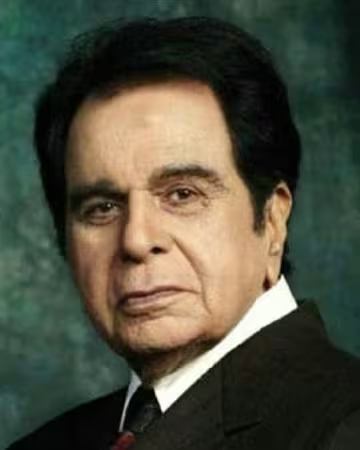
A Shadow and a Substance: The Life of Dilip Kumar
In the grand theatre of Indian history, certain figures cast a shadow so long and profound that they come to define their era. For the golden age of Hindi cinema, that shadow belonged to Muhammad Yusuf Khan, a man the world would come to know and revere as Dilip Kumar. He was not merely an actor; he was an institution, a pioneer of naturalism in a time of theatricality, and a cultural icon whose quiet intensity and brooding eyes mirrored the soul of a newly independent nation grappling with its identity. His life, spanning nearly a century from 1922 to 2021, is a chronicle of artistic evolution, personal integrity, and an enduring legacy that shaped the very craft of performance in India.
From the Bazaars of Peshawar to the Studios of Bombay
Muhammad Yusuf Khan was born on December 11, 1922, in the bustling Qissa Khwani Bazaar (the 'market of storytellers') of Peshawar, in what was then British India. He was one of twelve children born to Lala Ghulam Sarwar Khan, a prosperous Pashtun fruit merchant, and his wife Ayesha Begum. The family owned orchards in Peshawar and Deolali, and their trade brought them to the cosmopolitan hub of Bombay in the 1930s. Yusuf Khan grew up in a multilingual, multicultural environment, mastering Urdu, Hindko, Pashto, Hindi, and English with effortless ease.
He received his education at the prestigious Barnes School in Deolali, a hill station near Nashik. It was a world away from the crowded lanes of Peshawar, and it was here that he honed his English and developed a passion for sports, particularly football. In Bombay, his family lived in the same neighbourhood as the Kapoors, and a young Yusuf Khan was a childhood friend of Raj Kapoor, the man who would later become one of his greatest professional contemporaries.
His path to cinema was, however, entirely accidental. In the early 1940s, following a disagreement with his father, a teenaged Yusuf Khan left home for Pune. Demonstrating a sharp entrepreneurial spirit, he secured a contract at an army canteen and, with an initial investment, set up a successful sandwich stall. After saving a respectable sum of ₹5,000, he returned to Bombay, intending to help his father with the family business. It was on one of these trips, while shopping in a market, that fate intervened.
Dr. Masani, a friend, introduced him to Devika Rani, the celebrated actress and head of the iconic Bombay Talkies studio. Impressed by his striking looks and refined Urdu, she offered him an acting contract on a monthly salary of ₹1250—an astronomical sum at the time. His father, who held a dim view of the acting profession, was never told the true nature of his son's new job.
It was Devika Rani who suggested that a screen name would be more suitable for a romantic hero. She proposed three options: Vasudev, Jehangir, and Dilip Kumar. Yusuf Khan chose the last, a decision he would later explain in his autobiography, The Substance and the Shadow, was partly an act of self-preservation to shield his family from the perceived dishonour of his new profession. Thus, Muhammad Yusuf Khan receded into the background, and the legend of Dilip Kumar was born.
The Tragedy King and the Master of Understatement
Dilip Kumar's debut film, Jwar Bhata (1944), was unremarkable. His early years were a period of intense learning. He was not a 'natural' in the conventional sense; he was an observer, a student of human nature and the technicalities of his craft. He watched stalwarts like Ashok Kumar, whom he considered his mentor, and absorbed the nuances of performing for the camera.
His breakthrough came with the 1947 film Jugnu, which became his first major box office success. But it was the 1949 film Andaz, a sophisticated love triangle directed by Mehboob Khan, that catapulted him to superstardom. Co-starring Raj Kapoor and Nargis, the film saw Dilip Kumar portray a man consumed by unrequited love and jealousy. His subtle, internalized performance was a revelation.
This role set the stage for a series of films in the 1950s that would earn him the enduring epithet of the "Tragedy King." In films like Deedar (1951), Amar (1954), and most iconically, Bimal Roy's Devdas (1955), he perfected the art of portraying profound sorrow. His performance as the self-destructive lover Devdas is considered a benchmark in Indian cinema. He didn't just act out the pain; he inhabited it. His drooping shoulders, the quiver in his voice, and the haunting sadness in his eyes conveyed a universe of heartbreak without resorting to melodrama.
This deep immersion, however, came at a great personal cost. The relentless portrayal of tragedy began to affect his mental health, leading to bouts of depression. A psychiatrist in London famously advised him to seek out lighter, more cheerful roles to preserve his own well-being. This advice marked a pivotal turn in his career, forcing him to demonstrate his incredible versatility.
Beyond Tragedy: A Spectrum of Roles
Heeding the medical advice, Dilip Kumar consciously veered towards different genres. In Mehboob Khan's Aan (1952), India's first full feature in Technicolor, he played a swashbuckling village hero with flamboyant charm. The film was a massive success, even receiving a grand international release in London. He followed this with the light-hearted caper Azaad (1955) and the social drama Naya Daur (1957), which passionately argued the 'man versus machine' debate in a newly industrializing India.
His role as the charming prince in Kohinoor (1960) required him to learn to play the sitar, a task he undertook with characteristic dedication, practicing for months to perfect his fingering for a single song sequence. This commitment to authenticity was the hallmark of his craft.
This era culminated in what is arguably the grandest epic of Indian cinema: K. Asif's Mughal-e-Azam (1960). The film, which took over a decade to complete, was a monumental spectacle. As Prince Salim, torn between his love for the courtesan Anarkali (Madhubala) and his duty to his father, Emperor Akbar (Prithviraj Kapoor), Dilip Kumar delivered a performance of magnificent restraint. Amidst the film's opulent sets and theatrical dialogue, his portrayal was a quiet, smouldering fire. He conveyed Salim's defiance, passion, and despair through whispered words and defiant glances, proving that the most powerful emotions are often the ones left unspoken.
The Second Innings: A Pillar of Strength
After a period of less successful films in the 1970s, Dilip Kumar took a five-year hiatus from acting. He returned in 1981, not as a romantic hero, but as a formidable character actor. His comeback film, Kranti, was a blockbuster, but it was his role in Ramesh Sippy's Shakti (1982) that defined his second innings.
Shakti brought together two titans of Indian cinema: Dilip Kumar and the reigning superstar, Amitabh Bachchan. Playing a stoic, morally upright police officer and a distant father to his estranged criminal son (Bachchan), Dilip Kumar delivered a masterclass in controlled intensity. The simmering tension and unspoken grief between the two characters created some of the most electrifying scenes in Hindi film history, earning him his eighth and final Filmfare Award for Best Actor.
Throughout the 1980s and early 1990s, he excelled in powerful patriarchal roles in films like Mashaal (1984), Karma (1986), and Saudagar (1991), which reunited him on screen with his old contemporary, Raaj Kumar. His final film appearance was in Qila (1998).
Legacy: The Actor's Actor
Dilip Kumar's influence on Indian cinema is immeasurable. He was the progenitor of 'method acting' in India long before the term became fashionable. He pioneered a naturalistic, introspective style that stood in stark contrast to the prevalent theatricality of his time. He taught generations of actors that the true power of a performance lay not in loud declamation but in the quiet spaces—the pregnant pause, the subtle gesture, the flicker of an eye.
Actors from every subsequent generation, from Amitabh Bachchan and Naseeruddin Shah to Shah Rukh Khan and Irrfan Khan, have cited him as their ultimate inspiration. Amitabh Bachchan called him "the greatest actor ever," while Shah Rukh Khan, who reprised his role in a 2002 remake of Devdas, has always acknowledged his debt to the master.
His unparalleled contribution was recognized with India's highest cinematic honour, the Dadasaheb Phalke Award, in 1994. The Government of India conferred upon him the Padma Bhushan in 1991 and the Padma Vibhushan in 2015. In a rare and significant gesture of cross-border admiration, the Government of Pakistan awarded him its highest civilian honour, the Nishan-e-Imtiaz, in 1998, a testament to his status as a cultural bridge connecting the shared heritage of the subcontinent.
Beyond the screen, he was a man of immense dignity and grace. His marriage to actress Saira Banu in 1966, despite a significant age difference, was an enduring partnership that lasted over five decades. He also served a term as a Member of Parliament in the Rajya Sabha from 2000 to 2006.
When Muhammad Yusuf Khan passed away on July 7, 2021, at the age of 98, an entire epoch of Indian culture came to a close. The state funeral accorded to him was a recognition of his monumental stature. He was more than a star; he was a guiding light, the original Khan who set the benchmark for excellence. He was the storyteller from Peshawar's 'market of storytellers' who, through his art, told the most profound story of all: the story of the human heart in all its tragic, heroic, and beautiful complexity.