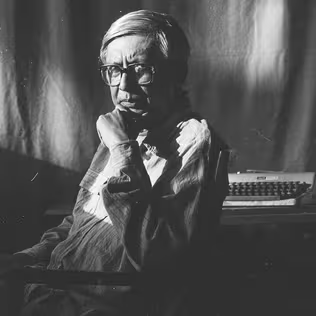
Dom Moraes: The Gentle, Haunted Poet of Indian English Literature
In the annals of Indian English literature, few figures cast as long and as melancholic a shadow as Dominic Francis Moraes. He was a paradox: an Indian who wrote with the cadences of an English master, a prodigy who won Britain's most prestigious poetry prize before he could legally drink there, and a perpetual wanderer who felt at home nowhere. Dom Moraes was more than a poet; he was a chronicler of his own fractured soul, and in doing so, he held a mirror to the complex, often dislocated, identity of the post-colonial artist. His life, which began in Bombay in 1938 and ended in the same city in 2004, was a tapestry woven with threads of literary genius, profound personal sorrow, and an unceasing search for a place to belong.
Early Life & Background: A World of Words and Wounds
Born on July 19, 1938, in Bombay, British India, Dom Moraes was destined for a life of letters. He was the son of Frank Moraes, a celebrated journalist who would become the first Indian editor of The Times of India and a formidable intellectual figure in the newly independent nation. His was a household where words were currency and ideas were the air one breathed. This privileged, anglicized upbringing, however, was shadowed by a deep and formative tragedy: the slow, painful decline of his mother, Beryl, due to mental illness.
This domestic turmoil shaped Moraes into a solitary, observant child who sought refuge in books. His father’s library became his sanctuary, and the works of English poets became his companions. The trauma of his mother's condition, a subject he would later explore with searing honesty in his memoirs, instilled in him a profound sense of loss and displacement that would become the central theme of his artistic life. He was, from a young age, an old soul, acutely aware of the fragility of the world around him.
In 1954, at the tender age of 16, Moraes left India for England to study at Jesus College, Oxford. This was not merely a change of continent; it was a plunge into the very heart of the literary world he had only read about. Oxford in the 1950s was a crucible of artistic and intellectual ferment. Moraes, with his boyish charm, precocious intellect, and already polished poetic voice, moved effortlessly among the era's literary giants. He befriended Stephen Spender, who became a mentor, and had memorable encounters with W.H. Auden, T.S. Eliot, and Allen Ginsberg. He was no longer just an Indian boy who wrote poetry; he was a poet, recognized and nurtured by the establishment.
It was during these formative years at Oxford that his genius flowered spectacularly. In 1957, while still an undergraduate, he published his first collection of poems, A Beginning. The work was a revelation. It showcased a technical mastery of form and a lyrical grace that was astonishing for a poet of any age, let alone a teenager. The poems, filled with classical allusions and a haunting, melancholic beauty, explored themes of exile, love, and mortality. The following year, in 1958, A Beginning was awarded the prestigious Hawthornden Prize, making the 19-year-old Moraes its youngest-ever recipient and the first non-English person to win. The boy from Bombay had arrived, crowned a prodigy on the English literary stage.
Career & Major Contributions: A Life in Letters
Dom Moraes's career was a sprawling, multifaceted journey that defied easy categorization. While poetry remained his first and truest love, he navigated the worlds of prose, journalism, and documentary filmmaking with a restless energy, often driven as much by financial necessity as by creative impulse.
The Poet: Lyrical Grace and a Long Silence
Following the stunning success of A Beginning, Moraes solidified his reputation with two more collections, Poems (1960) and John Nobody (1965). These works continued to display his signature style: a formal elegance, a rich musicality, and a deep-seated sense of alienation. His poetry was not overtly 'Indian' in the way some of his contemporaries' was. He was less concerned with the socio-political realities of post-Independence India and more with the timeless, universal landscapes of the human heart.
Then, in the mid-1960s, the poetry stopped. For nearly 17 years, one of the most promising poetic voices of his generation fell silent. Moraes later explained this creative drought as a feeling that he had exhausted his themes, that the wellspring of his inspiration had run dry. He felt he was merely repeating himself, a prospect his artistic integrity could not abide. This long hiatus became a defining chapter of his life, a period of wandering and working in other forms.
He returned to poetry in the early 1980s, and his Collected Poems 1957-1987, published in 1987, was a landmark event. The later poems, while still bearing his lyrical mark, were often sparer, more direct, and imbued with a quiet wisdom born of experience. In 1994, his immense contribution to literature was officially recognized in his homeland when he was awarded the Sahitya Akademi Award, India's highest literary honor, for his Collected Poems.
The Prose Writer: Confessions and Chronicles
During his poetic silence, Moraes honed his craft as a prose writer of exceptional clarity and emotional depth. He became a prolific journalist, editor, and travel writer, assignments that took him around the globe, from the battlefields of Vietnam and Algeria to the nascent state of Israel.
His most enduring prose works are his memoirs, which stand as classics of the genre. My Son's Father: An Autobiography (1968) is a masterpiece of confessional writing. In it, he recounts his unusual childhood, the painful relationship with his parents, and his literary apprenticeship in London and Oxford with unflinching honesty and elegance. It is a portrait of the artist as a young man, haunted by the ghosts of his past.
Other notable prose works include Gone Away: An Indian Journey (1960), an early travelogue capturing his impressions of India after his time in England, and Never at Home (1992), another volume of memoirs. His prose, like his poetry, is characterized by its lucid style and a keen, empathetic eye for the human condition.
He also worked on several UN projects and co-authored books with other artists, most notably the celebrated Indian painter M.F. Husain. This journalistic and non-fiction work, while providing him a livelihood, also fed his art, giving him a vast canvas of human experience from which to draw.
Legacy & Influence: The Perpetual Outsider
Dom Moraes's legacy is as complex as the man himself. He occupies a unique and vital space in the history of Indian literature. As part of the first generation of post-Independence writers, alongside figures like Nissim Ezekiel and A.K. Ramanujan, he was instrumental in proving that English could be a powerful and legitimate medium for Indian literary expression on the world stage.
His most significant contribution lies in his steadfast commitment to a universal aesthetic. At a time when many Indian writers were grappling with themes of nationhood and identity, Moraes's work remained intensely personal and lyrical. He was criticized by some for not being 'Indian' enough, for his seeming detachment from the immediate concerns of his country. Yet, it was precisely this detachment that gave his work its timeless quality. His themes of exile, loneliness, and the search for love and meaning resonated across cultural boundaries.
He is remembered as the "perpetual outsider." He felt alienated from the heat and dust of India due to his Westernized sensibilities, yet he never truly felt he belonged in England, where he was always seen, in some sense, as an exotic import. This feeling of being an eternal émigré, a man without a fixed home, is the central, poignant truth of his life and art. His poetry is the beautiful, sad song of this displacement.
For later generations of Indian English poets, Moraes set an uncompromisingly high standard for craft and technique. He demonstrated that mastery of form was not an impediment to emotional expression but a vessel for it. His candid memoirs also helped pave the way for a more personal, introspective mode of writing in Indian non-fiction.
Dom Moraes passed away in his sleep in Mumbai on June 2, 2004. He had returned to the city of his birth, but the journey had come full circle. He left behind a body of work that is a testament to a life lived intensely, a mind of rare brilliance, and a heart of profound sensitivity. He is remembered not just as a foundational figure of a literary movement, but as a gentle, haunted voice who transformed his personal pain into poetry of enduring beauty.