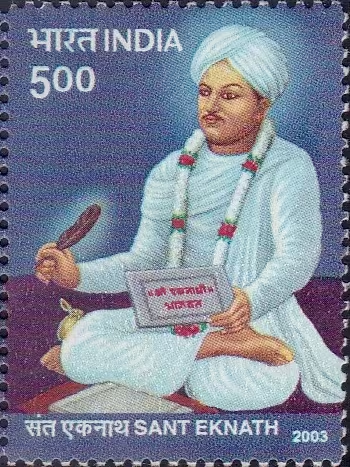
Eknath: The Compassionate Sage of Paithan
In the tumultuous 16th-century Deccan, a landscape fractured by the ambitions of the Sultanates, a spiritual light emerged from the ancient city of Paithan in Maharashtra. This was Eknath (1533-1599), a scholar, poet, social reformer, and householder-saint whose life became a masterclass in harmonizing the divine with the everyday. As a pivotal figure in the Varkari tradition, Eknath did not merely preach devotion; he lived it with a radical compassion that challenged the rigid social hierarchies of his time. He built a bridge between the esoteric Sanskrit scriptures of the elite and the simple Marathi tongue of the common people, ensuring that the streams of spiritual wisdom flowed freely to all, regardless of caste or creed.
Early Life & The Quest for a Guru
Eknath was born in 1533 in Paithan, a city on the banks of the Godavari River with a hallowed legacy as a center of learning and spirituality. His family belonged to the Deshastha Rigvedi Brahmin community, with his parents being Suryanarayan and Rukminibai. Tragedy struck early, as Eknath was orphaned at a young age and subsequently raised by his loving grandparents, Chakrapani and Saraswatibai. From his childhood, he displayed an intense spiritual inclination, a deep curiosity for the ultimate questions of life and divinity that set him apart from his peers.
Driven by an inner calling, the young Eknath embarked on a quest for a true spiritual master, a Sadguru. His search led him to the formidable Devgiri (Daulatabad) fort, a bastion of political power under the Nizam Shahi Sultanate. Here, he found his guru, Janardan Swami, a remarkable figure who was both a high-ranking official in the fort's administration and a devout mystic in the Dattatreya tradition.
Under Janardan Swami's tutelage, Eknath received a unique education that would define his life's philosophy. He was trained not in seclusion, but amidst the hustle of worldly duties. He studied the foundational texts of Hindu philosophy—the Vedas, Upanishads, and the Bhagavad Gita—while also learning accounting and administrative tasks. Janardan Swami instilled in him the core principle that spiritual realization (Paramartha) was not separate from worldly life (Prapancha), but could be achieved within it. For about six years, Eknath served his master with unwavering devotion, absorbing the lessons that taught him to see God in every duty and every being.
A Torrent of Literary and Spiritual Contributions
After completing his education, Eknath returned to Paithan on his guru's instructions. He married Girijabai, and together they led an exemplary life as householders (gṛhastha), raising a family while remaining deeply immersed in spiritual practice. It was from Paithan that Eknath's most significant contributions to Marathi literature and the Bhakti movement would flow.
The Eknathi Bhagavata: A Magnum Opus
Eknath’s crowning literary achievement is the Eknathi Bhagavata, a monumental commentary in Marathi on the Eleventh Canto (Skandha) of the Bhagavata Purana. This Sanskrit text, detailing the final teachings of Lord Krishna to his disciple Uddhava, was considered the pinnacle of devotional philosophy but was inaccessible to the masses. Eknath took upon himself the sacred task of rendering its complex Vedanta philosophy into lucid, poetic, and emotionally resonant Marathi verse.
He began this work in Paithan and completed it in Varanasi, the heart of Brahminical orthodoxy. His decision to write on such a profound subject in a vernacular language was revolutionary and initially met with resistance from the city's Sanskrit pandits. According to tradition, they challenged his work, but were ultimately won over by its spiritual depth and linguistic brilliance. The Eknathi Bhagavata became a cornerstone of Varkari philosophy, masterfully explaining how to live a life of devotion and detachment while fulfilling one's worldly responsibilities.
Preserving a Legacy: The Dnyaneshwari
One of Eknath's most selfless and vital contributions was the restoration of the Dnyaneshwari, the sublime 13th-century commentary on the Bhagavad Gita by the revered saint Dnyaneshwar. Over three centuries of being copied by hand, the original text had been corrupted with scribal errors and interpolations. Recognizing the urgent need to preserve this treasure of Marathi spirituality, Eknath undertook the painstaking scholarly work of collecting numerous manuscripts, comparing them meticulously, and establishing a purified, authentic version. This act of literary restoration was not merely academic; it was an act of profound devotion that ensured Dnyaneshwar's illuminating wisdom would continue to guide future generations.
Bhavarth Ramayana and Vernacular Storytelling
Eknath also authored the Bhavarth Ramayana, a Marathi retelling of the epic Ramayana. Infused with his unique devotional and philosophical insights, it presents the story not just as a historical narrative but as a profound allegory for the human soul's journey. He was unable to complete this epic work before his passing in 1599; the final sections were later completed by his disciple, Gavba. The Bhavarth Ramayana remains one of the most beloved versions of the epic in Maharashtra.
The Bharud: Spiritual Theatre for the Masses
Perhaps Eknath's most innovative contribution was his popularization of the Bharud. These were short, allegorical, and dramatic folk songs that used characters and situations from everyday life—a wandering acrobat, a street vendor, a domestic quarrel—to convey profound spiritual truths. Written in simple, rustic language and filled with wit and satire, the Bharuds were a form of spiritual street theatre. They demystified complex philosophical ideas, criticized social hypocrisy, and delivered ethical lessons in a format that was entertaining and instantly relatable to the common villager. Through the Bharud, Eknath became a teacher to the unlettered, a true folk-saint.
Living Philosophy: A Life of Radical Compassion
Eknath's greatness lay not only in his words but in his actions. His life was a living embodiment of the Vedantic principle of seeing the divine in all beings. Numerous well-documented anecdotes illustrate his radical empathy and his courage in defying caste-based discrimination.
The Thirsty Donkey: In a famous incident, Eknath was returning from the Godavari River carrying holy water intended for a ritual offering at the temple. On the way, he saw a donkey lying by the roadside, dying of thirst. Without a moment's hesitation, he poured the sacred water into the donkey's mouth, declaring, “The Lord who is in the temple is the same Lord who is in this suffering creature.” For Eknath, compassion was the highest form of worship.
Dining Across Caste Lines: At a time when caste purity was rigidly enforced, Eknath accepted an invitation to dine at the home of a man from a so-called “untouchable” caste. This act caused an uproar among the orthodox Brahmins of Paithan, who ostracized him. Unfazed, Eknath calmly endured their scorn, his actions speaking louder than any scripture about the unity of all humanity.
The True Shraddha: When performing the annual shraddha ceremony for his ancestors, it was customary to feed only learned Brahmins. Eknath, however, invited the poorest and most marginalized people of the city to the feast, believing that feeding the hungry and needy was the truest way to honor his ancestors and please God.
These acts were not mere gestures of charity but profound philosophical statements. They demonstrated his unwavering conviction that the divine essence, the Atman, pervades all of creation, making divisions of caste and creed meaningless illusions.
Legacy and Enduring Influence
In 1599, Sant Eknath concluded his earthly journey by entering into jalsamadhi (a conscious departure from the body in water) in the sacred Godavari River at Paithan. His departure was not an end, but the sealing of a legacy that continues to nourish the spiritual and cultural soil of Maharashtra.
Eknath is revered as one of the great pillars of the Varkari Sampradaya, the devotional movement centered on the worship of Vitthala of Pandharpur. He stands in a direct lineage with Dnyaneshwar and Namdev before him, and Tukaram after him. He is credited with revitalizing the movement, giving it a solid philosophical foundation through his writings and a powerful social conscience through his personal example.
His impact on Marathi literature is immeasurable. He elevated the language, demonstrating its capacity for the highest philosophical discourse while simultaneously celebrating its rustic, folk idioms. By choosing to write in the language of the people, he democratized spirituality and empowered millions.
Today, Sant Eknath is remembered as the compassionate sage, the householder-saint who taught that the path to God is not paved with renunciation alone, but with love, service, and the courageous performance of one's duty in the world. His abhangas are sung with fervor in temples and homes across Maharashtra, and his bharuds continue to entertain and enlighten. The annual Nath Shashti festival in Paithan draws thousands of pilgrims who come to honor the saint who saw God in a thirsty donkey and proved that a truly spiritual life is one lived with an open heart and boundless compassion for all.