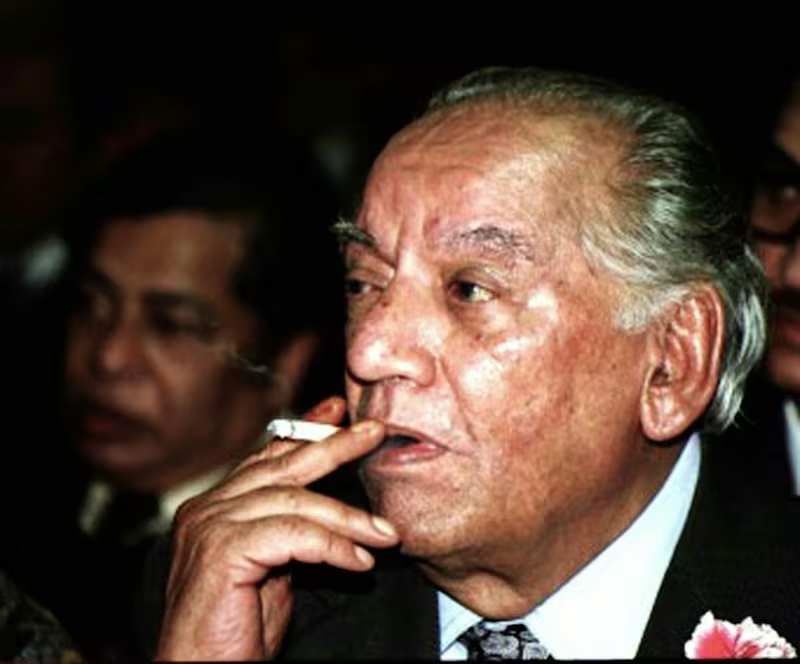
Faiz Ahmad Faiz: The Poet of Revolution and Romance
In the grand tapestry of 20th-century literature, few figures loom as large or cast as long a shadow as Faiz Ahmad Faiz. He was more than a poet; he was a conscience, a revolutionary, and a voice for the voiceless, whose words possessed the rare power to ignite protests and soothe wounded hearts with equal grace. A committed Marxist and a celebrated humanist, Faiz masterfully wove the threads of personal love (ishq) and collective revolution (inqilab) into a singular, breathtaking vision. His life, marked by acclaim, imprisonment, and exile, was a testament to his unwavering belief in the power of the word to challenge tyranny. From the literary salons of pre-partition Lahore to the grim confines of a prison cell, and onto the world stage as a recipient of the Lenin Peace Prize, Faiz’s journey is the story of a man who lived his poetry and whose poetry continues to live in the soul of the Indian subcontinent.
Early Life & Formative Years
Faiz Ahmad Faiz was born on February 13, 1911, in the village of Kala Qader, near Sialkot in Punjab, British India—a region that had also produced the great poet-philosopher Allama Iqbal. He was born into a privileged and educated family. His father, Sultan Muhammad Khan, was a learned barrister who had worked for the British government and even served as an emissary to the court of the Amir of Afghanistan. His mother was Sultan Fatima. This environment steeped in literature and intellectual discourse provided the young Faiz with a robust foundation. His early education was a blend of the traditional and the modern; he first studied at a maktab where he learned Arabic, Persian, and the Quran, before enrolling at the Scotch Mission School in Sialkot.
His intellectual horizons expanded dramatically when he moved to Lahore, the vibrant cultural and political heart of Punjab. He attended the prestigious Government College, where he immersed himself in literature, earning a B.A. with Honours in Arabic and later an M.A. in English Literature in 1932. He followed this with another M.A., this time in Arabic, from Oriental College, Lahore, in 1934. In the Lahore of the 1930s, Faiz was exposed to a whirlwind of ideas. The air was thick with anti-colonial sentiment, socialist thought, and a burgeoning modernist literary movement. Here, he studied the classical traditions of Ghalib and Mir while simultaneously engaging with Western literary figures. This dual education—deeply rooted in the Perso-Arabic literary tradition yet open to modern global influences—would become the hallmark of his unique poetic style.
A Career Forged in Words and Activism
Faiz began his professional life in academia, taking up a position as a lecturer at the Muhammadan Anglo-Oriental (MAO) College in Amritsar in 1935. It was here that his life took a decisive turn. He met Sahibzada Mahmud-uz-Zafar and his wife, Dr. Rashid Jahan, two firebrand intellectuals who were instrumental in founding the Progressive Writers' Movement (PWM). Faiz was immediately drawn to their cause. The PWM, inspired by socialist ideals, sought to unshackle literature from purely aesthetic concerns and use it as a tool for social and political change. They advocated for realism, championed the cause of the poor and oppressed, and were fiercely anti-imperialist. Faiz became one of the movement's most eloquent and influential voices.
His first collection of poetry, Naqsh-e-Faryadi (The Imprint of the Suppliant), published in 1941, announced the arrival of a major new talent. The collection contained one of his most iconic poems, "Mujhse Pehli Si Mohabbat Mere Mehboob Na Maang" (My Love, Do Not Ask of Me That Love I Once Had For You). The poem begins as a traditional address to a lover but pivots dramatically to a larger social consciousness, declaring that the world is filled with sorrows beyond the personal pain of love—the sorrows of poverty, oppression, and injustice. This poem perfectly encapsulated the progressive ideal and became an anthem for a generation.
With the outbreak of World War II, Faiz made a seemingly contradictory move. In 1942, he joined the British Indian Army, serving in the department of public relations. He rose to the rank of Lieutenant-Colonel and was awarded the MBE (Member of the Order of the British Empire). For many leftists, this was part of a strategic anti-fascist alliance against Nazi Germany. After the war ended and just before the partition of India, he resigned from the army in 1947 and returned to Lahore. He took on the role of editor for two prominent English and Urdu newspapers, The Pakistan Times and Imroze, using his editorial platform to advocate for social justice and democratic ideals in the newly formed nation of Pakistan.
The Years of Dissent and Imprisonment
The optimism of independence was short-lived. The trauma of Partition cast a long shadow, a sorrow Faiz captured poignantly in his poem "Subh-e-Azadi" (Dawn of Freedom), where he lamented, "Ye daagh daagh ujaala, ye shab-gazida seher / Woh intezaar tha jiska, ye woh seher toh nahin" (This stained light, this night-bitten dawn / This is not the dawn we had waited for). His critical stance and socialist leanings soon brought him into direct conflict with the Pakistani state.
In March 1951, Faiz was arrested in what became known as the Rawalpindi Conspiracy Case. He, along with a group of senior military officers and other left-wing figures, was accused of plotting a coup to overthrow the government of Prime Minister Liaquat Ali Khan. Faiz vehemently denied the charges, which were widely seen as a pretext to silence political dissent. He spent the next four years in prison, much of it in solitary confinement.
Yet, the prison cell could not silence his poetic voice; instead, it amplified it. This period of incarceration was one of immense creative output. The walls of the prison became a powerful metaphor for the broader oppression in society, and his poetry became a beacon of hope and defiance. His next two collections, Dast-e-Saba (Hand of the Breeze, 1952) and Zindan-Nama (The Prison Chronicle, 1956), were composed almost entirely behind bars. These works are considered masterpieces of resistance literature. In them, Faiz transformed the classical tropes of the ghazal—the longing for the beloved, the cruelty of the rival, the pain of separation—into powerful symbols of political struggle. The beloved became the revolution itself, and the prison cell, a temporary obstacle on the path to freedom.
He was finally released in 1955 due to international pressure and lack of evidence. Though exonerated, he remained a marked man, forever viewed with suspicion by the state.
Exile and International Recognition
Faiz continued his work, becoming a leading figure in the international peace movement and the Afro-Asian Writers' Association. However, the political climate in Pakistan grew increasingly repressive, culminating in the military dictatorship of General Zia-ul-Haq in 1977. Under Zia's brutal regime, which suppressed all forms of dissent, Faiz’s work was banned from state television and radio. Facing persecution, he chose a life of self-imposed exile, spending several years in Moscow and Beirut.
In Beirut, he served as the editor of Lotus, a prestigious literary journal of the Afro-Asian Writers' Association. This period brought him into close contact with the Palestinian struggle, a cause he deeply identified with and supported through his poetry. His collection from this era, Mere Dil Mere Musafir (My Heart, My Traveller), reflects his experiences of exile and his solidarity with global liberation movements.
Despite the persecution at home, his international stature soared. In 1962, he was awarded the Lenin Peace Prize, the Soviet Union's highest civilian honour, making him the first poet from Asia to receive it. Towards the end of his life, he was also nominated for the Nobel Prize in Literature. He returned to Pakistan in 1982 and passed away in Lahore on November 20, 1984, leaving behind a world of verse that would prove immortal.
Legacy & Enduring Influence
Faiz Ahmad Faiz’s legacy is monumental and multifaceted. He is celebrated as one of the greatest Urdu poets of all time, a modern master who bridged the classical and the contemporary with unparalleled skill. His genius lay in his ability to pour new, revolutionary wine into the old, elegant bottles of the ghazal and nazm. By re-imagining traditional symbols, he made political protest beautiful and accessible, crafting a language of dissent that was both lyrical and potent.
His most enduring legacy is perhaps his poem "Hum Dekhenge" (We Shall See). Written as a direct challenge to Zia-ul-Haq's tyranny, the poem draws upon Quranic imagery to prophesy the inevitable downfall of dictators and the ultimate triumph of the people. It became a global anthem of resistance. Its most legendary rendition was by the singer Iqbal Bano in Lahore in 1986. Defying a ban on sarees, she appeared on stage in a black saree and sang the poem to a rapturous audience of 50,000, an act of artistic and political defiance that has become iconic in South Asian history. Today, from student protests in Delhi to democratic rallies in Lahore, the words "Hum dekhenge... lazim hai ke hum bhi dekhenge" (We shall see... it is certain that we too shall see) echo as a powerful declaration of hope against despair.
His poetry has been set to music by the subcontinent's most legendary singers, including Noor Jehan, Mehdi Hassan, and Begum Akhtar, ensuring its place not just in literary canons but in the fabric of popular culture. He is remembered as a cultural icon who stood for secularism, humanism, and social justice. In an era of rising intolerance, Faiz’s voice remains a powerful reminder of a shared heritage and a call to a more compassionate and just world. He was a poet who truly believed that while the sorrows of the world are many, the human spirit's capacity for love, hope, and revolution is infinite.