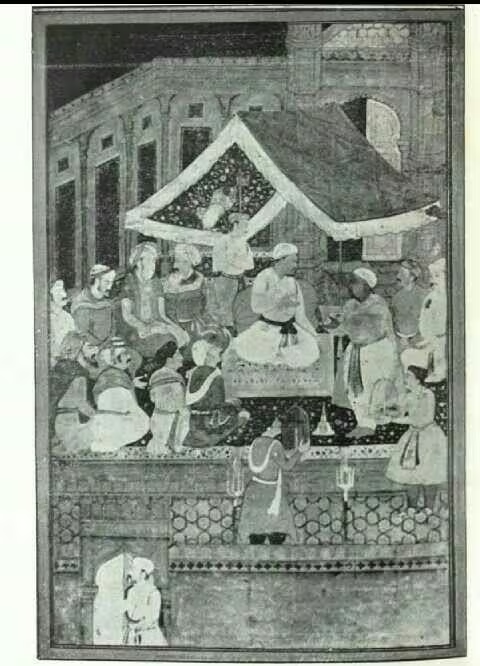
The Luminous Jewel: Faizi, Poet-Philosopher of Akbar's Court
In the grand theatre of the Mughal Empire, few reigns shimmer with the intellectual and cultural incandescence of Emperor Akbar's. At the heart of this golden age was a constellation of brilliant minds known as the Navaratnas—the Nine Jewels—who illuminated the court with their genius. Among them, holding the esteemed title of Malik-ush-Shu'ara (King of Poets), was Abu al-Faiz ibn Mubarak, known to history by his pen name, Faizi. More than a mere court poet, Faizi was a polymath, a philosopher, and a key architect of the syncretic vision that came to define Akbar's India. His life was a testament to the power of words to bridge cultures, challenge orthodoxy, and shape an empire's soul.
Early Life & A Legacy of Dissent
Abu al-Faiz was born in the Mughal capital of Agra in 1547. He was the eldest son of Shaikh Mubarak Nagori, a scholar of immense repute whose intellectual legacy would profoundly shape the destinies of his children. Shaikh Mubarak was a man of deep learning in Islamic theology, Greek philosophy, and mysticism, but his liberal and often heterodox interpretations of faith placed him in direct conflict with the rigid orthodoxy of the court's Ulama. The family, including Faizi’s brilliant younger brother Abul Fazl, lived under the constant threat of persecution. They were hunted, forced into hiding, and publicly denounced as heretics.
This crucible of intellectual dissent and physical danger became Faizi's first classroom. Under his father's rigorous tutelage, he mastered Arabic and Persian, delved into poetry, philosophy, theology, and even medicine. His precocity was astounding; by his early teens, he was already composing sophisticated verse and demonstrating a command of complex subjects that belied his age. The persecution his family endured did not break his spirit; instead, it forged in him a deep-seated skepticism towards religious dogmatism and a powerful belief in the pursuit of truth through reason and open inquiry. This formative experience would later make him a natural and indispensable ally for an emperor who was beginning his own journey of questioning.
The Poet's Arrival: A Summons to the Imperial Court
In 1567, the imperial court was abuzz. Emperor Akbar, growing weary of the suffocating influence of the orthodox clergy, was actively seeking out fresh, liberal minds to populate his circle. The names of Shaikh Mubarak's sons, Faizi and Abul Fazl, reached his ears. The summons for the 20-year-old Faizi to appear before the emperor was less an invitation and more a test. The family's enemies at court framed the call as a precursor to arrest, and Shaikh Mubarak feared the worst.
However, when Faizi stood before Akbar, the emperor was not met with a cowed heretic but a young man of dazzling intellect and poetic grace. Akbar, a keen judge of character and talent, was immediately captivated. Faizi's eloquence, his vast knowledge, and his ability to articulate complex philosophical ideas with poetic clarity won him a place at court. It was the beginning of a relationship that would last nearly three decades, a bond between a visionary ruler and the poet who could give voice to his vision.
Career & Major Contributions: Architect of a Cultural Renaissance
Faizi's ascent within the imperial hierarchy was swift. He became a close companion and advisor to Akbar, valued not just for his literary gifts but for his wisdom and counsel.
Malik-ush-Shu'ara: The King of Poets
In 1588, Akbar formally bestowed upon Faizi the title of Malik-ush-Shu'ara, or Poet Laureate. This was no mere honorific. It was a declaration that Faizi was the preeminent literary voice of the empire. His poetry, collected in his Diwan (a collection of lyrics), was celebrated for its originality and depth. He was a master of the ghazal and the qasida, but he infused these traditional forms with a fresh sensibility. He moved away from the highly ornate and artificial style then in vogue, preferring a more direct, elegant, and philosophically rich mode of expression that came to be known as the Sabk-i-Hindi (the Indian Style) of Persian verse.
A Bridge Between Worlds: The Translation Projects
One of Faizi’s most enduring contributions was his role as a cultural bridge-builder. Under Akbar's patronage, a grand project was initiated at the Maktab Khana (Translation Bureau) in Fatehpur Sikri to translate seminal Sanskrit texts into Persian, the administrative and cultural language of the empire. Faizi was placed at the head of this monumental undertaking.
His goal, aligned with Akbar's, was to foster a deeper understanding between the Hindu and Muslim intellectual traditions. He personally undertook the translation of Bhaskara II’s 12th-century mathematical masterpiece, the Lilavati, rendering complex algebraic and geometric concepts into elegant Persian prose. He also played a key role in the collaborative translation of the epic Mahabharata into the Razmnama (Book of Wars) and oversaw the translation of the Ramayana, the Atharva Veda, and the Panchatantra.
These were not just literal translations; they were acts of cultural interpretation, making the philosophical and narrative treasures of ancient India accessible to the Persian-speaking world for the first time on such a grand scale. This project was central to Akbar’s policy of Sulh-i-Kul (Universal Peace), creating a shared literary and intellectual heritage for all his subjects.
The Unfinished Masterpiece: The Khamsa
Inspired by the great 12th-century Persian poet Nizami Ganjavi, Faizi embarked on his own Khamsa, a quintet of epic poems. The first of these, Nal Daman, was a masterful retelling of the famous Sanskrit love story of Nala and Damayanti. Completed in 1594, it is considered the crowning achievement of his poetic career. The work was a perfect embodiment of his life's mission: weaving a quintessentially Indian story into the rich tapestry of Persian literature, creating something that was at once both and yet entirely new. He planned four other works to complete the quintet, including an epic on the life of Akbar, but his declining health prevented their completion.
A Scholar of Profound Dexterity
Beyond poetry, Faizi's scholarship was formidable. He composed two remarkable commentaries on the Quran that showcased his unparalleled command of Arabic. The first, Sawati al-Ilham (Rays of Inspiration), was a monumental achievement. The second, Mawarid al-Kalam (Sources of the Word), was an even greater display of linguistic virtuosity—an entire commentary written using only letters without dots, a feat known as san'at-i-muhmala.
Along with his brother Abul Fazl, Faizi was also a leading voice in the theological debates held in Akbar's Ibadat Khana (House of Worship). There, he championed reason over blind faith, helping to dismantle the authority of the dogmatic Ulama and paving the way for Akbar's own spiritual explorations, which culminated in the syncretic order of Din-i-Ilahi.
Legacy & Influence: The Enduring Light
Faizi’s health, always fragile, began to fail him in his later years. He suffered from severe asthma and passed away in Lahore in 1595, at the age of 48. Chroniclers record that a distraught Emperor Akbar visited his deathbed, a poignant testament to the deep bond they shared. After his death, his magnificent personal library, containing over 4,600 priceless manuscripts on a vast range of subjects, was absorbed into the Imperial Library, preserving his legacy as a great collector and patron of knowledge.
Faizi’s influence radiates through the centuries. He was not just a poet; he was an intellectual force who helped define the very character of the Mughal Empire at its zenith. His work embodied the spirit of the Akbari age—an era of curiosity, tolerance, and a bold attempt to synthesize the diverse cultural, religious, and philosophical streams of India into a unified whole.
His literary legacy lies in his perfection of the Sabk-i-Hindi, a style that would influence Persian poetry across India and Central Asia for generations. His Nal Daman remains a landmark of Indo-Persian literature, a symbol of the profound cultural synthesis that was possible in Mughal India.
Today, Abu al-Faiz ibn Mubarak is remembered as the luminous jewel of Akbar's court—a poet whose verse was as elegant as his philosophy was profound, a scholar who built bridges of understanding with words, and a man whose life's work helped shape one of the most remarkable chapters in Indian history.