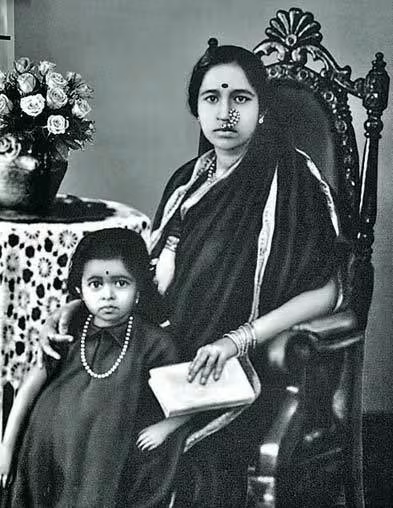
The Voice of a Generation: Gangubai Hangal
In the hallowed halls of Hindustani classical music, few voices resonate with the profound depth and unwavering integrity of Gangubai Hangal. Her voice, a majestic, soul-stirring baritone, was not merely a vessel for melody; it was a testament to a life of immense struggle, artistic purity, and triumphant resilience. For over six decades, from the pre-independence era to the dawn of a new millennium, Gangubai’s music echoed from concert stages across India, embodying the very soul of the Kirana gharana. She was more than a vocalist; she was a symbol of perseverance, an artist who overcame the rigid barriers of caste and gender to carve her name into the annals of Indian cultural history.
Early Life & The Sound of Hubli-Dharwad
Gangubai Hangal was born Gandhari Hangal on March 5, 1913, in Dharwad, a town in present-day Karnataka that, along with its twin city Hubli, was a fertile crescent of Hindustani classical music. This region was a unique confluence, a place where the Carnatic traditions of the south met the Hindustani streams of the north, creating a vibrant ecosystem for musical genius to flourish. She was born into a family of the Devadasi tradition, a community whose women were traditionally dedicated to the service of a temple deity and were often repositories of artistic knowledge, particularly in music and dance. However, by the early 20th century, the community faced immense social stigma and prejudice.
Her mother, Ambabai, was a proficient Carnatic vocalist, and the earliest sounds Gangubai heard were the intricate gamakas and lilting compositions of the southern tradition. The family home was alive with music, and from a young age, Gangubai displayed a prodigious talent and an insatiable curiosity for melody. Yet, her heart was drawn elsewhere. As she played in the streets of Dharwad, she was captivated by the strains of Hindustani music that drifted from the homes of connoisseurs and gramophone players. The slow, meditative elaboration of a raga, the emotional depth of a khayal—these sounds spoke to her in a way Carnatic music did not.
Recognizing her daughter’s powerful inclination, Ambabai made a momentous and selfless decision: she abandoned her own career in Carnatic music to ensure her daughter received the finest training in the Hindustani tradition. This was Gangubai’s first lesson in sacrifice and dedication.
Her formal education began under Krishnacharya Hulgur, but her destiny was to be shaped by one of the greatest masters of the era: Sawai Gandharva, whose real name was Rambhau Kundgolkar. A towering figure of the Kirana gharana and a disciple of the legendary Ustad Abdul Karim Khan, Sawai Gandharva was a notoriously exacting guru. To learn from him, a young Gangubai, accompanied by her mother, would undertake a grueling journey. They would wake before dawn, take a train from Hubli to the small town of Kundgol, and walk the rest of the way to the guru’s house for lessons. The training was relentless, rooted in the ancient gurukul tradition of rigorous practice, repetition (riyaaz), and complete surrender to the guru’s teachings. It was here, alongside fellow students who would become legends in their own right, like Bhimsen Joshi, that the foundations of her musical edifice were laid.
A Voice Forged in Struggle: Career & Contributions
Gangubai’s journey as a performing artist was fraught with challenges that went far beyond musical discipline. The social prejudices of the time were a constant, formidable barrier. As a woman from a so-called “low-caste” community, the simple act of performing on a public stage was an act of defiance. Early in her career, she was advised to change her name from the more caste-specific “Gandhari” to the simpler “Gangu” to avoid immediate discrimination.
She recounted painful memories of this period with a dignified stoicism later in life. In one infamous incident, she was served water in a separate, unwashed glass, a stark reminder of the practice of untouchability. These experiences of humiliation did not break her; instead, they steeled her resolve, channeling her pain and determination into the very fabric of her music. Her art became her sanctuary and her weapon.
Another pivotal, life-altering event shaped her unique vocal signature. As a teenager, she underwent a tonsillectomy that went wrong, permanently damaging her vocal cords. Her melodious, high-pitched voice was gone. In its place emerged a powerful, deep, and distinctly masculine voice. For any other vocalist, this could have been a career-ending tragedy. For Gangubai, it became her defining characteristic. She learned to harness the raw power and rich timbre of this new voice, transforming a perceived flaw into an unparalleled strength. Her gayaki (singing style) acquired a gravitas and depth that was utterly unique.
Her public career began to take shape in the 1930s. A significant milestone came in 1924, when, as a young girl, she was chosen to sing the invocation song at the Belgaum session of the Indian National Congress, in the presence of Mahatma Gandhi. She soon became a regular artist for All India Radio, which brought her voice to homes across the country. Over the ensuing decades, she became an indispensable presence at every major music conference in India, from the Tansen Sangeet Samaroh in Gwalior to the Sawai Gandharva Festival in Pune.
Musical Style and Artistic Purity
Gangubai Hangal was, above all, a purist. She was a torchbearer of the Kirana gharana, a school of music renowned for its emphasis on swara shuddhi (purity of the note) and a slow, poignant, and emotionally charged elaboration of the raga. Her performances were an exercise in musical meditation. She would build the edifice of a raga note by note, with meticulous precision and profound feeling, allowing the listener to immerse themselves completely in its mood.
Her forte lay in rendering profound and complex ragas like Malkauns, Darbari Kanhada, Bhimpalasi, and Todi. She eschewed the ornamentation and flashy virtuosity that tempted many of her contemporaries. Her focus was singular: the emotional truth of the note. Unlike many vocalists who performed lighter classical forms like thumri, dadra, or bhajan, Gangubai consciously avoided them, believing her powerful, masculine voice was unsuited to their lyrical and romantic nature. This unwavering commitment to the khayal form was a hallmark of her artistic integrity.
On stage, her presence was one of unadorned simplicity. Dressed in a simple sari, she would sit, close her eyes, and become one with her music. There were no dramatic gestures or theatrics; the entire drama was contained within the sonic architecture she so masterfully constructed.
Legacy & Enduring Influence
Gangubai Hangal’s legacy is twofold: it is one of immense musical contribution and profound social significance. She passed away on July 21, 2009, in Hubli, the city that had been her lifelong home, leaving behind a void in the world of classical music.
A Symbol of Resilience
Her life story remains a powerful narrative of triumph over adversity. In an era when women, especially those from her social background, were actively discouraged from public life, she shattered glass ceilings with the sheer force of her talent and willpower. She, along with a generation of pioneering female artists like Kesarbai Kerkar, Mogubai Kurdikar, and M.S. Subbulakshmi, irrevocably changed the landscape of Indian classical music, proving that the concert stage was not the exclusive domain of men. Her journey from being denied a clean glass of water to being honored with India’s highest civilian awards—the Padma Bhushan in 1971 and the Padma Vibhushan in 2002—is a powerful chapter in India’s social history.
The Guardian of Tradition
Musically, she is remembered as an uncompromising guardian of tradition. In an age of increasing commercialization and fusion, her music remained a bastion of classicism. She preserved the aesthetic purity of the Kirana gharana, passing on her knowledge meticulously to her daughter, Krishna Hangal, who often provided vocal support in her concerts, and to other disciples. Her music was not for the restless; it demanded patience, contemplation, and a deep emotional investment from the listener, rewarding them with an experience of sublime beauty.
A Life of Humility
Despite her towering stature in the music world, Gangubai remained a person of incredible humility and simplicity. She continued to live in her modest home in Hubli, shunning the glamour of larger cities. To generations of musicians and admirers, she was affectionately known as Gangubai-ajji (Grandmother Gangu), a term of endearment that reflected her warmth and accessibility. Her life was a testament to the idea that true greatness lies not in fame or fortune, but in unwavering dedication to one’s art and one’s principles.
Today, her legacy is preserved not only in her timeless recordings but also through institutions like the Dr. Gangubai Hangal Gurukul established by the Karnataka government in Hubli, which aims to propagate classical music in the traditional gurukul system she herself was a product of. Her voice, forged in the crucible of hardship and honed by decades of rigorous practice, remains a benchmark of artistic integrity—a deep, resonant, and profoundly human sound that continues to inspire and move listeners, reminding us of the power of music to transcend all barriers.