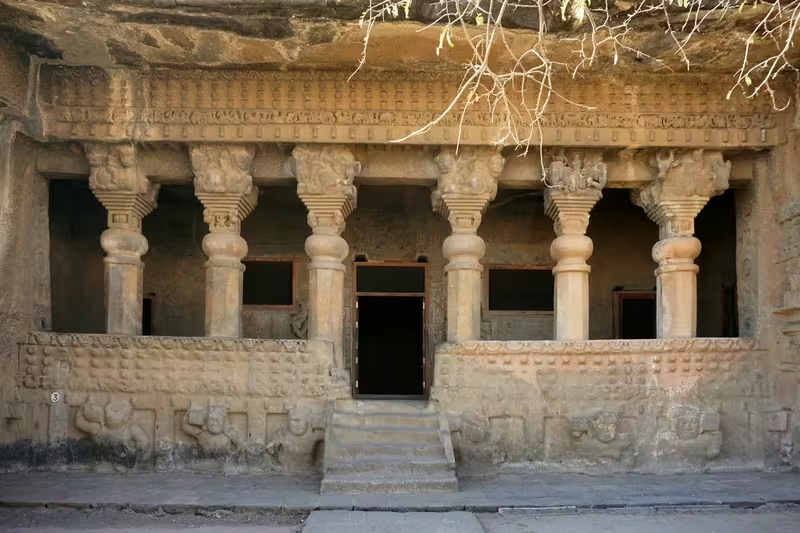
Gautamiputra Satakarni - The Saviour of the Satavahanas
In the grand tapestry of ancient Indian history, few figures blaze as brightly as Gautamiputra Satakarni. He was not merely a king; he was a restorer, a unifier, and the emperor who resurrected the fortunes of a flagging dynasty. In an age of chaos, when foreign powers encroached upon the heartland of the Deccan, he emerged as a formidable warrior and a benevolent ruler, an embodiment of indigenous pride and power. His story, pieced together from the proud inscriptions of his mother and the silent testimony of coins, is a powerful saga of military genius, administrative acumen, and the enduring legacy of a son who made his mother’s name immortal.
The Satavahana Decline: A Kingdom in the Shadow
To understand the magnitude of Gautamiputra Satakarni’s achievements, one must first appreciate the precarious state of the Satavahana Empire in the 1st century CE. The Satavahanas, also known as the Andhras, had once been a dominant power, their influence stretching across the Deccan plateau. However, by the time of Gautamiputra’s ascent, their glory had been severely diminished. From the west, a formidable power, the Western Kshatrapas or Sakas, had pushed deep into Satavahana territory.
These Saka invaders, of Scythian origin, had established a powerful kingdom under the Kshaharata dynasty. Their ambitious king, Nahapana, had wrested control of key regions, including northern Maharashtra, the Konkan coast, and parts of Malwa. These were not just territorial losses; they were economic and strategic blows. The prosperous western ports, vital for maritime trade with the Roman Empire, were now in Saka hands. The Satavahana authority was crippled, their pride wounded, and their very existence threatened.
It was into this world of peril and uncertainty that Gautamiputra Satakarni was born. While details of his early life and education remain lost to time, the context of his upbringing is clear. He would have grown up hearing tales of his dynasty's past glory and witnessing the present humiliation of Saka dominance. This environment undoubtedly forged in him a fierce determination to reclaim his ancestral lands and restore the honour of his lineage.
His very name, Gautamiputra Satakarni (“Satakarni, son of Gautami”), is a testament to the matrilineal customs of the Satavahanas, where rulers often identified themselves through their mothers. His mother, Gautami Balashri, was clearly a figure of immense importance and influence, a fact that would be forever immortalised in the records she left behind.
The Great Restoration: Campaign Against the Sakas
Gautamiputra Satakarni ascended the throne (with reign dates debated by historians but generally placed in the early 2nd century CE, c. 106-130 CE) with a singular, burning ambition: the complete annihilation of Saka power in the Deccan. He was not a man for half-measures or compromise. The inscriptions describe him as one who “crushed the pride and conceit of the Kshatriyas” and, most pointedly, as the “destroyer of the Sakas, Yavanas (Greeks), and Pahlavas (Parthians).”
His primary adversary was the powerful Saka king, Nahapana. Launching a series of brilliant and relentless military campaigns, Gautamiputra systematically dismantled the Saka kingdom. He drove them out of the fertile lands of Maharashtra and recaptured the strategically vital regions of Vidarbha, Aparanta (northern Konkan), and Anupa (the Narmada valley). The conflict was fierce, a clash of two titans for the soul of the Deccan.
Archaeology provides the most dramatic and irrefutable proof of his ultimate triumph. In 1906, a large hoard of over 13,000 silver coins was discovered at Jogalthambi in the Nashik district of Maharashtra. The vast majority of these coins belonged to Nahapana. But what made the discovery electrifying was that nearly two-thirds of them had been crudely re-struck, stamped over with the insignia of Gautamiputra Satakarni—his dynastic symbol of a three-arched hill and the Ujjain symbol.
This act of overstriking was a profound political statement. It was a public declaration of conquest, a symbol of humiliation for the vanquished foe, and a clear announcement that a new power was in command. Every re-struck coin that entered circulation was a tangible reminder to the people of the Deccan that the era of Nahapana was over, and the authority of the Satavahana emperor was absolute. This numismatic evidence transforms Gautamiputra from a figure of eulogies into a verifiable historical conqueror.
The Extent of an Empire
With the Sakas vanquished, Gautamiputra Satakarni presided over a vast and consolidated empire. The most detailed account of his domains comes from an inscription commissioned by his mother, Gautami Balashri, at Nashik. This famous epigraph, known as the Nashik Prashasti, was issued during the 19th year of the reign of his son and successor, Vasisthiputra Pulumavi.
The inscription paints a picture of an empire that was truly pan-Deccan in scope. It lists the provinces under his control, including Asika (on the banks of the river Krishna), Asmaka (in the Godavari valley), Mulaka (the region around Paithan, the Satavahana capital), Vidarbha, and many others. His authority was acknowledged by the mountains that defined the subcontinent, from the Vindhyas in the north to the Malaya and Mahendra mountains in the south.
The prashasti bestows upon him the grandiloquent title ti-samuda-toya-pita-vahana, meaning “he whose horses drank the waters of the three seas”—the Arabian Sea in the west, the Bay of Bengal in the east, and the Indian Ocean in the south. While this may be a conventional poetic boast for an emperor, it accurately reflects the immense sweep of his influence, which stretched from coast to coast.
As a ruler, the inscription portrays him as an ideal king. He was an ekabrahmana (the peerless Brahmana or the sole protector of Brahmanism), a title that underscores his commitment to the Vedic social order. He is described as a ruler who “stopped the contamination of the four varnas” and took care of the welfare of his subjects, empathising with their joys and sorrows. He was not just a conqueror but a consolidator, bringing stability and order to a realm long plagued by conflict.
Legacy & Influence
Gautamiputra Satakarni’s legacy is profound and multi-faceted, cemented in stone, silver, and the memory of his people.
The Nashik Prashasti: A Mother's Tribute
His most enduring monument is the eulogy recorded by his mother. The Nashik Prashasti is a document of immense historical and emotional power. It is a rare and intimate glimpse into the past, where a grieving but proud mother celebrates the life of her heroic son. Gautami Balashri describes him in glowing terms, not just as a warrior but as a man of exceptional character and physique.
She calls him “the abode of the sciences, the refuge of the virtuous, the fountain of good breeding.” She praises his handsome figure, his charming and beautiful face, and his graceful gait. In battle, he was “unique as a bowman, an unrivaled hero,” who was always victorious and never knew defeat. Yet, this formidable warrior was also a compassionate son who was “ever obedient to his mother.” This inscription humanises him, lifting him from the dry pages of history and presenting him as a beloved son and a paragon of kingship.
Cultural and Religious Patronage
While Gautamiputra’s personal titles suggest a strong adherence to Brahmanism, his reign, like that of other Satavahana rulers, was marked by a broad-minded patronage of different faiths. The inscriptions of his time record significant donations made by him and his family to Buddhist monastic communities. He donated land to the Buddhist monks at the Karle caves, and his mother made similar grants to the monks at Nashik. This demonstrates the syncretic religious atmosphere of the Deccan, where rulers upholding the Brahmanical social order could also be generous patrons of Buddhist institutions, which were vital centres of learning, trade, and culture.
The Satavahana Revival
His most significant political legacy was the revival of the Satavahana dynasty. He inherited a kingdom on the brink of collapse and transformed it into the most dominant power south of the Vindhyas. He restored its prestige, secured its borders, and reclaimed its economic lifelines. The stability he established allowed his successors, particularly his son Vasisthiputra Pulumavi, to rule over a prosperous and secure empire for several decades. Although the conflict with the Western Kshatrapas would resume under later rulers, it was Gautamiputra who had turned the tide decisively in the Satavahanas' favour.
Remembered Through the Ages
Gautamiputra Satakarni stands as one of the most celebrated indigenous rulers of ancient India. He is remembered as the champion of the Deccan who successfully repelled foreign invaders and forged an empire built on military strength and righteous governance. His story resonates as a classic tale of dynastic restoration, where a single, determined individual reverses the fortunes of his people.
In modern times, his legend has been revived, most notably through popular culture, including a 2017 Telugu epic film that brought his dramatic story to a new generation of Indians. He remains a powerful symbol of regional pride and a testament to the Deccan’s long and storied history of resistance and resilience.
Gautamiputra Satakarni was more than just a name on a coin or an inscription on a cave wall. He was the architect of an era, a dutiful son, a peerless warrior, and a king who not only conquered lands but also won the lasting admiration of his people. His reign was the glorious high-noon of the Satavahana Empire, a legacy of strength and honour that continues to inspire.