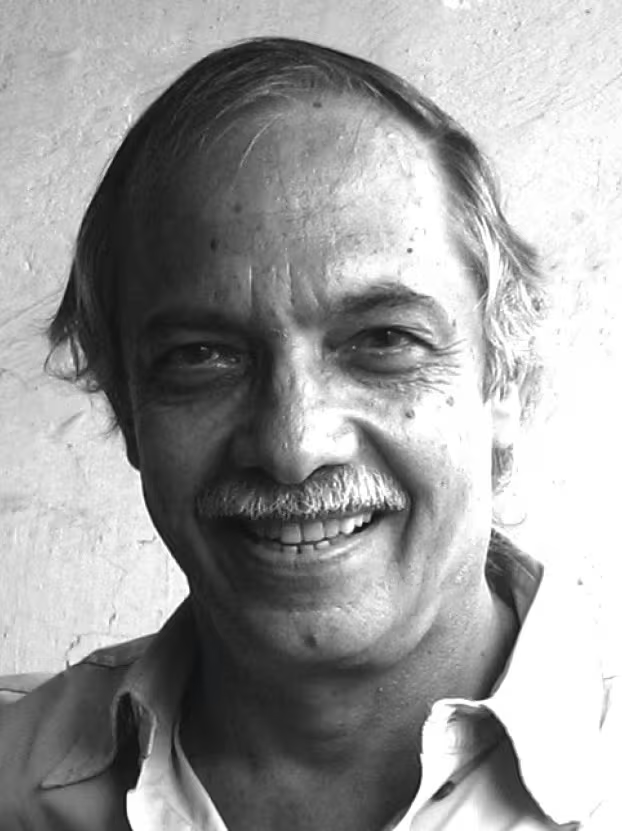
Gieve Patel: The Physician's Gaze, The Poet's Heart
In the bustling, often brutal, landscape of post-colonial Bombay, one of its most distinct and compassionate voices belonged to a man who spent his days attending to the ailing bodies of its citizens. Gieve Patel (1940-2023) was not merely a doctor; he was a poet, a painter, and a playwright—a true Renaissance figure whose multifaceted career was unified by a singular, unwavering focus: the complex, fragile, and resilient nature of the human condition. His art, like his medical practice, was an act of bearing witness. It did not flinch from decay, violence, or suffering, but instead looked directly into the abyss, finding in it a profound, if unsettling, beauty. Patel’s legacy is that of a quiet observer who, through the precise language of a surgeon and the empathetic vision of an artist, dissected the very soul of modern India.
Early Life & Formative Years
Gieve Patel was born on August 18, 1940, in Bombay (now Mumbai), into a Parsi family deeply rooted in the medical profession. His grandfather was a doctor and his father a dentist, creating an environment where the science of the human body was a part of daily conversation. This early immersion in a world of anatomy and pathology would become the bedrock of his artistic consciousness. Growing up in the vibrant, chaotic metropolis, the city itself became one of his earliest and most enduring muses.
His formal education further solidified this dual path. He attended the esteemed St. Xavier's High School before enrolling in Grant Medical College, one of India’s premier medical institutions. It was during these formative years that his two worlds—the clinical and the creative—began to coalesce. While he meticulously studied the intricate systems of the human body, learning to diagnose and treat its myriad ailments, he was simultaneously cultivating a keen artistic sensibility. The dissection hall, a place of objective scientific inquiry for his peers, became for Patel a theatre of profound existential questions about mortality, flesh, and the spirit contained within.
He was largely a self-taught painter, beginning to experiment with the medium in his late teens. The Bombay of the 1960s was a crucible of artistic modernism, and Patel found himself in the orbit of a new generation of artists and writers who were forging a new Indian identity. He was associated with the influential, if short-lived, “Group of 1965,” a collective of young, like-minded artists that included Bhupen Khakhar, Vivan Sundaram, and Ghulam Mohammed Sheikh. This environment provided him with a community of peers who, like him, were eager to break from academic convention and create art that was raw, personal, and deeply engaged with their immediate surroundings.
A Career in Medicine and Art
After graduating from medical college, Gieve Patel established a general practice in central Bombay, a decision that would prove central to his entire artistic output. His clinic was not a detached, sterile space but a window into the unvarnished realities of urban life. It was here that he encountered humanity in its most vulnerable state—the sick, the injured, the dying, and the grieving. This daily confrontation with physical suffering provided him with a constant stream of material, not in an exploitative sense, but as a source of deep empathy and philosophical inquiry.
His physician’s gaze was unique. It was trained to observe details with clinical precision, to notice the subtle changes in skin tone, the slump of a shoulder, or the flicker of pain in an eye. He translated this meticulous observation into his art. In his paintings, the human figures are rendered with a stark honesty, their bodies often appearing heavy, burdened, and achingly real. In his poetry, the language is spare, direct, and almost surgical, stripping away sentimentality to get to the core of an experience.
The symbiosis between his two professions was profound. Medicine gave his art its visceral, corporeal focus, while art provided an outlet to process the emotional and existential weight of his medical work. He once remarked that his professions were not in conflict but were two distinct ways of “attending” to the world. Both required patience, observation, and a deep sense of responsibility towards the subject, whether it was a patient in his clinic or a figure on his canvas.
The Poet of the Corporeal
Gieve Patel’s entry into the Indian literary scene was marked by the publication of his first collection, Poems, in 1966. Significantly, it was brought out by Nissim Ezekiel, a towering figure of Indian English poetry and a mentor to the new wave of “Bombay Poets.” This group, which included Patel, Ezekiel, Arun Kolatkar, and Adil Jussawalla, pioneered a new poetic idiom—one that was modern, urban, ironic, and rooted in the tangible realities of Indian life, moving away from the more romantic or spiritual traditions of the past.
Patel’s poetic voice was immediately distinct for its unflinching focus on the body. His second collection, How Do You Withstand, Body (1976), is a landmark in Indian poetry. The title itself is a direct, almost desperate, question posed to the physical self, acknowledging its immense capacity for both endurance and suffering. The poems within explore the body as a site of violence, decay, and quiet resilience. He writes of autopsies, street accidents, and the slow ravages of disease with a detached yet deeply compassionate eye.
Perhaps his most famous and widely anthologized poem is “On Killing a Tree.” Taught in schools across India, the poem uses the methodical, almost clinical description of uprooting a tree to explore themes of violence, resilience, and humanity’s destructive relationship with nature. The language is stark and devoid of sentimentality:
It takes much time to kill a tree, Not a simple jab of the knife Will do it. It has grown Slowly consuming the earth, Rising out of it, feeding Upon its crust, absorbing Years of sunlight, air, water, And out of its leprous hide Sprouting leaves.
His third and final collection, Mirrored, Mirroring (1991), continued these explorations with a more reflective and philosophical tone. Throughout his poetic career, Patel’s style remained consistent: free verse, precise imagery, and a voice that was at once personal and universal, finding profound meaning in the often-overlooked, grotesque, or mundane aspects of existence.
The Painter of Human Landscapes
As a painter, Gieve Patel’s work ran parallel to his poetry, both in theme and in tone. He was a figurative artist in an era when abstraction was gaining prominence, choosing to remain focused on the human form as his primary subject. His canvases are populated by ordinary people, often the marginalized and the downtrodden, whom he observed from his clinic or on the streets of Mumbai.
His early work from the 1970s included the powerful “Politicians” series. These were not traditional portraits but grotesque, cropped images of chests and torsos, often featuring anonymous, menacing figures in official attire. By refusing to show their faces, Patel made a powerful statement about the impersonal and dehumanizing nature of power and bureaucracy.
Later, he would become known for his recurring motifs, particularly scenes of everyday life on Mumbai’s railway platforms and his profound “Looking into a Well” series. The railway platform paintings capture the anonymity and quiet desperation of urban commuters, while the well series became a deeply personal and metaphorical exploration. The well, for Patel, was a potent symbol: an opening into the earth, a source of life-giving water, a dark space of reflection, and a metaphor for looking into the depths of the self. The figures in these paintings are often seen peering over the edge, their bodies contorted as they gaze into the abyss, their reflections staring back from the dark water below. The application of paint is thick and textured (impasto), giving the canvases a raw, sculptural quality that enhances their emotional weight.
He exhibited his work widely in India and abroad, including at the prestigious Menton Biennale in France in 1976 and in numerous solo shows at Mumbai's iconic Chemould Prescott Road gallery. His paintings, like his poems, are acts of intense observation, transforming the everyday into a site of profound contemplation.
The Playwright of Social Conscience
Though less prolific as a playwright, Patel’s contribution to Indian theatre is significant. He authored three plays—Princes (1971), Savaksa (1982), and Mister Behram (1987)—which explored the social and psychological complexities of his own Parsi community and the broader tensions of Indian society.
Mister Behram, set in colonial India of the 19th century, is a nuanced examination of the relationship between a Parsi grandee and his British patrons, delving into themes of identity, colonialism, and compromise. His plays are character-driven, filled with sharp dialogue and a keen sense of the subtle power dynamics that govern human relationships. They reveal yet another facet of his artistic persona: a sharp observer of social mores and historical currents.
Legacy and Influence
Gieve Patel passed away on November 3, 2023, leaving behind an extraordinary body of work that straddles multiple disciplines. His most enduring legacy is the powerful synthesis he achieved between art and science. He demonstrated that a clinical eye need not be a cold one; in his hands, it became a tool for profound empathy. He taught us that to truly understand the human condition, one must be willing to look at it all—the beautiful and the grotesque, the sacred and the profane, the living and the dying.
He was a quintessential Bombay artist, capturing the city’s grit, its anxieties, and its strange, resilient spirit without ever succumbing to romanticism. Along with his contemporaries, he helped shape a modern Indian sensibility, one that was confident, self-aware, and unafraid to confront uncomfortable truths.
At the heart of all his work—whether a poem about a dying man, a painting of a figure looking into a well, or a play about colonial anxieties—lies a deep and abiding humanism. His art was an act of witnessing, of paying attention to the lives that are so often ignored. In a world that increasingly demands specialization, Gieve Patel stands as a testament to the power of a wide-ranging, compassionate, and deeply integrated intellectual and artistic life. He was the doctor who tended to the body, and the artist who nourished the soul.