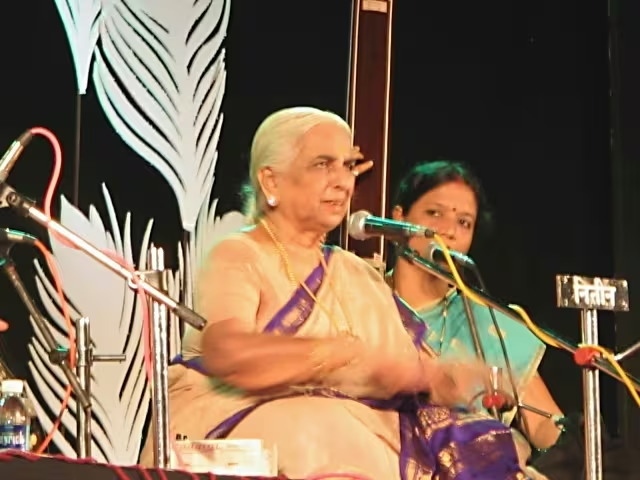
Girija Devi - The Soul of Banaras, The Voice of Thumri
In the ancient, labyrinthine lanes of Banaras, where the spiritual and the temporal have danced for millennia, a voice was born that would come to embody the very soul of the city. It was a voice that could whisper the playful coquetries of a lover, weep with the sorrow of separation, and soar with the ecstasy of devotion. This was the voice of Girija Devi, a titan of Hindustani classical music, who was not merely a singer but a custodian of an entire cultural ethos. Reverently called Appa-ji (elder sister) by her disciples and admirers, she was, and remains, the undisputed ‘Queen of Thumri,’ an artist who elevated a semi-classical form to the highest echelons of artistic expression.
Early Life & Musical Awakening in Banaras
Girija Devi was born on May 8, 1929, in Varanasi, a city whose cultural tapestry is woven with threads of music, religion, and philosophy. Her father, Ramdeo Rai, was a zamindar, a man of considerable social standing. Yet, unlike many of his peers, he was a passionate connoisseur of music. He played the harmonium and nurtured a deep love for the classical arts, an inclination that proved to be the most significant gift to his young daughter.
In an era when girls from land-owning families were expected to remain within the confines of domesticity, Ramdeo Rai made a revolutionary decision. He recognized a rare spark in his five-year-old daughter and decided to provide her with formal musical training. Her first guru was the vocalist and sarangi maestro, Sarju Prasad Misra. Later, she came under the tutelage of Chand Misra. Her training was immersive and rigorous, steeped in the rich traditions of the Banaras and Seniya gharanas.
Her education was not just technical; it was an absorption of the very atmosphere of Banaras. The city itself was her guru. The strains of the shehnai from the temples, the rhythmic chants of the priests by the Ganga, the plaintive songs of the boatmen, and the seasonal folk melodies—kajri, chaiti, and hori—that marked the changing seasons all seeped into her consciousness. This unique environment shaped her artistic sensibility, giving her music a distinctive flavour—an earthy, evocative quality deeply connected to the lifeblood of the Purvanchal region.
However, her journey was not without its challenges. The world of professional music, particularly the performance of thumri and its associated forms, was still viewed with social prejudice. These genres, with their emphasis on shringara rasa (the erotic or romantic sentiment), were often linked to the courtesan tradition. For a young woman from a 'respectable' family to pursue this path was to defy deeply entrenched conventions. Girija Devi often recounted the opposition she faced, particularly from her mother and grandmother, who feared the social stigma. It was her father’s unwavering support that allowed her to continue her sadhana (dedicated practice).
The Ascent of a Modern-Day Bai-ji: Career and Contributions
Girija Devi’s public debut took place in 1949 on All India Radio, Allahabad. The performance was a resounding success, heralding the arrival of a formidable new talent. However, the path to the public concert stage remained fraught with obstacles. After her marriage in 1946 to Madhusudan Jain, a businessman who shared her love for music, she initially agreed to not perform publicly. Yet, the artist within her could not be silenced. It was her husband’s encouragement and conviction in her talent that ultimately persuaded her to break the norms and share her gift with the world.
Her rise was meteoric. She quickly became a leading exponent of the Purab Ang (the eastern style) of thumri, a style characterized by its slow, meditative exposition and its profound emotional depth. Girija Devi’s genius lay in her ability to infuse the semi-classical forms with the gravitas and discipline of the more austere khayal genre. In her hands, a thumri or a dadra was not a mere light composition; it was a vast canvas for emotional and melodic exploration.
Her signature technique was the bol banao—literally, 'to make the words.' She would take a single line of poetry and, through intricate melodic variations, unpack its myriad emotional shades. A single phrase could express longing, complaint, joy, and despair, all within a few moments. Her voice, powerful and incredibly flexible, was a perfect instrument for this art. It could traverse three octaves with seamless ease, moving from a delicate whisper to a resonant cry, capturing the entire spectrum of human feeling.
While she was the ‘Queen of Thumri,’ her repertoire was vast and varied. She was an accomplished Khayal singer but chose to focus on the semi-classical genres because, as she often stated, they offered greater scope for abhinaya (expression). Her concerts were a masterclass in the folk-inspired forms of her native region:
- Thumri: The centerpiece of her art, expressing the divine and earthly love of Radha and Krishna or the pangs of a lovelorn nayika (heroine).
- Dadra: Lighter and more rhythmic than the thumri, often with a playful or romantic theme.
- Kajri: A monsoon song from Uttar Pradesh, evoking the longing of a woman separated from her beloved during the rainy season.
- Chaiti: A semi-classical song sung in the Hindu month of Chaitra (March-April), often celebrating the festival of Ram Navami.
- Hori: A lively composition celebrating the festival of Holi, full of playful banter and festive spirit.
- Tappa: A challenging form characterized by quick, cascading runs of notes, which she rendered with breathtaking precision.
In the 1980s, she joined the ITC Sangeet Research Academy in Kolkata as a faculty member, and later taught at the Banaras Hindu University. In these roles, she transitioned from a star performer to a revered guru, dedicating herself to passing on her immense knowledge to a new generation of musicians. She was a demanding but deeply affectionate teacher, ensuring that the purity and aesthetic integrity of her gharana’s tradition were preserved.
The Enduring Legacy of Appa-ji
Girija Devi's passing on October 24, 2017, marked the end of an era. Her legacy, however, is immortal, etched into the cultural memory of India. Her historical significance is multi-faceted.
First, she was a crucial bridge between the old world of courtly and salon music and the modern, democratic concert stage. She took the intimate, expressive art of the bai-jis (accomplished female artists) and, through her classical rigor and dignified stage presence, gave it unimpeachable respectability. In doing so, she broke down social barriers and paved the way for countless women from all backgrounds to pursue careers in classical music without fear of social censure.
Second, she single-handedly preserved and popularized the musical treasures of Banaras and the Purab Ang. In a world increasingly dominated by other gharanas, she stood as a proud sentinel of her own tradition. Her music was a living archive of the dialects, melodies, and poetic sentiments of eastern Uttar Pradesh.
Her influence extends far beyond the concert hall. She mentored numerous disciples, including Malini Awasthi, Sunanda Sharma, and Dalia Chakrabarty, who continue to carry her torch forward. Through them, the voice of Appa-ji and the soul of the Banaras gharana continue to resonate.
Today, Girija Devi is remembered not just for her technical virtuosity but for the profound humanity of her music. She was a master storyteller who used notes instead of words. To listen to her rendition of a thumri like “Nadiya Bairan Bhayi” (The river has become my enemy) is to feel the deep anguish of a woman separated from her lover. To hear her sing a kajri is to feel the first drops of monsoon rain on parched earth. Her music was never a sterile academic exercise; it was raw, visceral, and deeply moving.
Her contributions were recognized with India's highest civilian honors: the Padma Shri in 1972, the Padma Bhushan in 1989, and the Padma Vibhushan in 2016. She also received the Sangeet Natak Akademi Award in 1977 and its prestigious Fellowship in 2010.
Girija Devi was more than a singer; she was an institution. She was the loving Appa-ji, the fierce guardian of tradition, and the sublime artist. She was the voice of Banaras, a city of life, death, and eternal devotion. And in her timeless music, the spirit of that sacred city, and the deepest emotions of the human heart, live on forever.