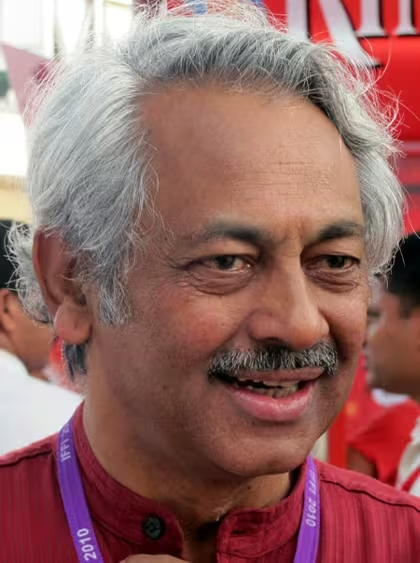
Girish Kasaravalli: The Conscience of Kannada Cinema
In the grand tapestry of Indian cinema, where spectacle often overshadows substance, the films of Girish Kasaravalli stand as profound, quiet monuments to the human condition. A master storyteller from Karnataka, Kasaravalli is a central figure in India's Parallel Cinema movement, a filmmaker whose lens has consistently sought out the silent struggles and moral dilemmas of ordinary people caught in the churning tides of social change. With a record number of National Film Awards to his name, his work is not just cinema; it is a deep, empathetic inquiry into the soul of a nation, rooted in the rich literary and cultural soil of his homeland.
Early Life & Background
Girish Kasaravalli was born on December 3, 1950, in Kesalur, a village nestled in the Malnad region of Karnataka's Shimoga district. This landscape—lush, rain-drenched, and steeped in tradition—would become a recurring, almost elemental, character in many of his films. He was born into a family that valued both intellectual pursuits and cultural heritage. His father, Ganesh Rao, was a freedom fighter, a farmer, and a patron of the arts, with a particular love for Yakshagana, the vibrant traditional theatre form of the region. This upbringing instilled in the young Girish a deep appreciation for local culture and a keen awareness of the social fabric around him.
His formative years were profoundly shaped by the Navya (Modernist) literary movement that was sweeping through Kannada literature. Writers like U.R. Ananthamurthy, Poornachandra Tejaswi, and Kuvempu were not just literary figures; they were intellectual giants questioning the very foundations of tradition, caste, and identity. Kasaravalli devoured their works, and this literary immersion would become the bedrock of his cinematic vision.
Interestingly, a career in filmmaking was not his initial path. He moved to Manipal to study pharmacy, pursuing a B.Pharma degree. However, his life took a decisive turn through the film society movement. It was a screening of Satyajit Ray's masterpiece, Pather Panchali (1955), that struck him like a revelation. The film demonstrated that cinema could be a powerful medium for portraying reality with artistic grace and profound humanism, much like the literature he so admired. This newfound passion led him to apply to the prestigious Film and Television Institute of India (FTII) in Pune.
At FTII, Kasaravalli found himself in a crucible of creative energy. The institute in the 1970s was a hub for aspiring filmmakers from across the country, all eager to challenge the conventions of mainstream commercial cinema. He specialized in Film Direction and graduated in 1975, winning the President's Gold Medal for his diploma film, Avashesh (The Remnant). This short film, which won a National Film Award, was a clear harbinger of the themes and stylistic austerity that would define his life's work.
Career & Major Contributions
Returning to Karnataka, Kasaravalli embarked on a journey to create a cinema that was both artistically uncompromising and deeply rooted in his cultural milieu. His feature film debut, Ghatashraddha (1977), was a cinematic thunderclap.
Based on a novella by his literary hero U.R. Ananthamurthy, the film tells the harrowing story of a young, pregnant Brahmin widow who is brutally excommunicated by her orthodox community. The tragedy unfolds through the innocent, uncomprehending eyes of a young Vedic student. Shot in stark black and white, with a cast of mostly non-professional actors, the film was a masterclass in realist filmmaking. It eschewed melodrama for a quiet, observational style that made its critique of religious hypocrisy and patriarchal cruelty all the more devastating. Ghatashraddha won the Swarna Kamal (Golden Lotus) for Best Feature Film at the National Film Awards, an unprecedented achievement for a debut director. It immediately established Kasaravalli as a major voice in Indian cinema.
Throughout his career, Kasaravalli's films have been characterized by their profound thematic concerns and their unique ability to adapt complex literary works to the screen. His filmography is a sustained exploration of several key themes:
- The Plight of Women: From the ostracized widow in Ghatashraddha to the resilient matriarch in Thaayi Saheba, his films consistently center the experiences of women navigating a patriarchal world.
- Tradition vs. Modernity: He masterfully depicts the friction between age-old customs and the encroaching forces of modernity, often focusing on the disintegration of feudal structures and joint families.
- Critique of the System: Films like Tabarana Kathe offer a searing indictment of bureaucratic apathy and the dehumanizing nature of the state.
His most significant works stand as landmarks of Indian cinema:
Tabarana Kathe (The Story of Tabara, 1987): Based on a story by Poornachandra Tejaswi, this film is a powerful and tragic tale of a low-level government servant, Tabara Shetty, who fights a losing battle against a callous bureaucratic system to claim his pension for his ailing wife's treatment. The film’s raw emotional power and its critique of systemic failure resonated across the country, earning Kasaravalli his second Swarna Kamal for Best Feature Film.
Thaayi Saheba (The Mother, 1997): Perhaps his most ambitious work, this film chronicles five decades of Indian history, from the pre-Independence era to the Emergency, through the life of its protagonist, Narmada Thayi. As the world outside changes, her personal world—her home—becomes a microcosm of the nation's journey. The film brilliantly intertwines the personal with the political, exploring themes of freedom, identity, and disillusionment. It won Kasaravalli his third Swarna Kamal and is widely regarded as one of the finest Indian films ever made.
Dweepa (The Island, 2002): A visually stunning and allegorical film, Dweepa tells the story of a family that refuses to be evacuated from their village, which is destined to be submerged by a new dam. The rising water becomes a powerful metaphor for displacement, the conflict between development and tradition, and the indomitable human will to survive. The film's breathtaking cinematography captures the beauty and terror of the Malnad monsoons, winning Kasaravalli his fourth Swarna Kamal for Best Feature Film—a feat unmatched by any other director.
Gulabi Talkies (2008): This film explores the impact of globalization on a remote Muslim fishing village when a television set enters the life of a midwife named Gulabi. The TV, a window to another world, disrupts the community's social and religious fabric, especially for its women. The film is a sensitive and insightful look at cultural change, female solidarity, and the complexities of identity, earning actress Umashree the National Film Award for Best Actress.
Kasaravalli’s filmmaking style is defined by its subtlety and psychological depth. He is a master of visual storytelling, using long takes, deliberate pacing, and evocative silences to build atmosphere and reveal his characters' inner lives. He avoids easy answers and melodramatic flourishes, trusting his audience to engage with the complex moral and social questions his films raise.
Legacy & Influence
Girish Kasaravalli's legacy is immense and multifaceted. He is, without question, the most important filmmaker to emerge from Karnataka and the primary torchbearer of the Parallel Cinema movement long after it had faded in other regions.
His most significant contribution lies in his remarkable ability to create a seamless bridge between literature and cinema. He has demonstrated that cinema can possess the same intellectual rigor, psychological complexity, and social consciousness as great literature. By adapting the works of Karnataka's finest writers, he not only brought their stories to a wider audience but also created a distinct cinematic language that was both universal in its appeal and authentically Kannada in its spirit.
He is one of India’s most decorated filmmakers. The four Swarna Kamal awards for Best Feature Film, along with numerous other National and International awards, are a testament to his consistent excellence. In 2011, the Government of India honored him with the Padma Shri, the nation's fourth-highest civilian award, for his contributions to the arts.
Today, Girish Kasaravalli is revered as an auteur, a filmmaker's filmmaker whose work is studied in film schools for its artistic integrity and unwavering commitment to meaningful storytelling. He has inspired generations of independent filmmakers to pursue a cinema of substance. In an industry often driven by commercial imperatives, he remains a steadfast symbol of artistic purity—a quiet, thoughtful observer who uses his camera not to escape reality, but to understand it more deeply. His films are a timeless and vital part of India's cultural heritage, reminding us of the power of cinema to illuminate, to question, and to affirm the enduring complexities of the human spirit.