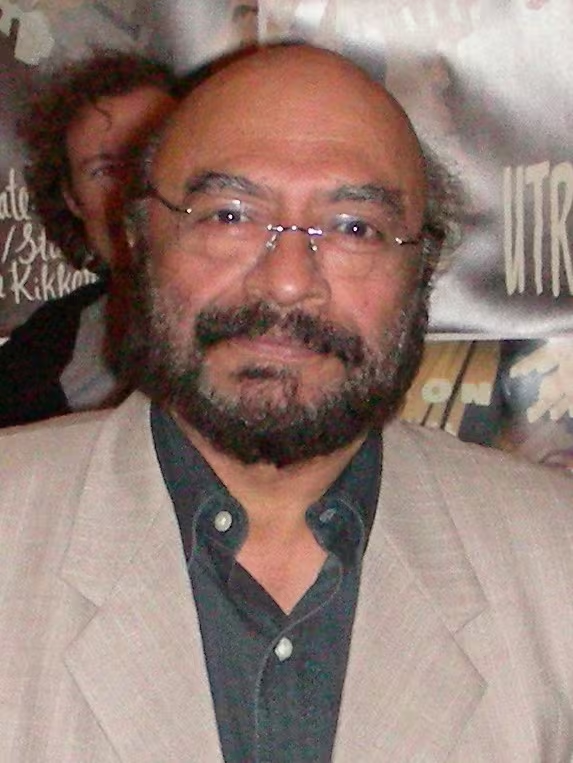
Overview
In the landscape of Indian cinema, few figures cast as long and imposing a shadow as Govind Nihalani. A master craftsman of light and shadow, he first defined the visual grammar of India's Parallel Cinema movement as a cinematographer before stepping behind the camera to become one of its most powerful and fearless directorial voices. Born in the twilight of the British Raj and forged in the crucible of post-independence India, Nihalani’s work is a blistering, uncompromising chronicle of his times. His films are not gentle stories; they are visceral, politically charged examinations of power, corruption, and the relentless struggle of the individual against an oppressive system. From the silent, simmering rage of Aakrosh to the explosive systemic rot of Ardh Satya, Nihalani’s cinema is a testament to the medium's power to confront uncomfortable truths and give voice to the silenced.
Early Life and Formative Years
Govind Nihalani was born on December 19, 1940, in Karachi, in what was then British India and is now Pakistan. His early childhood was irrevocably shaped by one of the most cataclysmic events in the subcontinent's history: the Partition of India in 1947. At the age of seven, he and his family were uprooted, joining millions of others in the painful exodus of refugees. They resettled in India, a dislocating experience that would profoundly influence the worldview of many artists and intellectuals of his generation. This early exposure to displacement and societal upheaval likely instilled in him a deep sensitivity to injustice and the human cost of political turmoil, themes that would dominate his later work.
His passion for the visual medium led him to pursue a formal education in the craft. In 1962, he graduated with a degree in cinematography from the S. J. Polytechnic in Bangalore (now the Government Film and Television Institute). Armed with technical knowledge and a burgeoning artistic vision, Nihalani moved to Bombay (now Mumbai), the heart of the Indian film industry, to begin his journey.
The Cinematographer's Eye: Forging a Path in Cinema
Nihalani began his career in the conventional way, working as an assistant to established cinematographers. His formative years were spent learning from the legendary V.K. Murthy, the visionary behind the camera for Guru Dutt's classic films. This apprenticeship provided him with invaluable experience, but it was his association with another emerging talent that would truly define his career and, in turn, an entire cinematic movement.
In the early 1970s, Nihalani began a long and seminal collaboration with director Shyam Benegal. Together, they became the architects of the Indian Parallel Cinema or New Wave Cinema, a movement that rejected the escapist song-and-dance formulas of mainstream Bollywood in favor of gritty, realistic, and socially conscious filmmaking. Nihalani's cinematography was the visual soul of this movement.
For Benegal’s landmark films, Nihalani created a distinct visual language. In Ankur (1974), Nishant (1975), Manthan (1976), and Bhumika (1977), he abandoned glossy studio lighting for the raw texture of natural light. His use of handheld cameras, earthy color palettes, and documentary-style realism created a sense of immediacy and authenticity that was revolutionary for its time. He wasn't just capturing images; he was capturing the oppressive heat of a feudal village, the dust of a rural landscape, and the claustrophobia of a patriarchal home. His camera was not a passive observer but an active participant, probing the psychological depths of the characters.
This partnership established Nihalani as one of the country's foremost cinematographers. His reputation extended beyond the parallel cinema circuit, leading to his involvement in Sir Richard Attenborough's monumental epic, Gandhi (1982). As the director of photography for the film's second unit, Nihalani was responsible for capturing some of its most sprawling and complex sequences, a testament to his technical mastery and international standing.
The Director's Chair: A Voice of Anger and Truth
After a decade of shaping the look of New Wave cinema, Nihalani felt an urgent need to tell his own stories. In 1980, he made his directorial debut with a film that exploded onto the Indian consciousness: Aakrosh (The Cry). Written by the celebrated playwright Vijay Tendulkar and starring the formidable trio of Om Puri, Naseeruddin Shah, and Smita Patil, the film was a stark and brutal indictment of the justice system's failure to protect the marginalized.
Based on a true story, Aakrosh tells the story of Lahanya Bhiku (Om Puri), a poor tribal man accused of murdering his wife. He is defended by a young, idealistic lawyer (Naseeruddin Shah), who slowly uncovers a terrifying conspiracy of silence and oppression involving local landlords and officials. The film’s most powerful and daring choice is to render its protagonist almost entirely silent. Bhiku’s trauma is so profound, his powerlessness so absolute, that he is robbed of speech. His rage simmers beneath a stone-faced exterior, conveyed through Om Puri’s haunting eyes. The silence is finally broken in the film's devastating climax, where Bhiku lets out a single, blood-curdling scream—a primal cry of anguish and rage that has become one of the most iconic moments in Indian cinema. Aakrosh was a critical triumph, winning the National Film Award for Best Feature Film and announcing Nihalani as a director of immense power and conviction.
Key Cinematic Works: A Deeper Look
Following the success of Aakrosh, Nihalani embarked on a series of films that cemented his reputation as the angry conscience of Indian cinema.
Ardh Satya (1983)
If Aakrosh was about the silence of the victim, Ardh Satya (Half Truth) was about the corruption of the enforcer. Widely regarded as Nihalani’s magnum opus, it is one of the most powerful and realistic police dramas ever made in India. The film charts the tragic trajectory of Anant Welankar (a career-defining performance by Om Puri), an idealistic and poetry-loving young man who joins the police force, only to be systematically brutalized by the very system he sought to uphold.
The film unflinchingly explores the nexus of crime, politics, and law enforcement. Welankar finds himself trapped, forced to choose between his conscience and the pragmatic, often illegal, demands of his superiors and political masters. The film's title and philosophical core are derived from a poem by Dilip Chitre, which Welankar recites in a moment of crisis, contemplating the 'half-truth' of his existence, caught in a chakravyuh (a deadly labyrinth) from which there is no escape. Ardh Satya was a commercial and critical success, lauded for its raw authenticity, gritty action, and Om Puri's towering performance, which won him the National Film Award for Best Actor. The film remains a benchmark for its stark portrayal of institutional decay.
Tamas (1988)
With Tamas (Darkness), Nihalani returned to the defining trauma of his childhood: the Partition. Based on the monumental Hindi novel by Bhisham Sahni, Tamas was a sprawling television miniseries that depicted the horror and human tragedy of the communal violence that erupted in Punjab in 1947. The narrative begins with a seemingly small act—a low-caste tanner is paid to kill a pig, whose carcass is then thrown in front of a mosque to incite a riot. From this single spark, a firestorm of hatred, violence, and paranoia engulfs an entire community.
When it was broadcast on the national television network Doordarshan, Tamas created a massive political and social storm. It was accused of being provocative and reopening old wounds. However, for millions of viewers, it was the first time they had witnessed such an honest and harrowing depiction of the Partition's reality. Nihalani's direction was masterful, capturing both the epic scale of the migration and the intimate, personal tragedies of families torn apart. Tamas won the Nargis Dutt Award for Best Feature Film on National Integration, a fitting tribute to a work that dared to confront a painful past in order to understand the present.
Drohkaal (1994)
In Drohkaal (Times of Betrayal), Nihalani turned his lens to the contemporary issue of terrorism. A taut, psychological thriller, the film delves into the morally grey world of counter-terrorism. It follows two elite police officers who must infiltrate a powerful terrorist group, exploring the immense psychological toll this work takes on them and their families. The film is a complex study of loyalty, betrayal, and the brutalizing effect of violence, questioning whether one must become a monster to fight a monster. With its sophisticated narrative and intense performances, Drohkaal is considered one of the finest Indian films on the subject.
Later Career and Other Ventures
In the late 1990s and 2000s, Nihalani continued to make films, often experimenting with new forms and technologies. Hazaar Chaurasi Ki Maa (1998), based on Mahasweta Devi's novel, saw him directing Jaya Bachchan in a powerful story about a mother piecing together the life of her deceased Naxalite son. He also ventured into more mainstream territory with Thakshak (1999), an action film, and explored science fiction with Deham (2001), one of India’s first feature films to be shot entirely on a digital format. In 2004, he directed Dev, a large-canvas film starring Amitabh Bachchan and Om Puri that addressed the subject of communal riots.
Cinematic Style and Themes
Govind Nihalani’s filmmaking is defined by a set of powerful, recurring characteristics:
- Unyielding Realism: His films possess a documentary-like quality, grounded in meticulous research and an authentic portrayal of milieu and character.
- The Individual vs. The System: This is the central conflict in his work. His protagonists are often honest, idealistic individuals who are systematically crushed, corrupted, or forced into rebellion by a larger, amoral system—be it the judiciary, the police force, or the political establishment.
- Political Consciousness: Nihalani's cinema is inherently political. He directly confronts the most pressing issues of his time: state-sponsored oppression, feudalism, corruption, caste and class conflict, and communalism.
- Psychological Intensity: His background as a cinematographer is evident in his visual storytelling. He uses stark lighting, claustrophobic framing, and intense close-ups to delve deep into the psychological turmoil of his characters. The camera in his films is a scalpel, dissecting the inner lives of his subjects.
Awards and Recognition
Throughout his illustrious career, Govind Nihalani has been decorated with numerous accolades. In 2002, he was awarded the Padma Shri, India's fourth-highest civilian honor, for his contributions to cinema. He has won multiple National Film Awards, including Best Feature Film for Aakrosh and Best Direction for Ardh Satya. He is also a multiple-time recipient of the Filmfare Award, recognizing his excellence in both cinematography and direction.
Legacy
Govind Nihalani's legacy is that of a master craftsman and a fearless truth-teller. Along with Shyam Benegal, he was a key architect of the Parallel Cinema movement, creating a body of work that stood as a powerful alternative to mainstream commercial cinema. He gave a platform to a generation of brilliant actors like Om Puri, Naseeruddin Shah, Smita Patil, and Shabana Azmi, whose intense, naturalistic performances became synonymous with the movement.
His films, particularly Aakrosh and Ardh Satya, are not just cinematic achievements; they are vital social documents. They captured the anger, disillusionment, and anxieties of a nation grappling with its own identity. In an industry often criticized for its detachment from reality, Govind Nihalani wielded his camera like a weapon, forcing audiences to confront the dark, uncomfortable truths of the world they lived in. His work remains a powerful reminder that cinema, at its best, is not just an escape, but a confrontation.