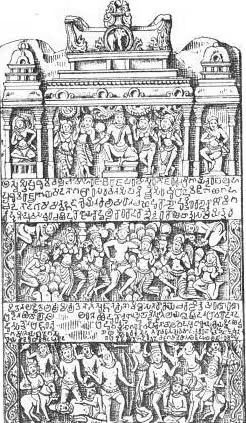
Govinda III: The Rashtrakuta Storm that Swept a Continent
In the grand tapestry of Indian history, few reigns blaze with the sheer military brilliance and imperial ambition of Govinda III. He was not merely a king; he was a force of nature, a political storm that erupted from the Deccan plateau in the late 8th century and swept across the entire subcontinent. His name, inscribed on copper plates and stone edicts, became synonymous with victory. During his reign from 793 to 814 CE, the Rashtrakuta Empire reached its absolute zenith, a sprawling dominion whose authority was acknowledged from the icy streams of the Himalayas to the shores of Lanka. This is the story of the emperor whose conquests transformed the political map of India and forged a legacy as one of its greatest warrior-kings.
Early Life & Background
Govinda III was born into the heart of imperial power, the son of the formidable Rashtrakuta Emperor Dhruva Dharavarsha. His father was a master strategist who had already established Rashtrakuta supremacy in the Deccan and had decisively intervened in the great "Tripartite Struggle" for control of northern India. Growing up in the bustling capital of Manyakheta (modern Malkhed in Karnataka), the young prince was immersed in a world of statecraft, military strategy, and imperial grandeur. He had two prominent brothers, Stambha (also known as Kambarasa) and Karka, and the question of succession would define the very beginning of his reign.
Emperor Dhruva, a shrewd judge of character and ability, saw in his younger son Govinda the qualities essential for a great ruler. Inscriptions note that Dhruva found Govinda to possess more guna (virtues or abilities) than his elder son, Stambha. In a move that was both unconventional and prescient, Dhruva bypassed the traditional right of the eldest and designated Govinda as his heir apparent. Around 793 CE, feeling his own reign had achieved its purpose, Dhruva Dharavarsha abdicated the throne, personally anointing Govinda III as the next emperor of the Rashtrakuta dynasty. This decision, while a testament to Govinda's promise, sowed the seeds of a bitter sibling rivalry that would present the new emperor with his first great test.
Career & Major Contributions
Govinda III's reign was a whirlwind of near-constant, brilliantly executed military campaigns. He was not a ruler who governed from the comfort of his palace; he was a soldier-emperor who lived in the saddle, leading his armies from one victory to another, fundamentally reshaping the political landscape of 8th and 9th century India.
Securing the Throne: The Confederacy of Twelve Kings
No sooner had Govinda III ascended the throne than his elder brother, Stambha, raised the banner of rebellion. As the governor of the strategic territory of Gangavadi (in southern Karnataka), Stambha felt his birthright had been stolen. Consumed by ambition and resentment, he forged a powerful confederacy of twelve kings and chieftains from southern India who were wary of the growing Rashtrakuta power. This was a direct and formidable challenge to the new emperor's authority.
Govinda III's response was a masterclass in statecraft. He first attempted diplomacy, sending emissaries to his brother in an effort to avoid bloodshed. But when conciliation failed, he acted with breathtaking speed and decisiveness. While Stambha was still gathering his forces, Govinda III, loyally supported by his other brother Karka, marched south. He met the rebel army head-on and, in a swift and conclusive battle, crushed the confederacy. Stambha was captured and brought before the emperor in chains.
Here, Govinda III revealed the political sagacity that complemented his military prowess. Instead of executing his rebellious brother, a common practice of the time, he pardoned him. In an extraordinary act of magnanimity, he reinstated Stambha as the governor of Gangavadi. This clemency was not a sign of weakness but of profound political wisdom. It instantly pacified the southern frontier, turned a dangerous rival into a loyal subordinate, and sent a powerful message of strength and justice across the empire.
The Northern Conquests: Lord of Aryavarta
With his home front secured, Govinda III turned his gaze northwards, to the heartland of Aryavarta and the ultimate prize: the imperial city of Kannauj. The Tripartite Struggle for control of this city, waged between the Rashtrakutas of the Deccan, the Gurjara-Pratiharas of the west, and the Palas of the east, was the defining political conflict of the era. His father Dhruva had defeated both the Pratiharas and the Palas, but Govinda III sought not just to defeat them, but to utterly dominate them.
Around 800 CE, he launched his grand northern campaign. His first target was the Gurjara-Pratihara emperor, Nagabhata II. The Rashtrakuta army, a disciplined and mobile force, stormed through central India. The Sanjan plates of his son, Amoghavarsha I, vividly describe the outcome: Nagabhata II, terrified by the advance of the Rashtrakuta war machine, "fled in fear, no one knew whither, even as the clouds disappear."
Having shattered the Pratihara power, Govinda III marched on Kannauj. Its ruler, Chakrayudha, was a protégé of the powerful Pala emperor, Dharmapala. Seeing the fate of his ally Nagabhata II, Dharmapala of Bengal and Chakrayudha chose discretion over valor. The inscriptions record that they "surrendered of their own accord" to the Rashtrakuta emperor. Govinda III stood as the undisputed master of North India.
But his ambition was not yet satisfied. In a move of breathtaking audacity, he pushed his armies even further north, towards the Himalayas. The Sanjan plates poetically state that his war-horses quenched their thirst in the icy liquid of the Himalayas and his war-elephants tasted the sacred waters of the Ganga. This was the ultimate act of a Digvijayin (world-conqueror), a symbolic gesture of paramount sovereignty that reverberated across the subcontinent. On his triumphant return journey, he received the submission of rulers from Malwa, Kosala, Kalinga, Vanga, and Dahala, cementing his authority over a vast swathe of northern and eastern India.
Southern Expeditions: From the Deccan to Lanka
While Govinda III was redrawing the map of the north, the political situation in the south had grown turbulent. With the same relentless energy, he turned his attention to re-establishing his absolute authority.
He launched a campaign against the Pallavas of Kanchi, defeating their king Dantivarman and occupying the city. He then marched to the Eastern Chalukya kingdom of Vengi, a perennial Rashtrakuta rival. He defeated the ruling king, Vijayaditya II, captured his forts, and installed his own nominee, Bhima Salki, on the Vengi throne, effectively turning the kingdom into a vassal state.
His conquests continued southwards. He suppressed the Western Gangas, punished other recalcitrant chieftains, and received the submission of the Chera and Pandya rulers of the deep south. His armies established a victory pillar on the banks of the Tungabhadra river and marched all the way to Kanyakumari (Cape Comorin), the southernmost tip of the Indian mainland.
The most telling testament to his power came from the island of Lanka (Sri Lanka). The Sanjan inscription records that the king of Lanka, hearing of the emperor's devastating campaigns and seeing the Rashtrakuta army encamped on the southern coast, was overcome with terror. To avert an invasion, the Sinhalese king sent two statues to Govinda III as a token of his complete submission—one of himself and one of his chief minister. This act, accepting the fealty of a ruler from across the sea, demonstrated that Govinda III's influence extended even beyond the shores of India.
By the end of his campaigns, Govinda III had achieved what very few rulers in Indian history ever had. He presided over an empire that stretched from Kannauj and the Himalayas in the north to Kanyakumari in the south, from Banaras in the east to the port of Bharuch in the west. His authority was supreme, and his titles—Prabhutavarsha (the Profuse Rainer), Jagattunga (Highest in the World), and Tribhuvanadhavala (Pure in the Three Worlds)—were not empty boasts, but reflections of a political reality he had forged with his sword.
Legacy & Influence
Govinda III's death in 814 CE marked the end of an era of explosive military expansion. His reign represents the absolute pinnacle of Rashtrakuta power, a high-water mark of imperial achievement that would never be surpassed by his successors.
His legacy is, first and foremost, that of a military genius. Historians have often compared his strategic acumen and the sheer scale of his conquests to those of other great captains of history. His ability to move large armies across vast distances with incredible speed, fight campaigns on multiple fronts simultaneously, and secure decisive victories against powerful empires marks him as one of the most successful military commanders in Indian history. His court poets compared him to the epic hero Arjuna, and the fear his name inspired in his rivals is a recurring theme in the inscriptions of the period.
Politically, his impact was profound. His northern campaigns shattered the power of the Gurjara-Pratiharas and humbled the Palas, fundamentally altering the dynamics of the Tripartite Struggle. While the Rashtrakuta hold on Kannauj proved temporary, his invasions left his northern rivals severely weakened for a generation. In the south, he consolidated Rashtrakuta dominance so thoroughly that the region remained under their firm control for decades.
Govinda III is remembered today as the architect of a true pan-Indian empire. The phrase "from the Himalayas to Cape Comorin" is often used poetically to describe the extent of legendary empires, but for Govinda III, it was a documented military and political fact. He was one of a handful of monarchs who translated this imperial dream into reality. The glowing accounts of his reign, particularly in the inscriptions written during the time of his celebrated son and successor, Amoghavarsha I, immortalized him as the invincible warrior who made the Rashtrakuta eagle the undisputed master of the Indian skies. His reign set a benchmark for imperial power and prestige that defined the Rashtrakuta dynasty for the rest of its glorious existence.