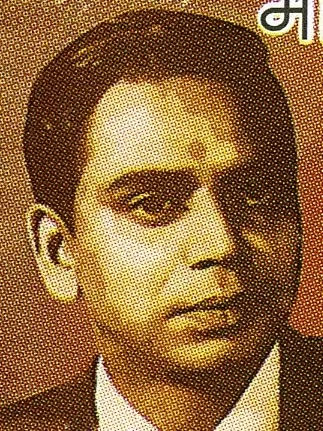
Gulzar: The Poet of the People's Soul
In the vast, star-studded firmament of Indian arts, few luminaries shine with the gentle, enduring luminescence of Sampooran Singh Kalra, known to the world simply as Gulzar. Born on August 18, 1934, he is not merely a name but an institution—a poet whose ink has flowed into the very veins of Indian cinema, a lyricist who has given voice to unspoken emotions, and a filmmaker who has framed human complexities with profound sensitivity. His life, which began in the pre-Partition landscape of British India, is a chronicle of resilience, artistic integrity, and the timeless power of words.
Early Life: A Childhood Interrupted by History
Gulzar was born Sampooran Singh Kalra into a Sikh family in Dina, a small town in the Jhelum District of Punjab, British India (now in Pakistan). His father, Makhan Singh Kalra, was a local trader. His early years were steeped in the sights and sounds of a Punjab that would soon be irrevocably fractured. As a young boy, he was deeply drawn to literature, spending hours engrossed in the works of Mirza Ghalib and Rabindranath Tagore, whose writings he would later translate with deep affection.
This idyllic world was shattered in 1947. The Partition of India, a cataclysmic event that cleaved the subcontinent, tore through his life, leaving indelible scars. As a teenager, he witnessed the brutal violence and mass displacement that followed. This trauma of being uprooted, of losing a homeland, became a silent, recurring motif in his work—a deep well of melancholy and nostalgia from which he would draw throughout his artistic career. His family was forced to migrate, and after a brief, difficult period, they settled in Delhi.
In Delhi, the young Sampooran Singh continued his education, but his heart was set on the literary world. He adopted the pen name 'Gulzar,' a word of Persian origin meaning 'garden of flowers.' Against his family's wishes for a more stable career, he moved to Bombay (now Mumbai), the bustling hub of Hindi cinema, to chase his dream. His early days in the city were a test of his resolve. To support himself, he took up a job at a garage in the Worli area, touching up the paint on accident-damaged cars. But even amidst the smell of paint and turpentine, he never abandoned his poetry. He became an active member of the Progressive Writers' Association (PWA), a circle that included some of the era's greatest literary and cinematic minds, such as Shailendra and Bimal Roy.
Career & Major Contributions: Weaving Words into Cinema
It was through his PWA connections that destiny intervened. The legendary film director Bimal Roy was working on his film Bandini (1963), and its primary lyricist, Shailendra, was having a creative disagreement with the composer, S.D. Burman. Bimal Roy, aware of the young poet in his circle, asked Gulzar to step in and write a song. The result was "Mora Gora Ang Lai Le," a song that not only fit the film's rustic ethos perfectly but also announced the arrival of a unique and powerful new voice. His journey from a garage mechanic to a film lyricist had begun.
The Master Lyricist
As a lyricist, Gulzar redefined the art form. He liberated the Hindi film song from the confines of conventional poetic diction, infusing it with the language of everyday life while retaining profound philosophical depth. His genius lies in his ability to find poetry in the mundane and to express complex emotions with startlingly simple, yet evocative, imagery.
His collaboration with composer R.D. Burman is the stuff of legend. Together, they created a soundscape that was revolutionary, blending Gulzar's introspective lyrics with Burman's innovative music. In films like Parichay (1972), Aandhi (1975), and Ijaazat (1987), they produced timeless classics. Songs like "Musafir Hoon Yaaron," "Tere Bina Zindagi Se Koi Shikwa Toh Nahin," and the heart-wrenching "Mera Kuchh Saamaan" showcase a perfect synergy of word and melody. The latter, from Ijaazat, which asks a former lover to return intangible memories—"a hundred and sixteen moonlit nights"—is a masterclass in lyrical innovation, earning Gulzar a National Film Award.
His versatility is staggering. He could pen the playful and innocent "Lakdi Ki Kaathi" for children in Masoom (1983), the existentially melancholic "Tujhse Naaraz Nahin Zindagi" from the same film, and decades later, the rustic, feisty "Beedi Jalaile" in Omkara (2006). He formed formidable partnerships with other composers, most notably with A.R. Rahman on films like Dil Se.. (1998) and Saathiya (2002), and with his own protégé, Vishal Bhardwaj, on masterpieces like Maachis (1996) and Haider (2014).
His international acclaim reached its zenith with the song "Jai Ho" from Slumdog Millionaire (2008). The song, composed by A.R. Rahman with lyrics by Gulzar, won an Academy Award for Best Original Song and a Grammy Award, bringing his distinct lyrical style to a global stage.
The Sensitive Filmmaker
Not content with just writing for the screen, Gulzar stepped behind the camera to become one of India's most respected writer-directors. His films are extensions of his poetic sensibilities—intimate, introspective explorations of human relationships, often set against a backdrop of social change.
His directorial debut, Mere Apne (1971), was a stark look at youth disillusionment and street violence. He followed it with Parichay (1972) and the landmark film Koshish (1972). Koshish was a brave and poignant portrayal of a deaf-mute couple, played brilliantly by Sanjeev Kumar and Jaya Bhaduri, navigating life's challenges. The film was celebrated for its sensitivity and for bringing the lives of the differently-abled to the forefront of mainstream cinema.
His filmography as a director is a collection of cinematic gems:
- Aandhi (1975): A mature political drama about a powerful female politician who reconnects with her estranged husband. The film courted controversy for its alleged resemblance to the life of then-Prime Minister Indira Gandhi and was temporarily banned.
- Mausam (1975): A complex, layered story of love, betrayal, and redemption spanning two decades, earning Sharmila Tagore the National Film Award for Best Actress.
- Ijaazat (1987): An exquisitely crafted film about a divorced couple who meet by chance in a railway station waiting room. Told through a series of non-linear flashbacks, the film is a poignant meditation on love, memory, and the choices that define our lives.
As a screenwriter and dialogue writer, his contributions are equally monumental. He penned the dialogues for Hrishikesh Mukherjee's classic Anand (1971), crafting lines for Rajesh Khanna's character that remain etched in public memory. His dialogues were never just functional; they were poetic, philosophical, and deeply rooted in the character's psyche.
Legacy & Influence: A Garden of Enduring Words
Gulzar's legacy is multifaceted. He is a bridge between the golden age of Urdu poetry and the populist medium of cinema. He made poetry accessible without ever diluting its essence. His signature crisp, white kurta-pajama has become as iconic as his words, symbolizing an understated, intellectual elegance.
A Literary Titan
Beyond cinema, Gulzar is a formidable literary figure in his own right. He has published numerous volumes of poetry, short stories, and children's books. He is credited with inventing a unique poetic form known as the Triveni—a three-line, non-rhyming poem where the first two lines establish a complete thought, and the third line adds a surprising, often profound, twist that re-contextualizes the first two.
His dedication to literature extends to translation, where he has painstakingly translated the works of Tagore, Ghalib, and other poets, making their genius available to a wider Hindi-Urdu readership. In 2014, he was honored with the Jnanpith Award, India's highest literary honor, a rare recognition for a figure so deeply entrenched in popular cinema. This, along with the Padma Bhushan (2004) and the Dadasaheb Phalke Award (2013), India's highest honor in cinema, solidifies his position as a cultural icon who has excelled in both literature and film.
The Gulzar School of Thought
His influence on subsequent generations is immense. Lyricists study his use of imagery and his seamless blending of dialects. Filmmakers like Vishal Bhardwaj and Meghna Gulzar (his daughter) carry forward his legacy of sensitive, intelligent storytelling. He taught an entire generation that a film song could be a piece of high art and that a film's dialogue could resonate with the cadence of poetry.
Today, Gulzar continues to write with the same passion and insight that defined his early career. He remains a vital creative force, collaborating with contemporary artists and continuing to publish his poetry. He is a living archive of a syncretic cultural past, a reminder of a time when language was a tool for connection, not division. His voice, both on the page and in his iconic recitations, is a soothing balm—a wise, gentle presence that assures us that even in a chaotic world, there is always room for beauty, empathy, and a perfectly turned phrase. He is not just a writer; he is a chronicler of the Indian experience, the quiet observer who finds the universe in a dewdrop and eternity in a fleeting moment.