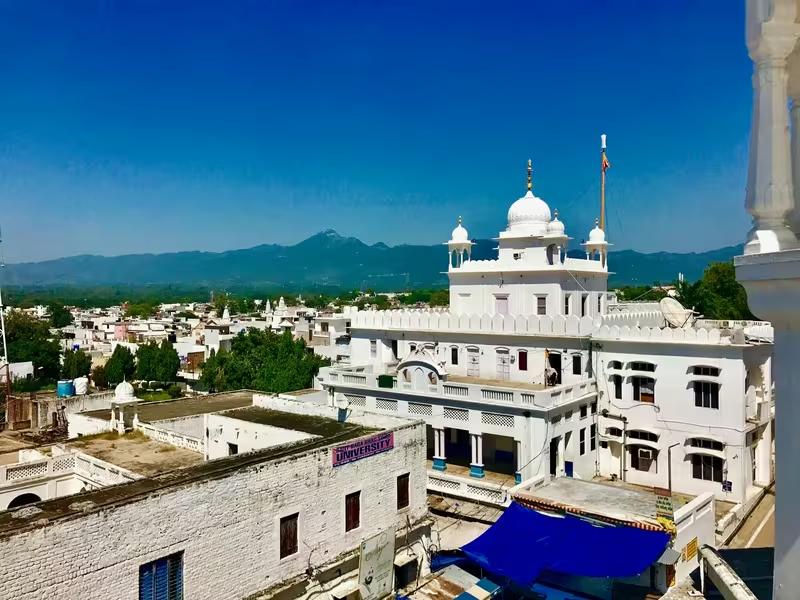
Guru Gobind Singh: The Saint-Soldier
In the grand tapestry of Indian history, few figures loom as large or as transformative as Guru Gobind Singh (1666-1708). The tenth and final human Guru of the Sikhs, he was a spiritual master, a revolutionary poet, a peerless warrior, and a profound philosopher. In a life defined by immense personal sacrifice and unwavering resolve, he reshaped the Sikh community from a peaceful religious fellowship into the Khalsa—a formidable order of saint-soldiers committed to upholding justice and freedom for all, regardless of creed.
The Forging of a Leader: Early Life and Influences
Guru Gobind Singh was born Gobind Rai on December 22, 1666, in Patna, in the eastern province of Bihar. He was the only son of the ninth Sikh Guru, Tegh Bahadur, and Mata Gujri. His birth occurred while his father was on a long preaching tour of Bengal and Assam, and his early years were spent in a city far from the Sikh heartland of Punjab. From a young age, it was clear that Gobind Rai was no ordinary child; tales from his childhood speak of a natural leader, charismatic and fearless.
His world was shaped by the oppressive political climate of the late 17th century. The Mughal Emperor Aurangzeb, a devout but intolerant ruler, had embarked on a campaign of religious persecution, aiming to consolidate his empire under a strict Islamic orthodoxy. This policy created an atmosphere of fear and coercion, particularly for non-Muslim communities.
The defining moment of Gobind Rai's childhood, and a pivotal event in Sikh history, came in 1675. A delegation of Kashmiri Pandits, facing forced conversion, sought the help of Guru Tegh Bahadur in Anandpur Sahib, the city he had founded in the foothills of the Himalayas. The Guru knew that a great sacrifice was needed to awaken the conscience of the empire and inspire courage in the oppressed. Seeing his father in deep contemplation, the nine-year-old Gobind Rai is said to have remarked that no one was worthier than his father to make such a sacrifice for dharma (righteousness).
His words sealed his father's resolve. Guru Tegh Bahadur traveled to Delhi, where he was publicly executed for refusing to convert to Islam. He became a martyr for the principle of religious freedom. The martyrdom of his father placed the heavy mantle of Guruship upon the shoulders of a nine-year-old boy. This profound loss instilled in him an unyielding determination to resist tyranny and empower his people to defend their faith and their rights.
At Anandpur Sahib, the young Guru's education was comprehensive. He immersed himself in the study of Sikh scriptures, alongside Sanskrit, Persian, and Braj Bhasha literature. Simultaneously, he mastered the arts of war: horsemanship, archery, and swordsmanship. This dual training in spiritual wisdom (piri) and temporal authority (miri) would become the bedrock of his philosophy.
The Rise of the Khalsa: A New Order
As Guru Gobind Singh reached manhood, he saw that the existing social structures, weakened by caste divisions and a passive mindset, were inadequate to face the military and ideological challenges posed by the Mughal state. He envisioned a new community—one that was disciplined, courageous, and spiritually centered, free from the shackles of caste and ritualism. This vision culminated in the momentous events of Vaisakhi, 1699.
On the day of the spring festival, a massive congregation of Sikhs gathered at Anandpur Sahib. In a dramatic and now-legendary moment, the Guru appeared before the crowd, drew his sword, and demanded a head—a life to be sacrificed for the faith. A wave of shock and fear rippled through the assembly. After a tense silence, a Sikh named Daya Ram stood up and offered himself. The Guru led him into a tent. A thud was heard, and the Guru re-emerged with a blood-stained sword, demanding another head.
Four more times he made the call, and four more men—Dharam Das, Himmat Rai, Mohkam Chand, and Sahib Chand—bravely offered their lives. After the fifth volunteer disappeared into the tent, the Guru emerged with all five men, alive and dressed in new, resplendent robes. They became the Panj Pyare, the "Five Beloved Ones," the first members of a new order.
The Guru then initiated them into this order through a new ceremony called Amrit Sanchar. He mixed water and sugar crystals (patashas) in an iron bowl, stirring it with a double-edged sword (khanda) while reciting prayers. This sanctified nectar, the Amrit, was given to the Panj Pyare to drink. He declared them the Khalsa—the "Pure," a community of saint-soldiers.
He mandated that all members of the Khalsa adopt five articles of faith, known as the Five Ks:
- Kesh: Uncut hair, a symbol of spirituality and acceptance of God's will.
- Kangha: A wooden comb, to keep the hair clean and tidy, symbolizing order.
- Kara: An iron bracelet, a reminder of one's bond with God and the Khalsa.
- Kacchera: A specific type of cotton undergarment, symbolizing chastity and readiness for action.
- Kirpan: A sword or dagger, representing the duty to defend the weak and uphold justice.
He abolished all caste distinctions within the Khalsa, giving the men the common surname Singh (lion) and the women Kaur (princess), creating a society based on equality. In a revolutionary act of humility, Guru Gobind Rai then knelt before the Panj Pyare and asked them to initiate him into the Khalsa. After receiving Amrit, Gobind Rai became Guru Gobind Singh. The Guru had become the disciple, establishing a democratic spirit at the heart of the new order.
The Saint-Soldier in Action: Years of Conflict
The creation of the Khalsa and the growing military strength at Anandpur were perceived as a direct threat by the surrounding hill Rajas and the Mughal authorities. This led to a series of battles that tested the Khalsa's resolve to its limits.
Guru Gobind Singh was a brilliant military strategist who led his forces in over a dozen major engagements. His first significant victory was at the Battle of Bhangani (1688), fought even before the founding of the Khalsa. However, the most grueling conflicts came after 1699.
The combined forces of the hill Rajas and the Mughals laid a prolonged siege to Anandpur Sahib in 1704. The Sikhs inside the fort endured starvation and constant attacks but refused to surrender. The Mughals eventually offered the Guru and his followers safe passage if they evacuated the fort, swearing an oath on the Quran. Knowing the offer was likely treacherous but facing dire conditions, the Guru agreed.
As the Sikhs left Anandpur, the enemy forces broke their oath and attacked. In the chaos that ensued while crossing the flooded Sarsa river, many Sikhs perished, and precious manuscripts were lost. The Guru’s family was separated. His two younger sons, Zorawar Singh (aged 9) and Fateh Singh (aged 7), along with their grandmother Mata Gujri, were captured. They were taken to Sirhind, where the governor, Wazir Khan, offered the young boys riches and power if they converted to Islam. When they steadfastly refused, they were bricked up alive in a wall and then executed, becoming the youngest martyrs in Sikh history. Their grandmother passed away from the shock.
Meanwhile, Guru Gobind Singh, with his two elder sons and a small band of about 40 Sikhs, took refuge in a small mud-brick fortress at Chamkaur. They were soon surrounded by a massive Mughal army. In the ensuing Battle of Chamkaur, one of the most remarkable last stands in history, the small group of Sikhs fought with incredible valor. The Guru watched as his two elder sons, Ajit Singh and Jujhar Singh, achieved martyrdom fighting on the battlefield. With only a handful of Sikhs left, they commanded the Guru to escape so he could rally the Khalsa once more. He did so under the cover of night, a lone figure who had lost his mother, all four of his sons, and the city he had built, all in a matter of days.
The Pen and the Sword: Literary and Spiritual Genius
Despite being a man of war, Guru Gobind Singh was also a prolific poet and scholar of immense talent. His court at Anandpur was a center for literary creation, where 52 poets translated classical texts and composed original works. The Guru’s own compositions are compiled in the Dasam Granth.
His writings are a powerful blend of spiritual devotion and martial inspiration. Compositions like Jaap Sahib and Akal Ustat celebrate the formless, timeless, and all-powerful nature of God. Other works, like those depicting the incarnations of the divine, used traditional Hindu mythology to inspire a spirit of righteous courage against evil.
Perhaps his most famous literary work is the Zafarnama, or the "Epistle of Victory." It is a defiant letter written in exquisite Persian verse to Emperor Aurangzeb after the Battle of Chamkaur. In it, the Guru admonishes the emperor for his tyranny, his breach of oath, and his un-Islamic conduct. While he had lost everything on a material level, the Guru declared a moral victory, stating, “When all other means have failed, it is righteous to draw the sword.” The Zafarnama is a masterpiece of diplomacy, philosophy, and courage, a testament to an unconquered spirit.
The Final Legacy: An Eternal Guru
After escaping from Chamkaur, Guru Gobind Singh rallied his followers and fought one final successful battle at Muktsar. Following Aurangzeb’s death in 1707, he developed a cordial relationship with the new emperor, Bahadur Shah. He traveled south to the Deccan, where, at Nanded in 1708, he was stabbed by assassins sent by Wazir Khan of Sirhind.
Knowing his end was near, the Guru performed his final, and perhaps most significant, act. He gathered the Sikhs and declared that the line of human Gurus was to end. He placed a copy of the Adi Granth (the Sikh holy scripture compiled by Guru Arjan Dev) before him, bowed to it, and vested the Guruship in the holy book itself. From that day forward, the scripture was to be known as the Guru Granth Sahib—the eternal, living Guru for all Sikhs.
This act was revolutionary. It democratized spiritual authority, making the divine word directly accessible to every follower and preventing any future personality cults or succession disputes. On October 7, 1708, Guru Gobind Singh passed away, leaving behind a legacy that was complete and self-sustaining.
His life was a perfect embodiment of the Sant-Sipahi (Saint-Soldier) ideal. He is remembered as Sarvans Dani—the one who sacrificed his all, including his father, mother, and all four sons, for the sake of his people and for the cause of righteousness. Guru Gobind Singh’s creation of the Khalsa gave Sikhs a distinct identity, and his final decree established the Guru Granth Sahib as the faith's sovereign core. His life remains a towering source of inspiration, a timeless lesson in courage, sacrifice, leadership, and unwavering faith in the face of unimaginable loss.