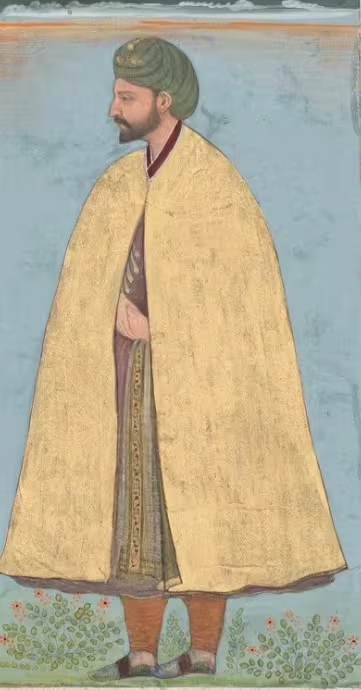
The Mind of the Court: The Life and Legacy of Hakim Humam
In the grand theatre of the Mughal Empire, few reigns were as intellectually vibrant and culturally incandescent as that of Jalal-ud-din Muhammad Akbar. His capital, whether the red sandstone city of Fatehpur Sikri or the bustling metropolis of Lahore, was a magnet for the greatest minds of the era. Among the luminaries who adorned this court—the poets, warriors, artists, and administrators—was a man whose influence was felt not through the sword, but through the quiet power of his intellect and the depth of his loyalty. He was Najib al-Din Humayun Gilani, known to the Emperor and posterity by his honored title, Hakim Humam.
A physician whose diagnostic skills were legendary and a diplomat whose tact could disarm the most formidable foreign rulers, Hakim Humam was more than a courtier; he was an imperial confidant, a pillar of Akbar’s inner circle, and a celebrated member of the legendary Navaratnas, or the 'Nine Gems' of the court. His story is not one of conquests and battles, but of wisdom, trust, and the subtle art of statecraft that helped shape the golden age of the Mughals.
Early Life & Background: A Journey from Persia to Hindustan
Like many of the brilliant minds that illuminated Akbar's court, Hakim Humam was not a native of Hindustan. He was born in Gilan, a lush province on the Caspian Sea coast of Persia (modern-day Iran). The exact year of his birth remains lost to history, a common fate for figures outside the immediate royal line. He hailed from a family of distinguished scholars. His father, Mir Ala-ud-daula Qazwini, was a learned man, and this intellectual inheritance was passed down to his sons.
Humam, along with his equally gifted elder brother Hakim Abu'l-Fath Gilani, received a classical Persian education steeped in philosophy, literature, and, most importantly, the Greco-Arabic medical tradition known as Unani Tibb. They were products of a rich intellectual environment, honing their skills in a land that had long been a center of scientific and cultural innovation.
The mid-16th century, however, was a period of political and religious flux in Safavid Persia. For ambitious and talented men, the Mughal Empire under Akbar offered a tantalizing promise of patronage, intellectual freedom, and unparalleled opportunity. The Emperor was famously eclectic in his tastes and meritocratic in his appointments, welcoming scholars, artists, and administrators from across the world, regardless of their ethnic or religious background. It was this promise that drew the Gilani brothers, like so many others, to undertake the arduous journey eastward.
They arrived in Hindustan around 1575. Their initial foray into Mughal service was not directly at the imperial court but under the patronage of Mun'im Khan, Akbar's governor in the eastern province of Bengal. However, the brilliance of the two brothers could not remain confined to a provincial court for long. Following Mun'im Khan's death, they were introduced to Emperor Akbar himself at his magnificent new capital, Fatehpur Sikri. It was here that Hakim Humam’s remarkable career would truly begin.
Career & Major Contributions: The Emperor’s Physician, Diplomat, and Friend
Hakim Humam’s ascent in the Mughal hierarchy was swift, propelled by his sharp intellect, profound medical knowledge, and an innate courtly grace. He quickly earned the Emperor's favor, becoming a regular presence in the most intimate circles of power.
The Royal Physician (Hakim)
As his title 'Hakim' denotes, Humam’s primary role was that of a physician. In an age where the monarch's health was synonymous with the stability of the empire, the position of the royal physician was one of immense responsibility and trust. It granted him unparalleled access to the Emperor, allowing him to become a confidant in a way few others could.
His medical prowess was the stuff of court legend. The court chronicler Abul Fazl, in his monumental work Ain-i-Akbari, recounts an anecdote that perfectly captures Humam’s celebrated diagnostic acumen. To test his new physician, Akbar presented Humam with a bottle containing the urine of a healthy person and a sick donkey, mixed together, and demanded a diagnosis. It was a seemingly impossible challenge designed to confound him. After carefully examining the sample, Humam, without a moment's hesitation, prescribed a specific type of grain mixed with other ingredients. When a puzzled Akbar asked for an explanation, Humam replied that the remedy was a restorative for the human and suitable fodder for the ailing beast. This display of almost supernatural insight, combining medical science with razor-sharp wit, solidified his reputation and cemented the Emperor's trust in him.
His role, however, went beyond mere prescriptions. He was a guardian of the Emperor's well-being, a counsellor on diet and lifestyle, and a constant, calming presence in the often-stressful environment of the court.
The Master Diplomat: The Embassy to Turan
While his medical skills opened the door to the Emperor’s chambers, it was his political and diplomatic astuteness that made him indispensable. Akbar recognized in Humam a mind capable of navigating the complex and treacherous currents of international politics. This trust culminated in what would become Hakim Humam’s most significant contribution to the Mughal state: his leadership of the prestigious embassy to Turan in 1586.
The northwestern frontier was the Mughal Empire's most vulnerable flank. Beyond the Hindu Kush lay Turan (Transoxiana), the domain of the formidable and ambitious ruler Abdullah Khan Uzbek. Abdullah Khan was a powerful sovereign who harbored designs on territories that bordered the Mughal realm. Akbar needed to secure this frontier, not just with military might, but with shrewd diplomacy. He required an envoy who was not merely a messenger, but a man of intellect, perception, and unwavering loyalty—someone who could represent the majesty of the Mughal court while gauging the true intentions of its most powerful neighbor.
His choice was Hakim Humam.
In 1586, Humam was dispatched from Lahore with a retinue carrying lavish gifts and a carefully worded letter from Akbar. The mission was a delicate dance of diplomacy. Humam’s task was to convey Akbar’s message of friendship and regional stability, while simultaneously acting as the Emperor's eyes and ears. He had to assess Abdullah Khan’s military strength, the political climate of his court in Bukhara, and the sincerity of his intentions. For several years, he remained at the Uzbek court, conducting himself with such dignity and intelligence that he earned the respect of Abdullah Khan himself. His detailed reports back to Akbar provided invaluable strategic intelligence, allowing the Emperor to formulate a long-term policy for Central Asia. The embassy was a resounding success, temporarily neutralizing a significant threat and showcasing the sophistication of Mughal diplomacy. Hakim Humam had proven that his talents extended far beyond the realm of medicine.
Administrator and Courtier
Hakim Humam’s influence was not limited to medicine and diplomacy. His administrative talents were also recognized and utilized by the Emperor. He was appointed to the high office of Sadr, a position that put him in charge of the imperial household's charitable and religious endowments. This role required impeccable integrity and organizational skill, and his appointment was another sign of the Emperor's absolute confidence in his character.
Furthermore, he was an active participant in the vibrant intellectual life of the court. He was present at many of the famous theological debates held in the Ibadat Khana (House of Worship), where Akbar brought together scholars from various faiths—Muslims, Hindus, Jains, Zoroastrians, and Christians—to discuss matters of philosophy and religion. As a learned man of Persian origin and Shia faith, Humam’s perspective would have been a valuable contribution to these syncretic discussions that so fascinated the Emperor.
He was also known for his wit and was a poet of some repute, though his works have not survived in any significant volume. He was a complete courtier in the Renaissance ideal: a man of science, letters, and statecraft, embodying the multifaceted genius that Akbar so admired.
Legacy & Influence: A Gem in the Imperial Crown
Hakim Humam passed away in 1595. The chronicles note that Emperor Akbar was deeply grieved by the loss, mourning not just a capable servant of the state, but a dear and loyal friend. His death marked the end of a remarkable career that exemplified the meritocratic spirit of the age.
The Navaratnas
Hakim Humam is most popularly remembered as one of the Navaratnas, the 'Nine Gems' of Akbar's court. This term, while more a product of popular folklore than a formal imperial designation, aptly describes the collection of extraordinary individuals who surrounded the Emperor. To be counted in this group alongside figures like the brilliant minister Abul Fazl, the witty advisor Birbal, the financial genius Raja Todar Mal, and the musical maestro Tansen, is a testament to the high esteem in which Humam was held. He represented the scientific and diplomatic intellect of this celebrated circle.
A Symbol of Trust and Syncretism
His legacy is not etched in stone monuments or grand architectural projects. Instead, it is woven into the very fabric of Akbar's reign. He stands as a symbol of the profound trust the Emperor placed in his chosen advisors. An immigrant from Persia, a Shia by faith, Humam rose to the highest echelons of a predominantly Sunni court in Hindustan, a powerful illustration of Akbar’s policy of 'Sulh-i-Kul' (peace with all) and his practice of judging men by their talent and loyalty, not their creed or origin.
His life story highlights the immense contribution of Persian intellectuals to the cultural and administrative richness of the Mughal Empire. These men brought with them a sophisticated tradition of art, literature, medicine, and governance that blended with Indian traditions to create the unique and dazzling high culture of the Mughal era.
Today, Hakim Humam is remembered through the pages of the Akbarnama and the Ain-i-Akbari, where Abul Fazl immortalized him as a man of wisdom, skill, and unwavering devotion. He was a quiet force in a dynamic court, a physician who healed the body and a diplomat who helped secure the body politic. He was, in every sense, one of the true gems of the Mughal Empire.