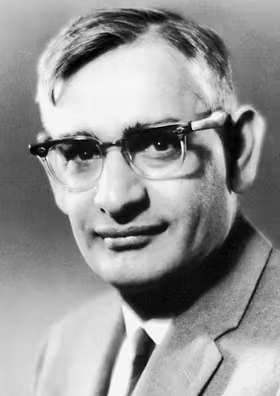
Har Gobind Khorana - Nobel Laureate in Physiology or Medicine
In the small, dusty village of Raipur in the Punjab of British India, a place without electricity or running water, a young boy began his education not in a classroom, but under the shade of a tree. This humble setting was the unlikely starting point for a mind that would one day decipher the very language of life itself. That boy was Har Gobind Khorana, and his journey from a remote village to the pinnacle of global science is a testament to the power of curiosity, intellectual rigor, and a father's unwavering belief in education.
Early Life & Background: A Mind Forged in Dust and Determination
Har Gobind Khorana was born in 1922, the youngest of five children. While official documents list his birth date as January 9, the exact day was uncertain, a common reality in rural India at the time. His father, Ganpat Rai Khorana, was a patwari, a village agricultural taxation clerk. In a community of roughly 100 people, Ganpat Rai was singularly dedicated to the education of his children. Because of his efforts, the Khoranas were the only literate family in the entire village. This profound emphasis on learning, instilled in him from his earliest days, became the bedrock of Khorana’s life.
He recalled his early education with gratitude, recognizing the sacrifices his father made. He excelled, moving on to the D.A.V. High School in Multan (now in Pakistan). His academic brilliance was evident early on, earning him a place at Punjab University in Lahore. There, under the mentorship of the great teacher Mahan Singh, he immersed himself in the world of chemistry, earning his Bachelor's degree in 1943 and a Master of Science in 1945.
As the subcontinent stood on the precipice of monumental change with the impending end of British rule, a new opportunity arose for Khorana. In 1945, he was awarded a Government of India Fellowship to pursue doctoral studies in England. He arrived at the University of Liverpool, intending to study insecticides and fungicides, but fate and academic curiosity intervened. He instead joined the research group of Roger J. S. Beer and delved into organic chemistry, the field that would become his domain. He completed his Ph.D. in 1948, just a year after India’s independence and the traumatic partition that redrew the map of his homeland.
Career & Major Contributions: From Cambridge to the Genetic Code
After a brief postdoctoral fellowship in Zurich with Vladimir Prelog, a future Nobel laureate himself, Khorana moved to Cambridge University in 1950. This move proved to be the most decisive of his scientific career. At Cambridge, he joined the group of George Wallace Kenner and Sir Alexander Todd (who would win the Nobel Prize in Chemistry in 1957). It was here, amidst the intellectual ferment of one of the world's premier scientific institutions, that Khorana first began working on nucleic acids—the molecules, DNA and RNA, that carry the blueprint of life.
Despite his growing expertise, a suitable research position in India proved elusive. In 1952, he relocated to Vancouver, Canada, to work at the British Columbia Research Council. It was a financially modest position, but it offered him something invaluable: complete scientific freedom. In his small lab, he began to assemble a team and hone the techniques of chemical synthesis that would define his life's work. He married Esther Elizabeth Sibler, a Swiss national he had met in Zurich, who became his lifelong partner and source of immense support.
In 1960, he moved to the Institute for Enzyme Research at the University of Wisconsin–Madison. By now, the world of biology was buzzing with excitement. Watson and Crick had unveiled the double-helix structure of DNA in 1953, but the great mystery remained: how did the simple, four-letter alphabet of DNA (A, T, C, G) direct the assembly of proteins from a twenty-letter alphabet of amino acids? How was the genetic code read?
Cracking the Code of Life
The first major breakthrough came in 1961 when Marshall Nirenberg discovered that a synthetic RNA strand made of only one repeating base, uracil (poly-U), produced a protein made of only one amino acid, phenylalanine. The first 'word' of the genetic code had been found: UUU codes for phenylalanine.
This was the opening Khorana had been waiting for. His mastery of organic chemistry allowed him to take Nirenberg’s discovery to a whole new level of precision. Instead of using simple, single-base strands, Khorana and his team developed a painstaking method to synthesize long RNA molecules with specific, repeating sequences of two, three, or four bases. This was a monumental feat of chemical engineering.
They created a chain of repeating UC units (UCUCUC...). When used in a protein-synthesis system, this RNA produced a polypeptide chain with alternating amino acids: serine and leucine. This elegant experiment proved that the code was read in groups of bases, and that UCU coded for serine while CUC coded for leucine. They followed this with other repeating chains: AAGAAG..., GAUGAU..., and UAUCUAUC... Each synthetic molecule was a key that unlocked another part of the genetic dictionary. By meticulously synthesizing these defined polymers and analyzing the resulting proteins, Khorana’s lab systematically and definitively confirmed the nature of the genetic code. They proved that the code was read in non-overlapping triplets of bases, called codons, and helped assign specific codons to each of the amino acids.
For this monumental achievement, Har Gobind Khorana, along with Marshall Nirenberg and Robert W. Holley (who had elucidated the structure of transfer RNA), was awarded the 1968 Nobel Prize in Physiology or Medicine. Their combined work had translated the book of life, turning biology into an information science.
The Ultimate Synthesis: Building a Gene from Scratch
For most scientists, a Nobel Prize would be a career-capping achievement. For Khorana, it was a stepping stone. Having learned to read the code, he set his sights on an even more audacious goal: to write it. He aimed to achieve the first total synthesis of a functional gene from simple, off-the-shelf chemicals.
In 1970, he moved his entire research team of over twenty scientists to the Massachusetts Institute of Technology (MIT), where he became the Alfred P. Sloan Professor of Biology and Chemistry. There, they embarked on a project of unprecedented complexity. The team chose to synthesize a yeast gene for alanine transfer RNA (tRNA), a relatively small gene with 77 base pairs.
Over several years, using the precise chemical methods he had perfected, they synthesized short DNA fragments and then stitched them together using enzymes. In 1972, they announced their success: the creation of the world's first artificial gene. But the final proof was yet to come. In 1976, Khorana's team synthesized a larger gene and demonstrated that it was fully functional when inserted into a living bacterium (E. coli). This was a landmark moment in science. It proved that life's instructions were not governed by some unknowable 'vital force,' but were based on tangible chemistry. It laid the theoretical and practical foundation for the entire field of genetic engineering and the biotechnology revolution that would follow.
Legacy & Influence: A Life Written in the Language of Science
Har Gobind Khorana remained at MIT for the rest of his career, retiring in 2007. In his later years, his research shifted to the study of membrane proteins and the mechanisms of vision, bringing his signature chemical rigor to new biological frontiers. He passed away on November 9, 2011, at the age of 89.
Khorana’s historical significance is immense. He was a central figure in the molecular biology revolution that defined the second half of the 20th century. His work transformed biology from a descriptive science into a precise, quantitative one. The ability to read and write genetic sequences, which he pioneered, is the bedrock of modern medicine and biotechnology—from DNA sequencing and genetic disease diagnosis to the creation of life-saving drugs like synthetic insulin and the development of mRNA vaccines.
For India and the global Indian diaspora, Khorana is a figure of immense pride and inspiration. His journey from a village with no literate inhabitants beyond his own family to a Nobel laureate at MIT is a powerful narrative of what is possible. He stands as one of a handful of Indian-born scientists to receive the Nobel Prize, a symbol of intellectual excellence on the world stage.
He is remembered by his colleagues and students as a profoundly dedicated, meticulous, and demanding scientist. He was a quiet and humble man who preferred the sanctuary of the lab to the glare of the public spotlight. He was driven not by fame, but by a deep-seated need to understand the fundamental chemical machinery of life. His legacy is not just etched on the Nobel medal he received, but is written into the very DNA of modern science, a code that he, more than almost anyone, helped us to understand.