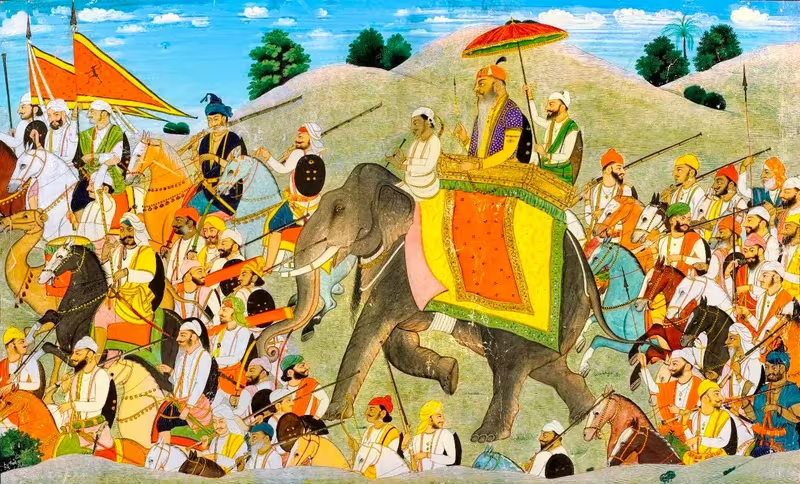
Hari Singh Nalwa: The Sikh Empire's Fearless Frontier General
In the annals of Indian military history, few names evoke the same awe and reverence as Sardar Hari Singh Nalwa. He was more than a general; he was a force of nature, the living embodiment of the Sikh Khalsa Fauj's martial spirit. As the Commander-in-Chief for Maharaja Ranjit Singh, he was the architect of the Sikh Empire's most daring conquests and the guardian of its most dangerous frontier. For centuries, invaders had poured into India through the treacherous mountain passes of the northwest. Hari Singh Nalwa not only slammed that door shut but reversed the tide, pushing the boundaries of an indigenous Indian empire to the very mouth of the Khyber Pass. His story is one of extraordinary courage, strategic genius, and an indomitable will that left a permanent mark on the geography and psyche of the subcontinent.
Early Life & The Making of a Legend
Hari Singh was born in 1791 in Gujranwala, Punjab, into an Uppal Khatri family. His father, Gurdial Singh, was a horseman in the Sukerchakia Misl, the precursor to the Sikh Empire, and had served under its leaders Charat Singh and Maha Singh, the grandfather and father of the future Maharaja Ranjit Singh. The martial environment of the misls, constantly vying for power and territory, was the crucible in which young Hari Singh's character was forged.
Tragedy struck early when his father passed away in 1798, leaving the seven-year-old Hari Singh to be raised by his mother, Dharam Kaur. Under her guidance, he was trained in the arts of war and statecraft. In 1801, he underwent the Amrit Sanchar ceremony, becoming an initiated Khalsa Sikh, fully committing himself to the faith and its martial traditions. He learned Persian, the courtly language of the time, and became proficient in horsemanship and swordsmanship, displaying a prodigious talent for the military arts.
His entry into the service of Maharaja Ranjit Singh is the stuff of legend. In 1805, at the tender age of fourteen, Hari Singh accompanied the Maharaja on a hunt. During the expedition, a ferocious tiger suddenly attacked the party. While others hesitated, the young Hari Singh reportedly leapt to the forefront. Forsaking his weapons after a close call, he is said to have seized the beast by its jaws and, with sheer brute force, torn its mouth apart, killing it instantly. Astonished by this display of superhuman bravery, the Maharaja bestowed upon him the cognomen “Nalwa.” The title is believed to be a reference to the valiant King Nala from the Mahabharata, a man of legendary strength and heroism. From that day forward, he was no longer just Hari Singh; he was Hari Singh Nalwa. The Maharaja, recognizing his immense potential, immediately commissioned him into the army, granting him command of a cavalry unit of 800 men. This single act of valour set the stage for a military career that would become legendary.
Career & Major Contributions: Forging an Empire
Hari Singh Nalwa’s career was a relentless series of campaigns that expanded and fortified the Sikh Empire. He was present in nearly every major conflict, often turning the tide with his aggressive tactics and personal leadership.
Early Campaigns: Kasur and Multan
Nalwa’s martial prowess was first put to the test in the Battle of Kasur in 1807. The Pathan-ruled city was a formidable bastion and a constant thorn in the side of the Sikh kingdom. Nalwa led the charge, displaying such ferocity and tactical skill that he became one of the heroes of the victory. The fall of Kasur was a significant early success for the fledgling empire.
Over the next decade, he participated in numerous campaigns, but his role in the Siege of Multan in 1818 cemented his reputation. The fortress of Multan was considered one of the strongest in India, defended by the Afghan governor, Nawab Muzaffar Khan. After a long and brutal siege, it was Hari Singh Nalwa's division that successfully breached the fort's walls. The victory at Multan was a monumental achievement, bringing the wealthy and strategically vital province under Sikh control.
The Governor of Kashmir (1820-1821)
Following the conquest of Kashmir from the Afghans in 1819, the valley was in a state of administrative collapse and economic ruin. Ranjit Singh appointed Hari Singh Nalwa as its governor to restore order. Nalwa proved to be as adept an administrator as he was a general. He swiftly established a firm rule, reformed the corrupt revenue system, and took measures to revive the region's famed shawl industry by encouraging weavers who had fled to return. To stabilize the economy, he also introduced a new Sikh currency in the province. Though his tenure was brief, his decisive actions brought a semblance of stability to the turbulent region.
Taming the Trans-Indus Frontier
It was in the wild, rugged lands beyond the Indus River that Hari Singh Nalwa would build his enduring legacy. This region, inhabited by fierce and independent Pashtun tribes, had defied conquerors for centuries. For Ranjit Singh, securing this frontier was paramount to the empire's survival.
In 1822, Nalwa was appointed governor of the Hazara region. He immediately set about pacifying the rebellious tribes through a combination of force and strategic infrastructure. He fought numerous battles to subdue local chieftains and established a network of forts to maintain control. In a masterful stroke of planning, he founded the city of Haripur in 1822, strategically located and fortified, which served as his base of operations and remains a major city in Pakistan today.
His greatest test came at the Battle of Nowshera in 1823. A massive force of Yusufzai and Khattak tribesmen, galvanized by a call for jihad and supported by the Afghan ruler Azim Khan, gathered to expel the Sikhs from the Peshawar valley. The Sikh army, led by Maharaja Ranjit Singh himself, faced this formidable host. Hari Singh Nalwa commanded a crucial flank of the army. The battle was a bloody, hard-fought affair. In a moment of crisis when the Sikh forces were wavering, the celebrated warrior-saint Akali Phula Singh launched a heroic, albeit fatal, charge that re-energized the Khalsa army. Nalwa’s forces held firm, and the Sikhs ultimately crushed the tribal army. The victory was decisive, shattering the Afghan-backed coalition and firmly establishing Sikh supremacy west of the Indus.
The Conquest of Peshawar and the Fort of Jamrud
For years, the Sikhs had controlled Peshawar through tributary rulers. In 1834, Maharaja Ranjit Singh decided to annex it directly. The task fell to Hari Singh Nalwa. He marched his army towards the city, and such was his fearsome reputation that the ruling Barakzai brothers fled without offering a fight. The saffron Nishan Sahib flag of the Khalsa was hoisted over Peshawar's historic Bala Hissar fort, a moment of immense symbolic importance. An Indian power now controlled the traditional winter capital of the Afghan empire.
Nalwa understood that holding Peshawar meant controlling its gateway: the Khyber Pass. To secure this legendary route of invasion, he undertook his most audacious project. In late 1836, he began the construction of a new fort, Jamrud, situated at the very eastern entrance of the pass. This was an act of supreme defiance, a mud-and-stone challenge to the Emir of Afghanistan, Dost Mohammad Khan. The fort effectively blocked the pass, severing the connection between Kabul and Peshawar and asserting the permanence of Sikh rule.
The Final Battle: A Hero's Death at Jamrud
The construction of Jamrud was a provocation Dost Mohammad Khan could not ignore. In April 1837, he dispatched a massive Afghan army, complete with heavy artillery, to destroy the fort and retake Peshawar. At the time, the main Sikh army was in Lahore celebrating the Maharaja's grandson's wedding, and Hari Singh Nalwa himself was in Peshawar suffering from a fever.
The small Sikh garrison at Jamrud, heavily outnumbered, fought valiantly but was on the verge of being overwhelmed. On receiving the desperate news, the ailing Nalwa rose from his sickbed and rushed with his troops to relieve the siege. On April 30, 1837, he arrived at Jamrud and immediately ordered a counter-attack.
Leading from the front as always, he charged into the Afghan lines, shattering their formations and forcing them into a retreat. The battle seemed won. But as he pursued the fleeing enemy, Nalwa was struck by two bullets. Mortally wounded, he knew his fall would demoralize his army. With his last breaths, he issued a final command: "Do not let the news of my death out." He was carried back into the fort, where he succumbed to his injuries. His officers, obeying his last order, kept his death a secret. Some accounts claim his body was propped up on the ramparts of the fort, giving the impression that the great general was still watching over the battlefield. The sight of his presence was enough to deter the Afghans from renewing their assault until Sikh reinforcements arrived from Lahore. The Afghan army eventually withdrew, and Peshawar remained firmly in Sikh hands. Hari Singh Nalwa had won his final victory, sanctifying the frontier with his own blood.
Legacy & Influence
Hari Singh Nalwa’s death was an irreparable loss for the Sikh Empire, from which it never fully recovered. His legacy, however, is immortal.
His most significant achievement was the pacification and administration of the northwestern frontier. For nearly a millennium, that border had been a source of invasion and instability for India. Nalwa not only secured it but established a stable administration, reversing the historical tide of conquest. He was a brilliant military strategist, an innovator in frontier warfare, and a leader who inspired fanatical loyalty in his men.
His name became so deeply ingrained in the folklore of the region that it was used to discipline children. For generations after his death, Pashtun mothers would quieten a crying child with the words, **“Chup sha, Haria Raghle!”** (Be quiet, Hari Singh is coming!). There can be no greater testament to the profound and terrifying impact he had on the psyche of his adversaries.
Today, Sardar Hari Singh Nalwa is revered as one of the greatest heroes in Sikh and Indian history. The city of Haripur in Pakistan stands as a living monument to his administrative foresight. He is remembered not just as a conqueror, but as the guardian of the gates of India, a warrior whose courage and vision shaped the destiny of a subcontinent. His life remains a powerful saga of a man who, through sheer will and valour, redrew the map of an empire and became a legend in his own time.