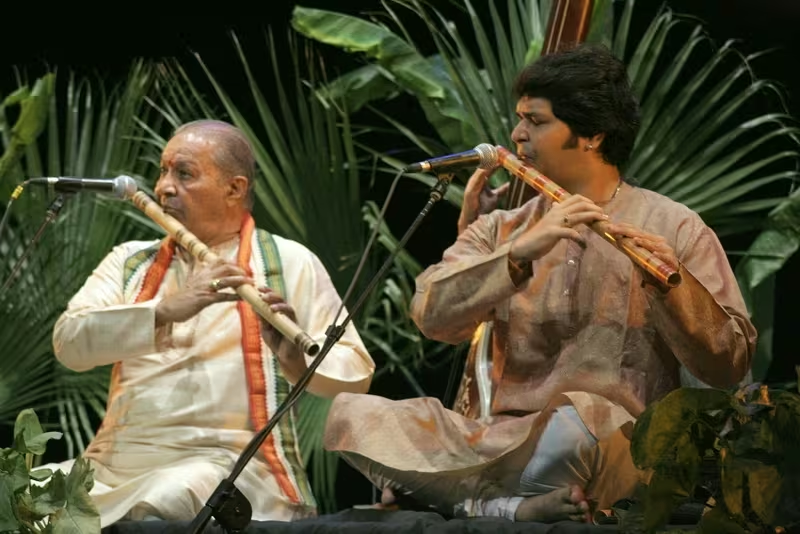
The Wrestler Who Breathed Music: The Story of Hariprasad Chaurasia
In the ancient, spiritual city of Allahabad (now Prayagraj), amidst the dust and din of the akhadas (traditional wrestling schools), a young boy was being groomed for a life of strength and combat. His father, a professional wrestler, saw in him the future of a family legacy built on physical prowess. Yet, within this boy, a different kind of strength was stirring—a silent, secret melody that would one day resonate across the world. This boy was Hariprasad Chaurasia, the man destined to become the undisputed emperor of the bansuri, the humble bamboo flute, and a towering figure in the pantheon of Indian classical music.
Pandit Hariprasad Chaurasia’s story is not just one of musical genius, but of quiet rebellion, unwavering dedication, and the profound transformation of a simple folk instrument into a vessel of sublime classical expression. His journey is a testament to the power of a calling that refuses to be silenced.
Early Life & A Secret Passion
Born on July 1, 1938, Hariprasad’s early life was marked by a stark dichotomy. His mother passed away when he was merely six, leaving him to be raised by a father whose world was defined by the rigorous discipline of wrestling. The young Hariprasad was dutifully enrolled in the local akhada, and for years, he followed the demanding regimen of diet and exercise. He built his body, learned the techniques, and did everything to please his father, but his soul remained untouched by the world of grappling.
His heart was captive to another sound. Secretly, he began his musical education at the age of 15, not with the flute, but with classical vocals. He started learning from his neighbour, Pandit Rajaram, concealing his music books within his wrestling gear and practicing when his father was away. This duality defined his adolescence: a wrestler by day, a musician by night. He lived two lives, one in deference to his father's dream and the other in pursuit of his own.
The true moment of epiphany arrived through the airwaves. Listening to a broadcast on All India Radio, he heard the ethereal notes of the bansuri played by Pandit Bholanath Prasanna of Varanasi. The sound struck him with the force of a revelation. It was fluid, evocative, and seemed to speak a language his soul instinctively understood. In that moment, he knew he had found his instrument. He sought out Pandit Bholanath and began an eight-year-long tutelage, all while maintaining the facade of a dedicated wrestler. He would practice his flute by the banks of the Ganga, letting the river carry his fledgling notes, a world away from the grunts and thuds of the wrestling pit.
The Journey to Mastery: Career and Contributions
In 1957, Chaurasia made his first decisive step away from his prescribed path. He took a job as a staff artist and composer with All India Radio in Cuttack, Odisha. This position provided not only a livelihood but, more importantly, the freedom to immerse himself completely in music. It was here that he began to hone his craft, performing and experimenting, his reputation as a gifted flautist slowly growing.
His career, however, was about to take a profound and transformative turn. After a transfer to Mumbai, he sought out the tutelage of one of the most revered and reclusive figures in Indian classical music: Annapurna Devi. The daughter of the legendary Ustad Allauddin Khan (founder of the Maihar gharana) and a virtuoso of the surbahar, Annapurna Devi had withdrawn from public performance and rarely accepted students. She was known for her uncompromising adherence to the purity and depth of her father’s musical tradition.
Chaurasia’s initial attempts to learn from her were met with refusal. But his persistence was relentless. Finally, she tested his commitment with a daunting challenge. Acknowledging that he was already a proficient and established artist, she told him he would have to unlearn everything he knew to begin anew. To prove his dedication, she demanded he switch from playing right-handed to left-handed. For a flautist, this was akin to learning to walk again. Without hesitation, Hariprasad agreed. This act of complete surrender to the guru convinced Annapurna Devi of his sincerity.
Under her rigorous guidance, Chaurasia’s music underwent a seismic shift. He was initiated into the deepest aspects of the Maihar gharana, learning to imbue his flute with the depth and structure of the dhrupad style and the emotional nuance of the gayaki ang (vocal style). He mastered the art of the long, meditative alap (the introductory, rhythm-free section of a raga), a feat previously thought difficult on the breath-dependent bansuri. He transformed the flute from an instrument of light, pastoral melodies into one capable of profound gravitas and complex classical exposition. He even made physical modifications to the bansuri, adding an eighth hole to expand its lower octave, enabling him to explore the deeper, contemplative notes (mandar saptak) essential for a full raga performance.
The Confluence of Titans: Shiv-Hari and Global Collaborations
While his classical foundation grew stronger, Chaurasia’s creative spirit sought new horizons. In Mumbai, he formed a legendary partnership with another brilliant young instrumentalist, santoor maestro Pandit Shivkumar Sharma. Together, they created a new sound that was both classically rooted and refreshingly modern.
Their 1967 album, Call of the Valley, created with guitarist Brij Bhushan Kabra, was a watershed moment. It was a concept album that musically depicted a day in the life of a Kashmiri shepherd. The album’s blend of classical ragas, folk-inspired melodies, and brilliant orchestration was revolutionary. It became a massive international success, introducing a generation of listeners worldwide to the expressive potential of Indian classical instruments.
This partnership evolved into the celebrated film composer duo, Shiv-Hari. They brought a new level of classical sophistication to mainstream Hindi cinema, composing timeless scores for films directed by Yash Chopra. Their music for Silsila (1981), Faasle (1985), Chandni (1989), Lamhe (1991), and Darr (1993) became iconic. Songs like “Rang Barse” and “Yeh Kahaan Aa Gaye Hum” were chartbusters that seamlessly integrated the sounds of the santoor and bansuri into popular music, making Chaurasia a household name across India.
Pandit Chaurasia was also a pioneer of global music collaboration. He worked with leading Western musicians, including guitarist John McLaughlin and saxophonist Jan Garbarek on the 1987 album Making Music. He collaborated with global giants like violinist Yehudi Menuhin and flautist Jean-Pierre Rampal, proving that the bansuri could hold its own on any world stage. These collaborations were not mere fusion experiments; they were dialogues between musical traditions, where the bansuri spoke its rich, Indian vocabulary with universal eloquence.
Legacy and Enduring Influence
Pandit Hariprasad Chaurasia’s greatest legacy is the singular identity he has given the bansuri. Before him, the bamboo flute was largely a folk instrument or an accompaniment in orchestral settings. He single-handedly elevated it to the status of a premier solo instrument in Hindustani classical music, on par with the sitar and sarod. Today, the sound of the classical bansuri is, for millions, the sound of Hariprasad Chaurasia’s breath.
His contributions have been recognized with India’s highest honors, including the Sangeet Natak Akademi Award (1984), the Padma Bhushan (1992), and the Padma Vibhushan (2000), the nation’s second-highest civilian award. He has also received international accolades, such as being made a Knight in the Order of Arts and Letters (Chevalier de l'Ordre des Arts et des Lettres) by the French government in 2009.
Beyond his personal achievements, Chaurasia has dedicated himself to preserving the future of his art form. Deeply committed to the traditional guru-shishya parampara (master-disciple tradition), he established the Vrindaban Gurukul—first in Mumbai in 1996 and later a larger campus in Bhubaneswar in 2010. In these schools, students live and learn with their guru, absorbing music as a way of life, not just a skill. In a departure from modern institutional norms, students receive their training, food, and lodging free of charge, ensuring that financial constraints never hinder true talent.
Today, Pandit Hariprasad Chaurasia continues to perform and teach, a living legend whose life has been a symphony of dedication. The boy who once hid his musical pursuits from his wrestler father now stands as a global ambassador for Indian culture. His breath, flowing through a simple shaft of bamboo, has produced music that is at once meditative, joyous, melancholic, and deeply spiritual. It is the sound of a wrestler's strength channelled into an artist's soul—a sound that will echo for generations to come.