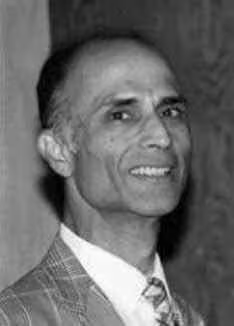
Harish-Chandra: The Architect of Infinite Symmetries
In the grand pantheon of 20th-century science, some figures burn with the explosive brilliance of discovery, while others possess the quiet, formidable power of a tectonic plate, slowly but irrevocably reshaping the very landscape of knowledge. Harish-Chandra (1923-1983) belonged to the latter. An Indian-American mathematician and physicist, he was a solitary genius, an architect who spent a lifetime constructing a magnificent and intricate cathedral of thought: the representation theory of semisimple Lie groups. His work, of staggering depth and technical power, provided the fundamental language for understanding symmetry in its most abstract and infinite forms, becoming an indispensable pillar of modern mathematics and theoretical physics.
Early Life & Background: A Fateful Turn from Physics
Harish-Chandra was born on October 11, 1923, in Kanpur, then part of the United Provinces of British India. His father, Chandrakishore, was a civil engineer, and the young Harish-Chandra grew up in an environment that valued intellectual rigour. He received his early education in Kanpur, eventually enrolling at the University of Allahabad.
It was here that his prodigious talent for the sciences began to shine. He completed his Bachelor of Science in 1941 and went on to pursue a Master of Science in Physics, which he received in 1943. At Allahabad, he was deeply influenced by the distinguished physicist K.S. Krishnan, who recognized his student’s extraordinary aptitude. Upon Krishnan’s recommendation, Harish-Chandra moved to Bangalore to work under the guidance of Homi J. Bhabha, the architect of India’s atomic energy program, at the Indian Institute of Science.
Bhabha, a towering figure in Indian science, saw in Harish-Chandra a future leader in theoretical physics. With Bhabha’s support, he secured a place at the University of Cambridge in 1945 to study for his doctorate under the legendary Paul Dirac, one of the founding fathers of quantum mechanics. It was a dream opportunity for any aspiring physicist. Yet, it was in the hallowed halls of Cambridge that Harish-Chandra’s path took a decisive and unexpected turn.
While working with Dirac, it became apparent that Harish-Chandra's mathematical intuition was as powerful, if not more so, than his physical insight. Dirac himself, known for his economy of words, famously remarked that he felt his student already knew enough physics and perhaps needed no further training. A now-famous anecdote illustrates this turning point. During a lecture by the formidable physicist Wolfgang Pauli, Harish-Chandra, then a young student, politely pointed out a mathematical error in Pauli's work. Pauli, a Nobel laureate not known for suffering fools gladly, was initially dismissive. However, after re-examining his calculations, he had to publicly concede that the young Indian student was correct. The incident was a clear sign that Harish-Chandra’s true calling lay in the pristine, abstract world of pure mathematics.
He completed his PhD in physics in 1947, but by then, his heart and mind were already committed to a new pursuit. He crossed the Atlantic to the United States, arriving at the Institute for Advanced Study (IAS) in Princeton, New Jersey—a veritable Olympus of scientific and mathematical thought, home to Albert Einstein, Hermann Weyl, and Kurt Gödel. It was here, surrounded by the greatest mathematicians of the era, that the physicist Harish-Chandra completed his transformation and emerged as a pure mathematician of unparalleled focus and ambition.
Career & Major Contributions: Building a New World
Harish-Chandra’s life's work was the systematic construction of the representation theory of a class of mathematical objects known as semisimple Lie groups. To the layperson, the term is arcane, but its importance is immense. Lie groups are the mathematical tools for studying continuous symmetry—the kind of symmetry seen in a sphere, which can be rotated in any direction and still look the same. These symmetries are not just geometric curiosities; they are the fundamental language of modern physics, describing everything from the behaviour of subatomic particles to the structure of spacetime.
Before Harish-Chandra, the theory was well-understood for "compact" groups (like the sphere), but the more complex "non-compact" groups remained largely uncharted territory. Understanding their "infinite-dimensional representations"—ways of translating their abstract symmetries into the concrete language of matrices and linear algebra—was a problem of colossal difficulty. This was the challenge Harish-Chandra set for himself.
For nearly four decades, first at Columbia University (1950-1963) and later as a permanent professor at the Institute for Advanced Study (1963-1983), he worked with monastic dedication, often in intellectual isolation, to build this theory from the ground up. His work was not a series of disconnected results but a single, monumental program. His major contributions include:
The Philosophy of Cusp Forms: One of his most profound insights was the concept of "cusp forms." He realized that to understand functions on these complex symmetric spaces, one had to control their behaviour at the boundaries, or "at infinity." This philosophy provided the analytical tools to tame the infinite and became a central organizing principle for the entire subject.
The Plancherel Formula: His crowning achievement was the explicit determination of the Plancherel formula for semisimple Lie groups. This is the analogue of the Fourier transform—a tool that breaks down a complex wave into its simple constituent frequencies—for the world of Lie groups. It allows mathematicians to decompose any reasonable function on the group into its fundamental "irreducible representations." The proof was a tour de force, published in a series of papers spanning hundreds of pages and taking over a decade to complete.
The Harish-Chandra Isomorphism: This foundational result established a deep and surprising connection between the algebraic heart of a Lie group (the center of its universal enveloping algebra) and a much simpler geometric object (the invariant polynomials on a Cartan subalgebra). This bridge between algebra and geometry is now a cornerstone of the field.
His work was characterized by its immense technical power and a deep, unifying vision. He combined techniques from algebra, analysis, and geometry in novel ways, creating a powerful synthesis that became the standard framework for the field. The sheer scale of his undertaking was legendary. He was not merely solving problems; he was creating a new world, complete with its own language, tools, and foundational principles.
Legacy & Influence: A Force of Nature
Harish-Chandra passed away from a heart attack on October 16, 1983, shortly after a walk on the grounds of the Institute for Advanced Study, the place that had been his intellectual home for so much of his life. He left behind a legacy that is as profound as it is enduring.
His work did not just solve a difficult problem; it created a field. Today, the representation theory of semisimple Lie groups is an essential tool in number theory, geometry, and mathematical physics. His most significant influence is arguably as the direct intellectual forefather of the Langlands Program, one of the most important and ambitious grand unified theories in modern mathematics. Robert Langlands, the visionary behind the program, has repeatedly stated that his own work would have been inconceivable without the vast, solid foundation laid by Harish-Chandra.
Colleagues remembered him with a mixture of awe and affection. The mathematician Armand Borel, a close friend, described his working style with a now-famous quote: "Unlike most of us, he was a force of nature, relentlessly, patiently, confidently moving toward his goals... He had a clear view of what he had to do and, with his exceptional powers of concentration, he brought all his energies to bear on it."
Despite his towering stature in the mathematical world, Harish-Chandra remained deeply connected to his Indian roots. He was a Fellow of the Royal Society (1973) and received the Cole Prize from the American Mathematical Society (1954). In 1974, he was awarded the Srinivasa Ramanujan Medal by the Indian National Science Academy, and in 1977, the Government of India honoured him with the Padma Bhushan, one of its highest civilian awards.
Today, his legacy is cemented in the institution that bears his name: the Harish-Chandra Research Institute (HRI) in Prayagraj (formerly Allahabad), a premier centre for research in theoretical physics and mathematics. It stands as a testament to a man who journeyed from the banks of the Ganga to the pinnacle of global science, forever changing the way we understand the fundamental symmetries of our universe.