Harshavardhana: The Sun of Virtue in a Fractured Age
In the twilight of ancient India, as the magnificent edifice of the Gupta Empire lay fragmented, the northern plains were a mosaic of warring kingdoms. Chaos was the new order. From this crucible of conflict arose a figure who would, for a brief but brilliant period, rekindle the flame of imperial unity. He was Harshavardhana of the Pushyabhuti dynasty, a young prince who ascended to a throne of sorrow and, through sheer will and political genius, became the last great emperor of classical North India.
Our knowledge of this remarkable ruler is uniquely rich, drawn not just from stone inscriptions but from two extraordinary literary sources: the Harshacharita, a glowing biography by his court poet Banabhatta, and the detailed travelogue of the Chinese Buddhist monk Xuanzang (Si-Yu-Ki). Together, they paint a portrait of a formidable warrior, a compassionate administrator, and a profound patron of culture, a man Xuanzang called Shiladitya—the Sun of Virtue.
Early Life and a Baptism by Fire
Harshavardhana was born around 590 CE into the ruling Pushyabhuti family of Sthanishvara (modern Thanesar in Haryana). His father, Prabhakaravardhana, was a powerful monarch who had carved out a significant kingdom, earning the title Maharajadhiraja by clashing with neighboring powers and holding back the marauding Hunas on the northwestern frontier. Harsha grew up in a court defined by military readiness, alongside his elder brother, Rajyavardhana, and a beloved sister, Rajyashri.
This world of princely privilege was shattered in 605 CE. As Harsha’s father lay on his deathbed, a series of catastrophic events unfolded with brutal speed. Rajyashri had been married to Grahavarman, the Maukhari king of the powerful and strategic city of Kannauj. This alliance was despised by their rivals. Devagupta, the king of Malwa, formed a treacherous pact with Shashanka, the ambitious and ruthless king of Gauda (in modern Bengal).
Their combined forces stormed Kannauj. Grahavarman was killed, and Rajyashri was captured and thrown into a dungeon. Upon hearing this devastating news, Harsha’s elder brother, Rajyavardhana, who had just become king after their father’s death, immediately marched his army to avenge the atrocity. He successfully defeated the Malwa army, but was then lured into a trap. Shashanka of Gauda, feigning a diplomatic meeting, treacherously assassinated him.
In a matter of weeks, the Pushyabhuti kingdom was in turmoil. It had lost its king, its heir, and its princess. It was at this moment of profound crisis, in 606 CE, that the council of ministers turned to the sixteen-year-old Harsha. Reluctantly, he accepted the crown, inheriting not a kingdom but a quest for vengeance and restoration. His first vow was twofold: to punish the perfidious Shashanka and to rescue his sister, Rajyashri, from an unknown fate.
The Forging of an Empire
Harsha’s reign began not with coronation feasts, but with a military campaign born of grief and duty. His immediate priority was his sister. He learned that Rajyashri had escaped from her prison in Kannauj and, overwhelmed by despair, had fled to the dense forests of the Vindhya mountains to commit sati (self-immolation). Racing against time, Harsha, with the help of local tribal chiefs, found her just as she was about to step into the funeral pyre. He rescued her, and she would remain his constant companion and advisor for the rest of his life.
With his sister safe, Harsha turned his attention to his enemies. He understood that Shashanka was too powerful to be confronted alone. In a masterstroke of diplomacy, he forged an alliance with Bhaskaravarman, the king of Kamarupa (modern Assam), who was a natural enemy of the Gauda kingdom on his western border. This strategic pincer movement placed immense pressure on Shashanka.
Harsha’s military campaigns over the next several years were relentless. He absorbed the Maukhari kingdom of his late brother-in-law, a move that prompted him to shift his capital from the provincial Thanesar to the magnificent, centrally located city of Kannauj on the banks of the Ganges. This act symbolized his new imperial status. Kannauj became the political and cultural heart of North India for centuries to come.
He waged a long and bitter war against Shashanka. While details are scarce, it is clear that by the time of Shashanka's death around 637 CE, Harsha had conquered large parts of his kingdom, including Magadha, and extended his influence over Bengal and Odisha. Xuanzang speaks of Harsha conquering the "five Indies"—a term generally interpreted to mean Punjab, Kannauj, Gauda, Mithila, and Orissa. His empire, at its peak, stretched from the Himalayas in the north to the Narmada River in the south, and from the Punjab in the west to Bengal and Assam in the east.
The Southern Limit: Clash with Pulakeshin II
Harsha's ambition, however, knew no bounds. Having established himself as the undisputed sovereign of the north (Sakalottarapathanatha, or Lord of all of North India), he turned his sights south towards the Deccan, which was ruled by the equally formidable Chalukya Emperor, Pulakeshin II. Sometime around 618-619 CE, Harsha marched his grand army, famed for its thousands of war elephants, to cross the Narmada River.
Here, his triumphant advance met a wall of resistance. In a decisive battle on the banks of the Narmada, Pulakeshin II inflicted a crushing defeat on Harsha's forces. This event is proudly recorded by Pulakeshin in his Aihole inscription, which states that the mighty Harsha, whose “lotus-feet were arrayed with the rays of the jewels of the diadems of hosts of feudatories,” had his harsha (joy) melted away by fear. The defeat was a stunning check on Harsha's power. It established the Narmada as the firm boundary between the two great empires and ensured the political independence of the Deccan for centuries.
Administration, Religion, and Culture
Defeated in the south, Harsha focused on consolidating and governing his vast northern empire. He was not a distant ruler. Xuanzang noted that the emperor spent a great deal of his time on inspection tours throughout his domain, ensuring justice was administered and his officials were not corrupt. The government was organized on feudal lines, with many conquered kings retained as vassals (mahasamantas) who paid tribute and provided military support.
Taxation was reportedly light, with one-sixth of the agricultural produce being the primary source of state revenue. While criminal law was severe, the overall administration was efficient, leading to peace and prosperity within the empire.
A Patron of Faiths
Harshavardhana’s reign was marked by a profound spirit of religious tolerance and patronage. Born into a family of Shaivites, he personally gravitated towards Buddhism later in life, particularly the Mahayana school, influenced by his sister and the teachings of Xuanzang. Yet, he never forsook his ancestral faith. His own inscriptions begin with invocations to Lord Shiva, and his plays celebrate Hindu deities.
His patronage of Buddhism was legendary. He is said to have constructed thousands of stupas and monasteries (viharas), and he banned the slaughter of animals throughout his kingdom. He held two magnificent religious assemblies that showcased his devotion and generosity.
The Kannauj Assembly: Convened to honor Xuanzang, this grand assembly was attended by thousands of Buddhist monks, Brahmins, and Jains, as well as eighteen vassal kings. For days, Xuanzang expounded upon the doctrines of Mahayana Buddhism, and though debates were invited, none could successfully challenge his arguments. The event was a spectacular display of imperial power and religious scholarship.
The Mahamoksha Parishad at Prayaga: Every five years, Harsha held a great festival of charity at the confluence of the Ganga and Yamuna rivers at Prayaga (modern Allahabad). Xuanzang was a guest at the sixth such event in 643 CE. Over 75 days, the emperor systematically emptied the royal treasury, donating immense wealth to Buddhist monks, Hindu Brahmins, Jains, ascetics, and the poor and orphaned from all faiths. On the final day, having given away everything including his personal jewels and robes, he begged his sister Rajyashri for a common cloth to wear. This extraordinary act of ritualized charity demonstrated his detachment from material wealth and his commitment to the welfare of all his subjects, regardless of their creed.
The Emperor as a Scholar
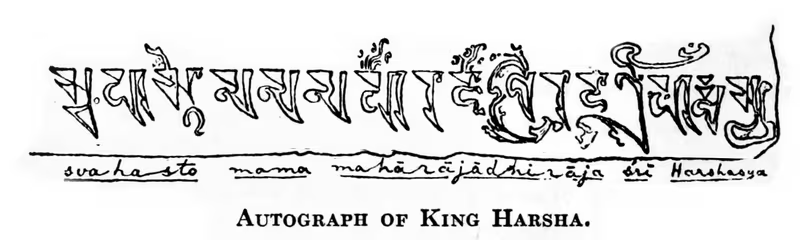
Perhaps Harsha’s most unique quality was that he was not just a patron of literature but a creator of it. He was an accomplished Sanskrit playwright, credited with authoring three celebrated plays: Ratnavali, Priyadarshika, and Nagananda. The first two are charming romantic comedies, while Nagananda is a more profound work with a strong Buddhist theme of self-sacrifice. His court was a hub of learning, famously hosting Banabhatta, one of the greatest prose writers in Sanskrit literature. Under Harsha's stable and prosperous rule, the great university at Nalanda in Bihar reached its zenith, attracting scholars from all over Asia. Harsha endowed it with the revenues of over one hundred villages to support its thousands of students and teachers.
Legacy: The Last Flicker of a Golden Age
Harshavardhana died in 647 CE without a clear heir. His mighty empire, largely held together by his personal charisma and military strength, disintegrated almost immediately. North India once again splintered into a constellation of smaller, competing states, paving the way for the rise of the Rajput clans. The imperial unity he had so painstakingly built was lost.
In this sense, Harsha stands as a pivotal figure in Indian history. He was the last of the great Hindu emperors of the classical era to preside over a truly vast, pan-North Indian empire. His reign was the final, brilliant sunset of an age that began with the Mauryas and Guptas. The political model that followed his death was one of regionalism, a pattern that would define medieval India.
Today, Harshavardhana is remembered as a model king—a military genius who avenged his family and unified a continent, a just administrator who cared for his people, a man of immense culture who wrote plays and fostered learning, and a pious soul who gave away his entire fortune for the benefit of others. His story, a dramatic saga of tragedy, revenge, and imperial glory, remains one of the most compelling chapters in the long and rich history of India.