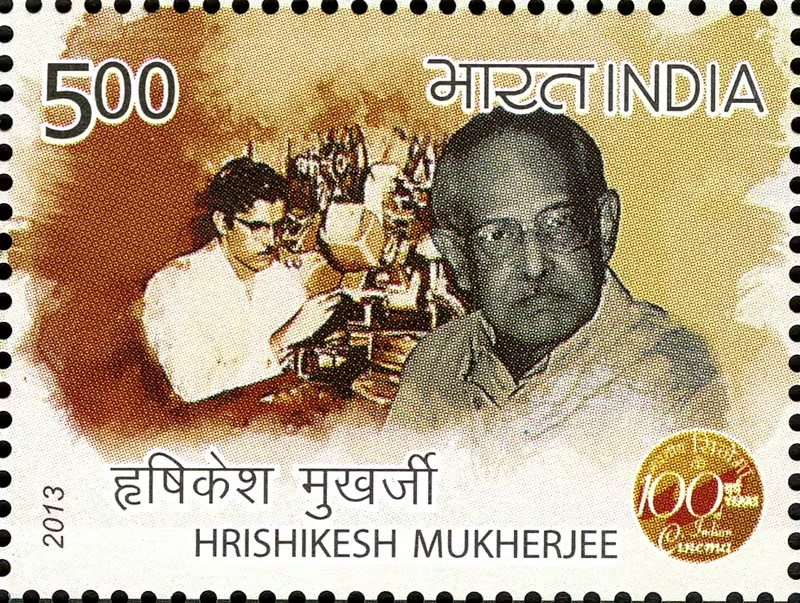
The Master of the Middle Path
In the grand, often bombastic theatre of Hindi cinema, there existed a quiet, compassionate corner where stories were not shouted, but whispered; where heroes were not superheroes, but simple, relatable people navigating the everyday trials and triumphs of life. This was the world of Hrishikesh Mukherjee. Affectionately known throughout the industry as Hrishi-da, he was more than a director; he was a sociologist with a camera, a philosopher of the mundane, and the undisputed pioneer of India’s ‘middle cinema’. His films formed a gentle, yet powerful, bridge between the larger-than-life commercial blockbusters and the stark realism of art-house cinema, creating a cinematic language that spoke directly to the heart of the Indian middle class.
For over four decades, Hrishi-da crafted a universe populated by principled professors, mischievous grandfathers, aspiring singers, and earnest clerks. Through masterpieces like Anand, Chupke Chupke, Gol Maal, and Bawarchi, he taught audiences that the most profound stories were often found in the simplest of moments, and that a film could make you laugh and cry, often in the same scene, without a shred of melodrama.
From Science to Celluloid: The Early Years
Hrishikesh Mukherjee was born on September 30, 1922, in Calcutta (now Kolkata), a city that was then the cultural crucible of India. His early life seemed destined for a path far from the glitz of the film world. A bright student, he graduated with a degree in Chemistry and briefly worked as a teacher of mathematics and science. However, a passion for the arts, particularly photography and chess, hinted at a mind drawn to precision, composition, and strategic storytelling.
This artistic inclination soon led him to the burgeoning film industry. In the late 1940s, he moved to Bombay (now Mumbai) and began his career at the very bottom of the ladder, working as a laboratory assistant before moving into the editing room. His life took a decisive turn when he joined the studio of the legendary filmmaker Bimal Roy. This was no ordinary job; it was the finest apprenticeship a budding filmmaker could ask for. Under Roy’s mentorship, Mukherjee honed his skills as an editor and assistant director on seminal films like the neo-realist classic Do Bigha Zamin (1953) and the tragic romance Devdas (1955).
His work as an editor was particularly formative. It taught him the art of narrative economy—the skill of telling a story with precision, cutting away every ounce of fat to leave only the essential. This editor’s instinct would become a hallmark of his directorial style, where not a single scene or dialogue felt superfluous. The lessons learned in Bimal Roy's school of sensitive, socially-conscious filmmaking laid the foundation for the cinematic edifice he would soon build himself.
Crafting a Cinematic Universe: The Director's Chair
By the mid-1950s, Mukherjee was ready to tell his own stories. His journey as a director was a gradual ascent, marked by a commitment to his unique vision.
A Quiet Debut
In 1957, Hrishikesh Mukherjee made his directorial debut with Musafir. The film was a bold experiment, structured as a triptych of stories featuring different families—a newly married couple, a family in crisis, and an old man facing death—all linked by the house they inhabit. While it was not a commercial blockbuster, the film, starring Dilip Kumar, Suchitra Sen, and Kishore Kumar, was critically acclaimed and showcased the director's penchant for exploring the entire spectrum of human life.
His commercial breakthrough came two years later with Anari (1959). Starring Raj Kapoor and Nutan, the film was a heartwarming tale of an honest, simple man navigating a world of deceit. It was a resounding success and established the quintessential Mukherjee template: a simple plot, strong moral undertones, memorable music, and a deep-seated humanism. He had found his voice.
The Golden Decade (1970s)
The 1970s were the zenith of Hrishikesh Mukherjee's career. While Hindi cinema was being defined by the angry-young-man persona and multi-starrer action films, Hrishi-da carved out his own niche, delivering hit after hit that celebrated the opposite: gentleness, humour, and introspection.
The Philosophy of Life and Death: Anand Perhaps no film better encapsulates the soul of Hrishikesh Mukherjee's cinema than Anand (1971). The story of a terminally ill man who decides to live his remaining months to the fullest, spreading joy to everyone he meets, is a masterclass in filmmaking. He took the reigning superstar, Rajesh Khanna, and stripped him of all heroic pretense, casting him as the vulnerable, talkative, and utterly unforgettable Anand. Opposite him was a brooding, serious Amitabh Bachchan as Dr. Bhaskar. The film’s dialogues, penned by Gulzar, became iconic, and its profound message—"Babumoshai, zindagi badi honi chahiye, lambi nahin" (Life should be grand, not long)—resonated deeply with the nation. Anand was not a story about dying; it was a profound celebration of living.
Deconstructing Stardom Hrishi-da had a unique ability to work with the biggest stars of the day and present them as ordinary, flawed human beings. In Guddi (1971), he cast a young Jaya Bhaduri as a star-struck teenager and used the film to gently demystify the larger-than-life world of cinema. He brought real-life stars like Dharmendra, Dilip Kumar, and Rajesh Khanna on screen as themselves, showing the hard work behind the glamour.
He frequently collaborated with Amitabh Bachchan and Rajesh Khanna, often in two-hero films like Namak Haraam (1973), which explored complex themes of friendship and class conflict. In Abhimaan (1973), he brilliantly depicted the corrosion of a marriage by professional jealousy, drawing powerful performances from Amitabh and Jaya Bachchan.
The Comedy of Manners While he could masterfully handle tragedy, Hrishikesh Mukherjee was also the king of sophisticated, situational comedy. His comedies were not based on slapstick but on clever writing, mistaken identities, and the charming quirks of middle-class families. Bawarchi (1972) saw Rajesh Khanna as a multi-talented cook who mends a dysfunctional family. Chupke Chupke (1975) was a sublime comedy of errors featuring a stellar cast led by Dharmendra, Sharmila Tagore, Amitabh Bachchan, and Jaya Bachchan. The film’s humour stemmed from its witty wordplay around pure and colloquial Hindi.
And then there was Gol Maal (1979), arguably one of the greatest comedies in Indian cinema. It featured the quintessential Mukherjee hero, the common man, played to perfection by Amol Palekar. As Ramprasad Dashrathprasad Sharma, a simple man who has to invent a flamboyant, moustache-less twin to keep his job, Palekar became the face of the middle-class struggle, with a comedic twist. These films were clean, intelligent, and could be enjoyed by the entire family—a rarity then, and even more so now.
The Hrishi-da Touch: A Signature Style
What made a Hrishikesh Mukherjee film so distinct? It was a combination of subtle, yet powerful, directorial choices.
- The Editor's Eye: His background as an editor was his greatest strength. His films were tightly paced, with no wasted frames. He believed in telling his story efficiently and moving on, a discipline that kept his narratives engaging and crisp.
- Simplicity as Strength: Mukherjee’s canvas was small, but his emotional palette was vast. He eschewed lavish outdoor locations and extravagant sets, preferring the familiar confines of a middle-class home. This focus on intimate spaces allowed the characters and their relationships to take center stage. The hero of his film was always the story.
- Music as Narrative: Music was never an interruption in a Hrishi-da film; it was an extension of the narrative. The songs, often composed by maestros like S.D. Burman or R.D. Burman with lyrics by giants like Gulzar and Anand Bakshi, were seamlessly woven into the plot. Think of "Kahin Door Jab Din Dhal Jaye" from Anand or "Tere Mere Milan Ki Yeh Raina" from Abhimaan—these were not just songs, but expressions of the characters' deepest emotions.
- Strong Female Characters: In an era often dominated by passive heroines, Mukherjee wrote women of substance. Whether it was the quiet dignity of Sharmila Tagore in Anupama (1966), the bubbly confidence of Jaya Bhaduri in Guddi, or the playful rebellion of Rekha in Khubsoorat (1980), his female characters had agency, intelligence, and their own distinct identities.
Beyond the Director's Lens
Mukherjee's contribution to Indian cinema extended beyond his own films. He served as the chairman of the Central Board of Film Certification (CBFC) and the National Film Development Corporation (NFDC). In these roles, he championed meaningful cinema and worked to create a healthier ecosystem for filmmakers.
He was also a generous mentor to many, including Gulzar, who started his directorial career with Mere Apne (1971), a film produced by Mukherjee. His sets were known to be disciplined yet relaxed, and he was universally respected for his integrity and humility.
An Enduring Legacy: The Man Who Made Us Smile and Cry
Hrishikesh Mukherjee directed his last film, Jhooth Bole Kauwa Kaate, in 1998. In his later years, he suffered from severe kidney ailments and passed away on August 27, 2006, leaving behind an unparalleled legacy. His work was recognized with the highest honours in Indian cinema and the nation. He was awarded the Dadasaheb Phalke Award in 1999 and the Padma Vibhushan, India's second-highest civilian honour, in 2001.
But his true legacy lies not in awards, but in the timelessness of his films. In an industry obsessed with trends, Hrishi-da's work remains eternally relevant. His stories about family, friendship, integrity, and the simple joys of life continue to resonate with new generations of viewers. He proved that you don't need a massive budget or a convoluted plot to make a great film; all you need is a heart.
Hrishikesh Mukherjee was the quiet revolutionary of Hindi cinema. He didn't just make films; he held up a mirror to a society, and in it, we saw the best version of ourselves. He made us laugh with his comedies, weep with his tragedies, and in the end, left us with a profound sense of hope and humanity.