The Architect of an Empire: Shams ud-Din Iltutmish
In the grand tapestry of Indian history, some figures are conquerors, flashing across the subcontinent like brilliant, ephemeral comets. Others are builders, painstakingly laying the foundations upon which empires are built. Shams ud-Din Iltutmish (c. 1176 - 1236 CE) was unequivocally the latter. While Qutb-ud-din Aibak established a Turkic foothold in Delhi, it was his successor and son-in-law, Iltutmish, who transformed a precarious military occupation into a durable, institutionalized empire. Through shrewd diplomacy, relentless military campaigning, and visionary administrative reforms, he cemented the foundations of the Delhi Sultanate, earning his title as its true founder.
Early Life & Ascent from Slavery
Born in the Ilbari tribe of Turkestan, Iltutmish's early life reads like a tale of tragic romance, a common motif in the chronicles of Mamluk (slave) rulers. He was said to be handsome, intelligent, and the favorite son of his father, a tribal chieftain. This favoritism ignited a fire of jealousy in his brothers, who, in a story reminiscent of the biblical Joseph, tricked him and sold him to a slave merchant.
His journey as a slave took him through Bukhara and Ghazni. His remarkable intellect and noble bearing were so evident that the Ghurid Sultan, Muhammad of Ghor, heard of him and forbade his sale in the city. Eventually, Qutb-ud-din Aibak, then the Ghurid viceroy in India, sought permission to purchase him. In 1197, Iltutmish was finally brought to Delhi and purchased for the then-exorbitant sum of 100,000 jitals.
Aibak immediately recognized the young man's potential. Iltutmish was not treated as a mere slave but as a protégé. He rose swiftly through the ranks, first appointed as Sar-Jandar (chief of the royal bodyguards) and later granted the governorship (iqta) of Gwalior and then Badaun, one of the most important fiefs in the nascent Sultanate.
His moment of ultimate recognition came during the campaign against the rebellious Khokhar tribes in Punjab in 1205-1206. Iltutmish fought with such ferocity and strategic skill that he caught the eye of Muhammad of Ghor himself. The Sultan was so impressed that, in a highly unusual act, he ordered Aibak to manumit Iltutmish, granting him his freedom even before his own master, Aibak, had been formally freed. This act elevated Iltutmish's status immensely among the Turkic nobility.
The Throne of Thorns: Consolidation of Power
In 1210 CE, Qutb-ud-din Aibak died in a polo accident in Lahore. The Turkic nobles hastily placed his son, Aram Shah, on the throne. But Aram Shah proved to be weak and incompetent, and the fragile Sultanate began to fracture. Sensing disaster, a faction of nobles in Delhi invited Iltutmish, the capable governor of Badaun, to assume control.
Iltutmish marched on Delhi, defeated Aram Shah's forces, and ascended the throne in 1211. But the crown he inherited was a crown of thorns. The Sultanate was in disarray:
- Taj al-Din Yildiz, the Ghurid ruler of Ghazni, asserted his suzerainty over Delhi, viewing it as a vassal state.
- Nasir-ud-din Qabacha, the ambitious governor of Multan and Uch, had declared independence and seized Lahore.
- Ali Mardan Khalji had broken away, establishing an independent sultanate in Bengal and Bihar.
- Powerful Rajput kingdoms like Ranthambore and Gwalior, subdued by Aibak, had reasserted their independence.
Iltutmish’s reign was, therefore, a relentless struggle for survival and consolidation. He spent the first decade systematically eliminating his rivals. In 1216, he decisively defeated and captured Yildiz at the Third Battle of Tarain—the same battlefield that had sealed Turkic dominance a generation earlier. This victory was monumental; it severed the final political link between Delhi and Ghazni, establishing the Delhi Sultanate as a fully independent and sovereign entity.
He then turned his attention to Qabacha, pushing him out of Punjab and eventually cornering him in his fortress at Bhakkar on the Indus River. In 1228, facing certain defeat, Qabacha drowned himself in the river, leaving Sindh and Multan to be annexed by Iltutmish. The reconquest of Bengal required several expeditions, but by the late 1220s, it too was brought back under Delhi's authority.
The Mongol Storm and a Diplomatic Masterstroke
Perhaps Iltutmish's most critical and far-sighted contribution was his handling of the Mongol threat. In the early 1220s, the Mongol hordes under Genghis Khan had swept across Central Asia, annihilating the powerful Khwarazmian Empire. The last Khwarazmian Shah, Jalal ad-Din Mingburnu, fled towards India with the Mongol army in hot pursuit.
In 1221, Jalal ad-Din reached the banks of the Indus, crossed into Punjab, and sent an envoy to Iltutmish seeking asylum and aid against the Mongols. Iltutmish was faced with a terrifying dilemma. To grant asylum would be to invite the wrath of Genghis Khan, an unstoppable force that had already laid waste to great empires. The fledgling Delhi Sultanate stood no chance against a full-scale Mongol invasion.
In a moment of brilliant diplomatic acumen, Iltutmish sent a polite but firm refusal. He claimed, with thinly veiled pretext, that the climate of Delhi would not suit the visiting Shah. He offered no aid and kept his armies away from the conflict. Frustrated, Jalal ad-Din lingered in Punjab for a time before departing for Persia. Genghis Khan, who had been pursuing him, saw no reason to cross the Indus and engage a neutral power. He turned back from the river's edge, and India was saved.
This single act of political pragmatism preserved the Delhi Sultanate from the cataclysmic destruction that befell Persia and Central Asia. It allowed the Sultanate to mature in relative peace, becoming a sanctuary for scholars, artisans, and nobles fleeing the Mongol terror, which in turn enriched its culture and administration.
The Architect of a State: Administrative & Monetary Reforms
With his rivals vanquished and the external threat neutralized, Iltutmish focused on building the institutional framework of the state. His reforms were foundational and shaped the Sultanate for the rest of its existence.
1. The Iqta System: Iltutmish institutionalized the Iqtadari system. An iqta was a grant of land revenue from a territory, assigned to nobles and military commanders in lieu of a cash salary. The holder, or Iqtadar, was responsible for maintaining law and order and supplying a quota of troops to the Sultan when required. This system integrated the nobility into the state's military and financial structure, enabling centralized control over a vast territory.
2. The Turkan-i-Chihalgani: He created a new ruling class, a powerful corps of forty loyal Turkic slaves known as the Turkan-i-Chihalgani or "The Forty." These men, personally loyal to him, were appointed to the highest military and administrative posts, forming the backbone of his government. While they were a source of strength during his reign, their immense power and ambition would later make them formidable kingmakers, leading to decades of instability after his death.
3. Standardized Coinage: Before Iltutmish, the currency in North India was a chaotic mix of old Hindu coins and Ghurid bullion. Iltutmish introduced the first standardized currency of the Sultanate, which became the basis for coinage for centuries. He minted a pure silver coin, the tanka, weighing approximately 175 grains, and a copper coin, the jital. This uniform and reliable currency facilitated trade and commerce, unifying the empire economically.
4. Capital and Legitimacy: He officially made Delhi the capital of the Sultanate, shifting the center of power from Lahore. He beautified the city with magnificent architecture, establishing it as the imperial heart of Muslim rule in India. In 1229, he achieved a major political coup by receiving a robe of honor and a formal letter of investiture from the Abbasid Caliph of Baghdad. This recognition, though symbolic (the Caliphate was a shadow of its former self), granted him immense religious and political legitimacy. He was now the Sultan-i-Azam (Great Sultan), the legally recognized sovereign of India in the eyes of the Islamic world.
Patron of Art and Architecture
Iltutmish was not just a soldier and statesman; he was also a great builder. His architectural legacy is a testament to the fusion of Persian and Indian artistic traditions that defined the Sultanate style.
- Qutb Minar: He completed the iconic Qutb Minar, which had been started by his predecessor, adding three storeys to Aibak's first. The Minar became a symbol of Turkic power and Islamic victory.
- Sultan Ghari: When his eldest son and heir apparent, Nasir-ud-din Mahmud, died unexpectedly in 1229, a grief-stricken Iltutmish built a tomb for him in 1231. Known as Sultan Ghari (Sultan of the Cave), it is considered the first Islamic mausoleum in Delhi. Its unique fortress-like structure and octagonal chamber are remarkable architectural features.
- Hauz-i-Shamsi: He commissioned a large water reservoir in Mehrauli to supply water to the city's inhabitants, an essential piece of public infrastructure.
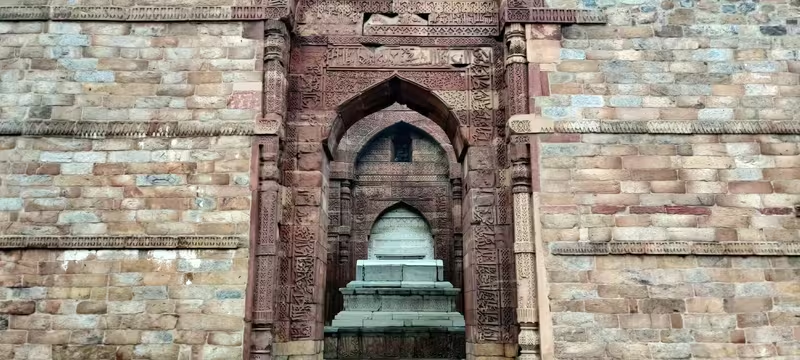
- Tomb of Iltutmish: Located within the Qutb complex, his own tomb, built in 1235, is a masterpiece of early Indo-Islamic architecture. Though its dome has long since collapsed, the interior is covered in exquisite geometric and arabesque carvings, and it features the first use of the squinch arch in India to support a dome.
Legacy and Final Years
After a long and successful reign, Iltutmish fell ill during a campaign in 1236 and returned to Delhi, where he passed away. His legacy is immense and multifaceted.
He had transformed a fragile kingdom into a mighty empire. He gave it a capital, a sovereign status, a monarchical form of government, a standardized currency, and a powerful governing class. He saved it from internal disintegration and external annihilation.
In a move that demonstrated his remarkable foresight and disregard for convention, Iltutmish nominated his daughter, Razia, as his heir. He deemed his surviving sons to be pleasure-seeking and unfit to rule, while Razia had proven her administrative capabilities. This was an exceptionally progressive decision for the 13th century. Though the nobles initially placed her brother on the throne, they were forced to concede to Iltutmish's choice, and Razia Sultana would go on to become the first and only female Muslim ruler of the Delhi Sultanate.
Shams ud-Din Iltutmish was more than just a sultan; he was the true architect of the Delhi Sultanate. He inherited a house of bricks and left behind an empire of marble—an empire with a robust administrative structure, a stable economy, and the resilience to endure for over three hundred years. He was the consolidator who ensured that the Turkic conquest of India was not a fleeting episode but the beginning of a new, epochal chapter in the subcontinent's history.