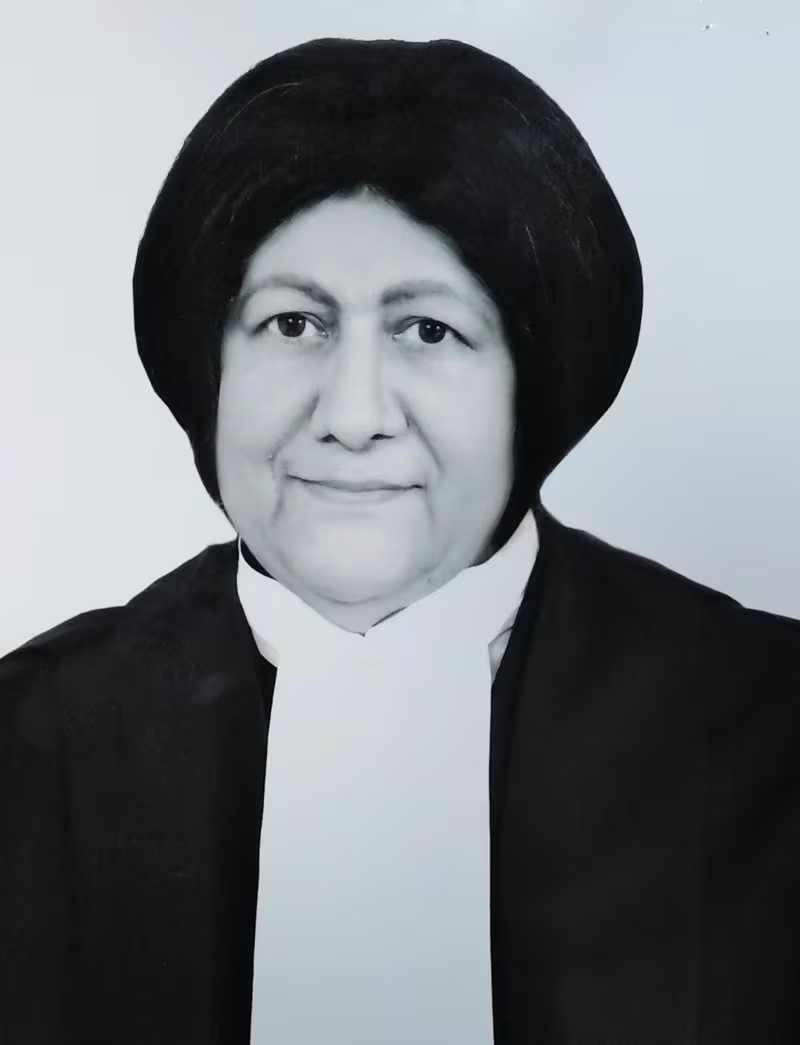
Indira Banerjee: A Beacon of Justice on India's Highest Bench
In the hallowed halls of the Supreme Court of India, where the destiny of a nation is often debated and decided, the presence of certain figures marks a turning point in history. Justice Indira Banerjee was one such figure. Ascending to the apex court on August 7, 2018, she became only the eighth woman to be appointed as a Supreme Court judge, a quiet but powerful testament to a journey defined by intellect, perseverance, and an unwavering commitment to the rule of law. Her four-year tenure on the highest bench was the culmination of a distinguished career that spanned over three decades, leaving an indelible mark on Indian jurisprudence.
Early Life & A Foundation in Law
Indira Banerjee was born on September 24, 1957, in Calcutta (now Kolkata), a city then throbbing with intellectual and cultural fervour. The seeds of her legal future were sown in her own home. Her father, the late Aninda Kumar Banerjee, was a highly respected civil lawyer and a designated senior advocate in the Calcutta High Court. Growing up in an environment where legal principles and courtroom debates were part of the daily discourse undoubtedly shaped her young mind, instilling in her a deep respect for the law and its practice.
Her formal education was a testament to academic excellence. She attended the prestigious Loreto House in Kolkata, known for its rigorous curriculum and emphasis on holistic development. Following her schooling, she pursued a bachelor's degree at the historic Presidency College (now Presidency University), an institution that has nurtured some of India's finest minds. It was here, amidst the vibrant intellectual climate of one of the country's premier colleges, that she further honed her analytical skills and critical thinking.
With a clear ambition, she enrolled in the College of Law at Calcutta University to study for her LL.B. degree. The university's law faculty, with its long and storied tradition, provided her with the robust legal grounding that would become the bedrock of her future career. These formative years in Kolkata were not just about academic learning; they were about absorbing the city's spirit of inquiry and its deep-seated respect for justice and constitutional values.
A Distinguished Career in Law and Judiciary
The Making of a Lawyer (1985-2002)
On July 5, 1985, Indira Banerjee enrolled as an advocate, formally beginning her journey in the legal profession. She started her practice at the Calcutta High Court, the very institution where her father had made his name. For seventeen years, she navigated the complexities of the bar, handling a wide and diverse range of cases. Her expertise spanned civil, constitutional, company, labour, and appellate law, showcasing a remarkable versatility and a deep understanding of multiple legal domains. She quickly earned a reputation as a meticulous, well-prepared, and formidable counsel, respected by both her peers and the judges before whom she appeared.
Ascension to the Bench (2002-2018)
Her profound legal acumen and unwavering integrity did not go unnoticed. On February 5, 2002, her career took a pivotal turn when she was elevated to the bench as a permanent judge of the Calcutta High Court. For the next fourteen years, she served with distinction, authoring numerous significant judgments and earning a reputation for her patient hearings, sharp legal reasoning, and compassionate approach.
In August 2016, she was transferred to the Delhi High Court, one of the most prominent and high-profile courts in the country. This move was a recognition of her judicial capabilities and experience. Her tenure in Delhi, though brief, further solidified her standing as a senior and respected jurist.
Her career reached a new pinnacle on April 5, 2017, when she was appointed the Chief Justice of the Madras High Court. This was a historic appointment, making her only the second woman to head this chartered high court, one of the oldest in India. As Chief Justice, she was not only a judge but also the chief administrator of the state's judiciary. During her tenure, she presided over several sensitive and complex cases. Notably, she handled the public interest litigations concerning the anti-Sterlite protests in Thoothukudi, where she skillfully balanced the citizens' right to peaceful protest with the state's duty to maintain law and order. Her leadership during this period was marked by a firm yet fair judicial temperament.
A Historic Chapter at the Supreme Court (2018-2022)
On August 7, 2018, Justice Banerjee took her oath as a judge of the Supreme Court of India. Her elevation was a landmark moment for gender representation in the higher judiciary. She was sworn in alongside Justices Vineet Saran and K.M. Joseph, and her appointment meant that for the first time in its history, the Supreme Court had three sitting women judges simultaneously, the others being Justices R. Banumathi and Indu Malhotra.
During her four-year term, Justice Banerjee was part of several constitution benches and delivered judgments that have had a lasting impact on Indian law. Some of her most significant contributions include:
The Sabarimala Dissent: Perhaps her most widely discussed judicial opinion was her dissenting verdict in the Sabarimala review case (2019). The original 2018 judgment had permitted women of all ages to enter the temple. Justice Banerjee, the lone woman on the five-judge bench hearing the review petitions, authored a powerful dissent. She argued for judicial restraint in matters of deeply held religious beliefs, stating that the court should not ordinarily interfere with faith and worship. Her opinion emphasized that what constitutes an essential religious practice is for the religious community to decide, and it is not for the court to determine the logic or rationality of a belief. This nuanced dissent sparked a national conversation on the delicate balance between constitutional morality and religious freedom.
Rights of a Daughter-in-Law: In the landmark case of Satish Chander Ahuja v. Sneha Ahuja (2020), she was part of a three-judge bench that delivered a progressive verdict strengthening the rights of women under the Protection of Women from Domestic Violence Act, 2005. The bench held that a wife is entitled to claim the right of residence in a "shared household," even if the house is owned by her in-laws, provided the couple lived there with some permanence. This judgment provided crucial protection to women facing domestic disputes.
Clarifying Evidence Law: In Pattu Rajan v. The State of Tamil Nadu (2019), Justice Banerjee authored a key judgment that clarified the law on the admissibility of evidence recovered based on a disclosure statement made by an accused in custody under Section 27 of the Indian Evidence Act. Her lucidly written verdict laid down clear principles for trial courts to follow, ensuring that the rights of the accused were protected while allowing for effective investigation.
The Central Vista Project: She was part of the 2:1 majority in Rajeev Suri v. Delhi Development Authority (2021) that upheld the environmental clearance and notifications for the ambitious Central Vista project in New Delhi. The majority opinion found no infirmity in the grant of approvals for the project.
Justice Banerjee's judgments were consistently marked by their clarity, thoroughness, and deep grounding in legal principles. She retired from the Supreme Court on September 23, 2022, leaving behind a rich legacy of jurisprudence.
Legacy & Influence
Justice Indira Banerjee's legacy is multifaceted. Foremost, she stands as a powerful symbol of women's advancement in the legal profession. Her journey from a first-generation judge to the highest court in the land has inspired countless young women to pursue a career in law. Her presence on the Supreme Court bench, particularly as part of the historic trio of women judges, was a significant step towards a more inclusive and representative judiciary.
Her judicial philosophy was that of a pragmatist, deeply rooted in constitutionalism. She was not an ideologue but a jurist who decided cases based on a careful application of law to the facts before her. Her Sabarimala dissent showcased a belief in judicial restraint and a profound respect for India's pluralistic fabric. Conversely, her judgments in family and criminal law demonstrated a deep-seated empathy and a commitment to protecting the rights of the vulnerable.
Colleagues at the bar and on the bench remember her for her grace, dignity, and calm demeanor. In his farewell address, then Chief Justice of India U.U. Lalit praised her as a "jewel" and highlighted her contributions, noting that she was always well-prepared and her presence enriched every bench she was a part of.
Justice Indira Banerjee's life and career serve as a testament to the power of quiet dedication and intellectual rigour. She did not seek the limelight, but her work spoke volumes. She navigated a male-dominated profession with poise and brilliance, breaking barriers not with grand pronouncements but with the sheer force of her intellect and the integrity of her character. In the annals of Indian history, she will be remembered as a trailblazing jurist, a role model for future generations, and a judge who served the cause of justice with unwavering conviction and grace.