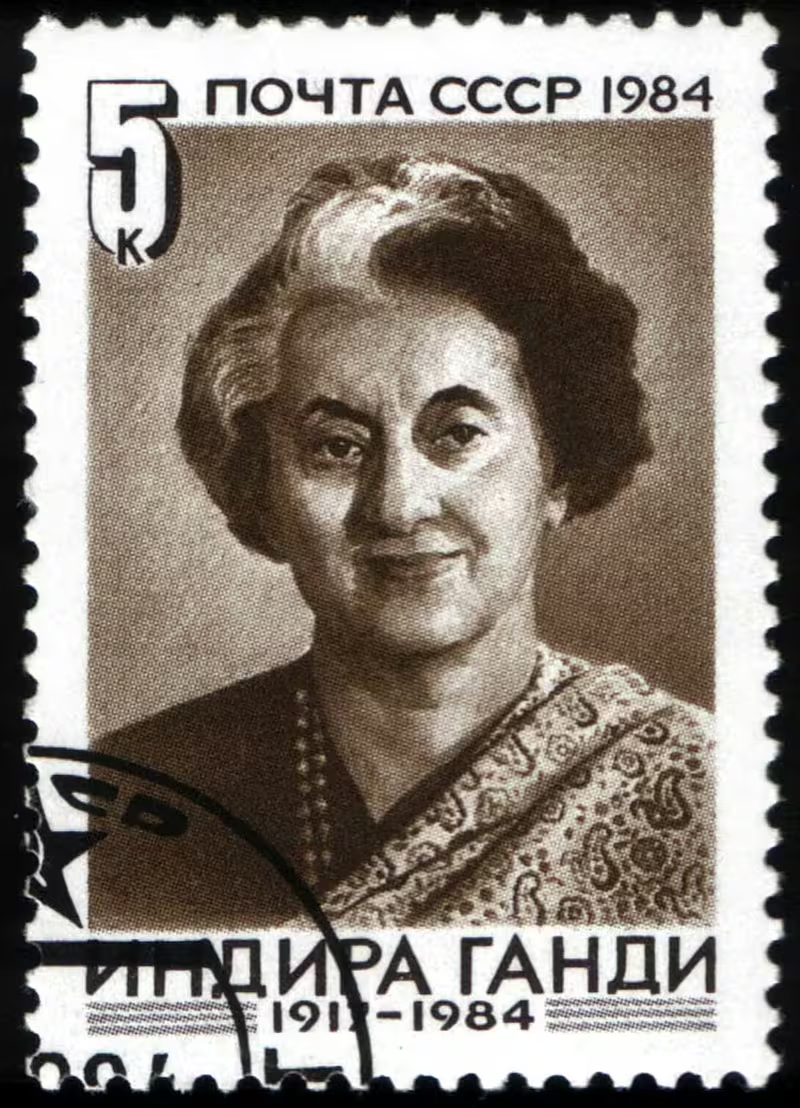
A Legacy of Power and Paradox
Indira Priyadarshini Gandhi was not merely a prime minister; she was a phenomenon. For nearly two decades, she dominated India's political landscape with an authority that was both revered and feared. As the nation's first and, to date, only female Prime Minister, she was a figure of immense strength, a shrewd political strategist who commanded the world stage. Yet, her legacy is a complex tapestry woven with threads of brilliant triumphs and dark transgressions, of populist charisma and authoritarian control. She was hailed as a goddess, 'Durga', for leading India to a decisive military victory, and condemned as a dictator for suspending democracy itself. To understand Indira Gandhi is to understand the turbulent, formative decades of modern India—a nation she shaped profoundly, for better and for worse.
Early Life & Background
Born on November 19, 1917, in Allahabad, Indira Priyadarshini Nehru was a child of the Indian independence movement. Her home, Anand Bhavan, was not just a residence but the nerve centre of the Indian National Congress. Her grandfather, Motilal Nehru, was a prominent nationalist leader, and her father, Jawaharlal Nehru, was Mahatma Gandhi's chosen heir and India's future first Prime Minister. Politics was the air she breathed.
Her childhood was marked by a profound sense of loneliness and upheaval. Her father was frequently imprisoned by the British, and her mother, Kamala Nehru, battled chronic illness, eventually succumbing to tuberculosis in 1936. Letters from a jail cell were often her primary mode of communication with her father. This isolating upbringing forged in her a steely resilience and a self-contained nature. From a young age, she displayed a nascent political consciousness. A famous anecdote tells of a young Indira, inspired by the story of Joan of Arc, organizing local children into the 'Vanar Sena' (Monkey Brigade) to run errands, carry messages, and make flags for Congress party workers, playing her small part in the freedom struggle.
Her formal education was fragmented, punctuated by political turmoil and ill health. She attended schools in India, including Visva-Bharati University in Shantiniketan, and later in Switzerland, before enrolling at Somerville College, Oxford. While her academic record was undistinguished, her time in Europe provided her with a broad, international perspective, exposing her to the currents of global politics on the eve of the Second World War. It was during this period that she grew close to Feroze Gandhi (no relation to Mahatma Gandhi), a fellow Indian student and youth activist whom she would marry in 1942, against her father's initial reservations.
Career & Major Contributions
The Political Apprenticeship
After India gained independence in 1947 and her father became Prime Minister, Indira Gandhi assumed the role of his official hostess and close confidante. This was her de facto political apprenticeship. She managed Nehru's household, accompanied him on state visits across the globe, and met with world leaders like John F. Kennedy, Gamal Abdel Nasser, and Nikita Khrushchev. She observed the machinations of power and diplomacy from the inside, developing a keen understanding of both domestic and international politics. In 1959, she was elected President of the Indian National Congress, a significant step that marked her emergence as a political figure in her own right. Following her father's death in 1964, she joined Prime Minister Lal Bahadur Shastri's cabinet as the Minister of Information and Broadcasting.
The Accidental Prime Minister
When Shastri died suddenly in January 1966, the powerful syndicate of Congress party bosses, led by K. Kamaraj, chose Indira Gandhi as his successor. They saw her as a charismatic, nationally recognized figure who, they believed, would be a malleable puppet—a gungi gudiya (dumb doll), as one opponent called her. It was one of the greatest miscalculations in Indian political history. Upon becoming Prime Minister, she moved swiftly to consolidate her power.
Her early years were challenging. She faced internal dissent, a food crisis, and a difficult 1967 general election where the Congress party's majority was significantly reduced. However, these challenges only hardened her resolve. The defining moment of her rise came in 1969. In a direct challenge to the party syndicate, she supported V.V. Giri for President against the official Congress candidate. When Giri won, the party bosses expelled her, but the majority of Congress MPs sided with her. The party split, and her faction, the Congress (R), became the new centre of power. She had outmaneuvered the old guard and established her undisputed authority.
The Zenith: 'Garibi Hatao' and the Birth of Bangladesh
Freed from the constraints of the syndicate, Indira Gandhi embraced a populist, left-leaning platform. In 1969, she nationalized 14 of India's largest banks and, in 1971, abolished the Privy Purse—a payment guaranteed to the erstwhile rulers of princely states. These moves were immensely popular, cementing her image as a champion of the poor and a foe of the privileged. She went into the 1971 general elections with a powerful and simple slogan: Garibi Hatao (Abolish Poverty).
The result was a landslide victory. Later that year, she would face her greatest foreign policy test. As millions of refugees fled from a brutal military crackdown in East Pakistan into India, she acted with decisive resolve. After securing diplomatic support through the Indo-Soviet Treaty of Friendship and Cooperation, she ordered the Indian military to intervene. The ensuing Indo-Pakistani War of 1971 lasted just 13 days and resulted in a resounding victory for India and the creation of the independent nation of Bangladesh. Indira Gandhi's popularity soared to unprecedented heights. Her rival, Atal Bihari Vajpayee, famously likened her to the goddess Durga.
Her triumphs continued. In May 1974, India conducted its first successful nuclear test in Pokhran, Rajasthan, codenamed "Smiling Buddha." The test stunned the world and established India as a nuclear power, a source of immense national pride.
The Emergency: India's Democratic Abyss
By the mid-1970s, the sheen had begun to wear off. The 1973 global oil crisis triggered rampant inflation and economic stagnation in India. Widespread public discontent grew, fueled by accusations of corruption. Veteran socialist leader Jayaprakash Narayan (JP) launched a massive student-led movement for a "Total Revolution," challenging her authority directly.
The final blow came on June 12, 1975. The Allahabad High Court found her guilty of electoral malpractice during the 1971 election and declared her election to Parliament void. She was barred from holding office for six years. Facing calls for her resignation and a political crisis, Indira Gandhi made a fateful decision. On the night of June 25, 1975, she advised President Fakhruddin Ali Ahmed to declare a state of internal emergency, citing threats to national security.
For the next 21 months, India's democracy was suspended. Fundamental rights were curtailed, the press was heavily censored, and thousands of political opponents, journalists, and activists were arrested without trial. The period was notorious for the excesses committed by a coterie of advisors, most notably her younger son, Sanjay Gandhi, who wielded immense extraconstitutional power and spearheaded a brutal forced sterilization campaign. It remains the darkest chapter in India's post-independence history.
Defeat, Return, and a Tragic End
In a move that continues to puzzle historians, Indira Gandhi unexpectedly called for elections in March 1977. The Indian electorate, in a powerful reassertion of its democratic values, handed her and the Congress party a crushing defeat. The opposition Janata Party, a motley coalition of her former rivals, swept to power.
Her time in the political wilderness, however, was brief. The Janata government was plagued by internal squabbles and proved incapable of effective governance. Indira Gandhi, meanwhile, skillfully recast herself as a victim and a protector of the people. When the government collapsed in 1979, she stormed back to power in the 1980 elections with a commanding majority. The people had chosen her strong, decisive leadership over the chaos of the Janata experiment.
Her final term was overshadowed by personal tragedy and a growing crisis in the state of Punjab. In June 1980, her son and chosen political heir, Sanjay, was killed in a plane crash. A grieving Indira reluctantly persuaded her elder son, Rajiv, a commercial pilot with no interest in politics, to join her.
Simultaneously, a violent secessionist movement for an independent Sikh state, Khalistan, was gaining ground in Punjab, led by the militant preacher Jarnail Singh Bhindranwale. His armed followers fortified the Akal Takht, the temporal seat of Sikh authority, within the sacred Golden Temple complex in Amritsar. After negotiations failed, in June 1984, Indira Gandhi ordered the Indian Army to storm the temple in what was codenamed Operation Blue Star. The operation succeeded in clearing the militants, but it resulted in heavy casualties and caused grievous damage to the holy shrine, deeply wounding the sentiments of the Sikh community worldwide.
The consequences were tragic and immediate. On the morning of October 31, 1984, as she walked through the garden of her residence in New Delhi, Indira Gandhi was assassinated by two of her own Sikh bodyguards, Beant Singh and Satwant Singh, in an act of revenge. Her death plunged the nation into mourning and triggered horrific anti-Sikh pogroms, particularly in Delhi, that claimed thousands of lives.
Legacy & Influence
Indira Gandhi's legacy is, and will likely always be, fiercely debated. She was a leader of profound contradictions. She was the democrat who suspended democracy, the socialist who fostered a culture of cronyism, and the secularist whose actions inflamed religious passions.
Her supporters remember her as a strong, decisive leader who strengthened India's position in the world. They point to the victory in the 1971 war, the Green Revolution which made India self-sufficient in food grains, and the establishment of the country's nuclear program as evidence of her nation-building prowess. For millions of poor and marginalized Indians, her populist rhetoric and policies made her a messianic figure, their 'Indira Amma' (Mother Indira).
Her detractors, however, see her as an authoritarian who systematically weakened India's democratic institutions. They argue that she centralized power in the Prime Minister's Office, undermined the judiciary and federalism, promoted a culture of sycophancy within her party, and normalized dynastic succession in Indian politics. The Emergency stands as an indelible stain on her record, a stark reminder of how fragile democratic norms can be.
Indira Priyadarshini Gandhi was a formidable force who left an imprint on every aspect of Indian life. She reshaped the country's political map, defined its foreign policy for a generation, and altered the very nature of its democratic discourse. More than three decades after her death, she remains a potent and polarizing symbol—a testament to a life lived at the very centre of power, a leader who was, in the end, as complex and contradictory as the nation she governed.