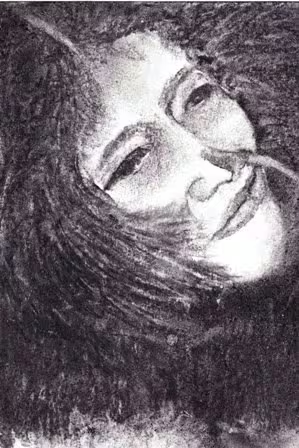
Irom Sharmila: The Iron Lady's Sixteen-Year Vigil
In the annals of non-violent protest, few stories are as stark, profound, and physically demanding as that of Irom Sharmila Chanu. For sixteen years—5,757 days—she did not willingly eat or drink. Her body, sustained against her will by a nasogastric tube, became a silent, unyielding battlefield. Her singular demand was the repeal of a single piece of legislation: the Armed Forces (Special Powers) Act, 1958 (AFSPA). Known as the "Iron Lady of Manipur," her protest transcended personal sacrifice, evolving into a global symbol of peaceful resistance against state power and becoming the longest hunger strike in history.
Early Life & The Unquiet Hills
Irom Sharmila Chanu was born on March 14, 1972, in Kongpal, Imphal, in the state of Manipur. She was the youngest of nine children in a modest family. Her father, Irom Chanu Nanda, worked in a junior position in the state's veterinary department. Growing up in the 1970s and 80s, Sharmila’s world was shaped by the pervasive tension that gripped Manipur. The region was, and remains, a complex tapestry of ethnic identities, aspirations, and long-standing insurgencies seeking autonomy or independence from India.
In response to this unrest, the Indian government had declared Manipur a "disturbed area" and imposed the Armed Forces (Special Powers) Act in 1958, granting the military sweeping powers. Under AFSPA, soldiers could arrest individuals without a warrant, search any premises, and use lethal force if they deemed it necessary, all with a significant degree of legal immunity. For the people of Manipur, this act became a symbol of oppression, creating a climate of fear, extrajudicial killings, and human rights abuses.
Sharmila was a quiet, sensitive, and introspective child. She completed her schooling but did not pursue higher university education, instead involving herself in local social issues and human rights discussions. She wrote poetry, her verses often reflecting the pain and suffering she witnessed around her. She was not a political leader or a prominent figure, but a private citizen deeply pained by the cycle of violence that defined life in her homeland.
The Catalyst: The Malom Massacre
Everything changed on November 2, 2000. On that Thursday afternoon, at a bus stop in Malom, a small town on the outskirts of Imphal, ten civilians were waiting. They were not militants, not combatants; they were ordinary people going about their lives. Following a suspected militant attack on an Assam Rifles convoy nearby, soldiers from the 8th Assam Rifles allegedly opened fire on the group. Ten people were killed in cold blood. The victims included Leisangbam Ibetombi, a 62-year-old woman, and Sinam Chandramani, an 18-year-old who had received a National Child Bravery Award in 1998.
The next day, the images of the blood-soaked, bullet-riddled bodies appeared in local newspapers. For 28-year-old Sharmila, these photographs were not just news; they were an unbearable testament to the impunity granted by AFSPA. The incident, which came to be known as the "Malom Massacre," was the final, brutal catalyst. A deep sense of helplessness and rage coalesced into a steely resolve. She decided that she could no longer remain a silent witness.
On November 5, 2000, three days after the massacre, Irom Sharmila sat down in her hometown and began a fast. She vowed not to eat, drink, comb her hair, or even look in a mirror until the Indian government repealed the AFSPA. Her protest had begun.
The World's Longest Hunger Strike
Sharmila’s act was one of profound personal sacrifice, rooted in Gandhian principles of satyagraha, or truth-force. However, the state’s response was immediate and clinical. Within three days, she was arrested by the Manipur police and charged under Section 309 of the Indian Penal Code for “attempting to commit suicide.” This colonial-era law, which criminalizes the act of trying to end one's own life, became the legal mechanism used to contain her protest for the next sixteen years.
This began a bizarre and grueling cycle. As an undertrial prisoner, Sharmila could be legally held for a maximum of one year. So, every year, she would be formally released by the court. A frail but resolute figure, she would step out of custody, resume her fast, and within a day or two, be re-arrested on the same charge. Her prison was a single, guarded room in the Jawaharlal Nehru Institute of Medical Sciences in Imphal.
It was here that she endured the most invasive aspect of her long ordeal: force-feeding. Twice a day, a mixture of vitamins, minerals, and protein liquids was pumped into her body through a nasogastric tube. The Ryles tube, a constant presence in her nose, was a stark, physical symbol of the state's power—a lifeline she never asked for, forced upon her by the very authorities she was protesting against. It kept her alive, but it was also a daily violation, a constant reminder of her lack of agency over her own body.
Her protest, however, could not be contained within the hospital walls. Her unwavering resolve captured the imagination of people far beyond Manipur. She became the "Iron Lady of Manipur," a living embodiment of the struggle for justice. Her cause was amplified by local support groups like the Sharmila Kanba Lup (Save Sharmila Campaign) and international human rights organizations. Amnesty International declared her a "Prisoner of Conscience," highlighting her case as a powerful example of the suppression of dissent.
Over the years, Sharmila received numerous accolades for her incredible endurance and moral courage:
- The Gwangju Prize for Human Rights (2007)
- The Mayilamma Award (2009)
- A Lifetime Achievement Award from the Asian Human Rights Commission (2010)
- The Rabindranath Tagore Peace Prize (2010)
Despite the global attention, the Indian government remained unmoved. While committees like the Justice Jeevan Reddy Committee (2005) recommended that AFSPA be repealed, calling it "a symbol of oppression, an instrument of high-handedness," no concrete political action was taken. For sixteen years, Sharmila persisted, her body weakening but her spirit unbroken.
A Change in Strategy: The End of the Fast
On July 26, 2016, Irom Sharmila made an announcement that stunned her supporters and the nation. She declared her intention to end her 16-year-long fast on August 9. Her reasoning was pragmatic and born of deep frustration. "I have been fasting for 16 years and I have not got anything from it yet," she told the media. She had concluded that her protest, monumental as it was, had failed to move the levers of power. She needed a new strategy.
Her new path was to be electoral politics. She announced she would contest the upcoming Manipur state assembly elections to fight for the repeal of AFSPA from within the legislative system. "I want to be the chief minister of Manipur to make a positive change," she declared.
On August 9, 2016, the world watched as Sharmila sat before a throng of cameras and supporters. A supporter held out a jar of honey. With tears streaming down her face, she tentatively dipped her finger into it and brought it to her lips. The taste of food, a sensation her body had not known for nearly 6,000 days, was overwhelming. It was a moment of profound emotional and political significance, marking the end of an era of protest.
The Political Foray and Public Response
Sharmila’s transition from a revered activist icon to a political candidate was fraught with complexity. She formed a new political party, the Peoples' Resurgence and Justice Alliance (PRJA), to contest the 2017 Manipur Assembly elections. Her platform was clear: the repeal of AFSPA, good governance, and an end to corruption.
However, the very public that had canonized her as a self-sacrificing symbol of resistance was hesitant to accept her as a politician. Some of her staunchest supporters felt betrayed by her decision to end the fast. Others were skeptical of her political acumen. The established political machinery of Manipur, deeply entrenched in power and patronage, proved a formidable opponent.
She contested from two constituencies, including Thoubal, the home turf of the then-Chief Minister, Okram Ibobi Singh. The results were a brutal reality check. In Thoubal, against a powerful incumbent, Irom Sharmila received a mere 90 votes. It was a humbling and devastating defeat. The people had revered her as a martyr, a goddess-like figure on a pedestal of sacrifice, but they did not vote for her as a leader.
Deeply disillusioned by the verdict, she announced her decision to quit politics shortly after the results were declared. Her brief, painful foray into the electoral arena was over.
Legacy and Influence
Though her fast did not achieve its stated goal and her political career was short-lived, Irom Sharmila’s legacy is monumental. Her sixteen-year vigil is an unparalleled chapter in the history of civil disobedience. Her primary achievement was dragging the issue of AFSPA from the neglected corners of India's Northeast and Kashmir into the mainstream national and international discourse.
Before Sharmila, AFSPA was a law that most of India was unaware of or indifferent to. Her protest forced media, policymakers, and the judiciary to confront its draconian nature. While the act remains in force, the pressure she generated has contributed to a more nuanced approach, with the central government recently withdrawing AFSPA from large parts of Nagaland, Assam, and Manipur, citing an improved security situation—a development that would have been unthinkable without the sustained spotlight she placed on the issue.
She remains an enduring symbol of the power of an individual's conscience against the might of the state. Her struggle raises profound questions about the nature of democracy, the limits of non-violent protest, and the complex relationship between activism and electoral politics. She is remembered not just for her incredible endurance but also for her humanity—her decision to end her fast, seek a different path, and ultimately, to live her life on her own terms.
After leaving politics, Sharmila married her long-time partner, British citizen Desmond Coutinho, in 2017. In 2019, she gave birth to twin daughters. Today, she lives a quiet life away from the public glare, a private citizen once more. Her public battle may be over, but the story of the Iron Lady of Manipur—a woman who used her own body as the ultimate weapon for peace—will forever be etched in the history of the fight for human rights in India.