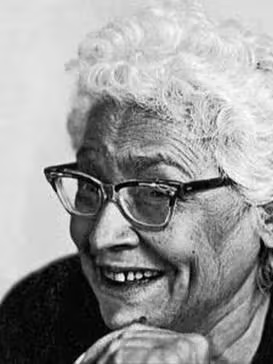
Ismat Chughtai: The Grande Dame of Urdu Fiction
In the grand theatre of 20th-century Indian literature, few voices were as audacious, as unapologetically honest, or as enduringly resonant as that of Ismat Chughtai. A novelist, short story writer, and filmmaker, she was a titan of Urdu prose and a foundational pillar of the Progressive Writers' Movement. Armed with a pen that was both a scalpel and a sword, she dissected the hypocrisies of a patriarchal society, explored the forbidden territories of female desire, and gave voice to the inner lives of women with a wit and realism that was nothing short of revolutionary. Chughtai was not merely a writer; she was a force of nature, a rebel whose legacy is etched not just in literary history, but in the very fabric of feminist consciousness in South Asia.
Early Life & A Rebellious Spirit
Ismat Chughtai was born on August 21, 1911, in Badayun, Uttar Pradesh, the ninth of ten children in a large, educated Muslim family. Her father, Mirza Qaseem Baig Chughtai, was a civil servant whose transferable job meant the family moved frequently across British India. This peripatetic childhood exposed Ismat to a diverse cross-section of Indian life, from dusty provincial towns to bustling cities, an experience that would later enrich the social tapestry of her fiction.
From a young age, Chughtai displayed a fiercely independent and rebellious streak. Growing up in a household with six brothers, she resisted the traditional confines prescribed for girls of her time. She preferred the company of her brothers, playing sports and engaging in activities deemed unladylike. Her most significant early influence was her elder brother, Azeem Baig Chughtai, who was already an established writer. He recognized her burgeoning talent and encouraged her to read voraciously, introducing her to the works of Chekhov, Shaw, and Ibsen, while also nurturing her own unique voice.
Her quest for education was itself an act of rebellion. When her family attempted to marry her off after she completed middle school, she fought back, even threatening to run away and convert to Christianity to secure an education. Her resolve was so unshakeable that her family eventually relented. She went on to study at the Aligarh Muslim University, a profoundly formative experience. In 1936, she earned her Bachelor of Arts degree and, defying convention yet again, a Bachelor of Education degree—becoming one of the first Muslim women of her generation to do so. Her time in Aligarh, living in a women's hostel, provided her with a unique vantage point into the cloistered world of women, their friendships, rivalries, and unspoken desires, a world she would later immortalize in her writing.
A Career Forged in Fire and Ink
Ismat Chughtai’s literary career began in the early 1940s, a period of great political and social ferment in India. She was drawn to the Progressive Writers' Association (PWA), a collective of anti-imperialist, left-leaning writers that included luminaries like Saadat Hasan Manto, Faiz Ahmed Faiz, and Krishan Chander. The PWA's manifesto, which called for literature to be an instrument of social change, resonated deeply with her own convictions. She began writing short stories that challenged the status quo, focusing on the lives of middle-class and lower-middle-class Muslim families, particularly the women trapped within them.
Her writing was distinguished by its use of colloquial, everyday language, especially the idiomatic Urdu spoken by women in North Indian homes, known as Begumati Zaban. This linguistic choice was revolutionary; it stripped away the ornate, Persianized prose that had dominated Urdu literature and brought an electrifying authenticity to her characters.
'Lihaaf' and the Lahore Obscenity Trial
In 1942, Chughtai published the short story that would make her both famous and infamous: “Lihaaf” (The Quilt). Published in the prestigious literary journal Adab-i-Latif, the story is told from the perspective of a young girl observing the lonely life of a wealthy noblewoman, Begum Jan. Neglected by her husband, the Begum finds solace and companionship with her masseuse, Rabbo. The story masterfully alludes to a homosexual relationship through suggestive imagery, culminating in the child narrator's terror as she sees the quilt moving in the dark like a writhing elephant.
“Lihaaf” caused an immediate uproar. It shattered the silence surrounding female sexuality and same-sex desire, topics considered utterly taboo. Chughtai was accused of obscenity, and a summons was issued for her to appear before the Lahore High Court in 1944. She faced the trial with characteristic defiance and wit. Accompanied by her husband, the filmmaker Shahid Lateef, and her fellow writer Saadat Hasan Manto (who was also facing obscenity charges for his story “Bu” or “Odour”), she refused to apologize. In her autobiography, Kaghazi Hai Pairahan (The Paper Attire), she recounts the farcical nature of the proceedings. Her lawyer successfully argued that the story contained no explicit words and relied entirely on suggestion. Ultimately, the judge, after reading the story multiple times and finding no obscene vocabulary, dismissed the case. The trial, however, cemented Chughtai’s reputation as a fearless writer who refused to be censored.
Masterworks of Urdu Prose
While “Lihaaf” brought her notoriety, her broader body of work established her as a master of the craft. Her semi-autobiographical novel Terhi Lakeer (The Crooked Line, 1945) is considered a landmark in Urdu literature. It is a powerful coming-of-age story that follows its protagonist, Shaman, from a difficult childhood to a rebellious youth and a tumultuous adulthood. The novel is a profound psychological study of a young woman’s struggle for identity, independence, and intellectual freedom against the backdrop of a changing India. It remains one of the most important feminist texts in Indian literature.
Her short stories continued to explore the lives of marginalized women with empathy and unflinching realism. In “Chauthi ka Joda” (The Wedding Suit), she poignantly depicts the desperation of a poor family trying to marry off a daughter. In “Kallu”, she tells the story of a dark-skinned servant boy and the complex, often cruel, class dynamics of the household he serves. Her characters were not idealized heroines; they were complex, flawed, and utterly human, navigating a world of limited choices with resilience and quiet dignity.
Foray into Filmmaking
In the mid-1940s, Chughtai and her husband moved to Bombay (now Mumbai), the heart of the Indian film industry. Here, she embarked on a parallel career as a screenwriter and dialogue writer. She brought the same sharp insight and social realism from her fiction to her screenplays. She wrote the story for the film Ziddi (1948), which helped launch the career of actor Dev Anand. She collaborated with her husband on several films, including Arzoo (1950) and Sone Ki Chidiya (1958).
Her most significant cinematic contribution was co-writing the screenplay and dialogue for M.S. Sathyu’s masterpiece, Garam Hawa (1973), with Kaifi Azmi. The film is a poignant and powerful portrayal of the plight of a North Indian Muslim family grappling with the trauma of the Partition of India. It remains one of the most definitive films ever made on the subject, and Chughtai’s contribution was crucial in capturing the nuanced emotional and social turmoil of the era.
Legacy & Enduring Influence
Ismat Chughtai passed away on October 24, 1991, in Mumbai. In a final act of defiance against orthodoxy, she had wished to be cremated rather than buried, a wish her family honored. Her death marked the end of an era, but her work continues to burn as brightly as ever.
Her historical significance is immense. She was a feminist icon long before the term gained popular currency in India. She expanded the thematic and linguistic boundaries of Urdu literature, proving that the language of the home and the hearth could be a powerful medium for profound social commentary. By placing women—their bodies, their desires, their frustrations, and their small victories—at the center of her narrative universe, she challenged centuries of patriarchal literary tradition.
Chughtai’s impact on Indian culture is multifaceted. She inspired generations of writers, particularly women, to write with courage and honesty about their own experiences. Her stories have been translated into numerous languages and continue to be studied in universities worldwide for their literary merit and their sociological insights. They offer an invaluable window into the social dynamics of 20th-century India, tackling issues of class, religion, sexuality, and the politics of the female body with a candor that remains striking even today.
She is remembered as Ismat Apa, a term of respect and affection, the “Grande Dame” of Urdu fiction. She was more than just a writer; she was a personality—sharp, witty, compassionate, and utterly fearless. In an age when women were expected to be silent and submissive, Ismat Chughtai chose to roar. Her life and work stand as a powerful testament to the belief that literature, at its best, is not a polite art but a necessary act of rebellion.