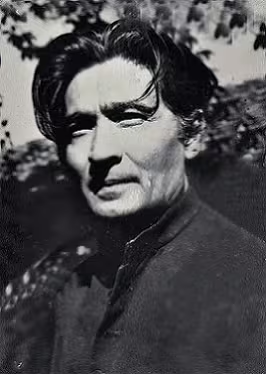
Jan Nisar Akhtar: The Poet of Romance and Revolution
In the grand tapestry of 20th-century Indian literature and cinema, few threads are as vibrant and intricately woven as that of Jan Nisar Akhtar. He was a man who lived between two worlds: the hallowed halls of Urdu poetry, with its rich traditions of the ghazal and nazm, and the dazzling, populist universe of Bombay cinema. Akhtar navigated both with a rare grace, becoming a celebrated poet of the Progressive Writers' Movement and one of the most significant lyricists of Hindi cinema's golden age. His life, marked by literary lineage, personal struggle, and unwavering commitment to his ideals, is a story of how art can be both a deeply personal expression and a powerful voice for a generation.
Early Life & A Legacy of Words
Jan Nisar Akhtar was born Syed Jan Nisar Hussain Rizvi on February 18, 1914, in Gwalior, a princely state in British India. The air he first breathed was thick with poetry and scholarship. He was not merely born into a family; he was born into a formidable literary dynasty. His father, Muztar Khairabadi, was a respected Urdu poet, and his paternal grandfather, Fazl-e-Haq Khairabadi, was a renowned theologian and scholar of Islamic studies who was famously exiled to the Andaman Islands for his role in the 1857 War of Independence. This legacy of intellectual rigor and rebellious spirit was a heritage that would profoundly shape Akhtar’s own worldview.
Tragedy struck early when his mother passed away, leaving a void that would echo through much of his later poetry, often imbued with a deep sense of yearning and melancholy. Raised in a household where poetic couplets were as common as conversation, young Jan Nisar developed a natural affinity for language. He completed his early education in Gwalior, eventually earning his Bachelor of Arts (Honours) from Victoria College.
The most transformative period of his formative years came when he enrolled at Aligarh Muslim University (AMU). In the 1930s, AMU was not just an institution of higher learning; it was a crucible of intellectual and political ferment. It was here that Akhtar came into contact with the nascent Progressive Writers' Movement (PWA), a powerful literary-political current that sought to align art with the struggle for social justice, equality, and independence from colonial rule. He completed his Master of Arts in Urdu in 1939, but more importantly, he left Aligarh with a clear artistic and social purpose. The PWA's manifesto, which declared that literature must grapple with the fundamental problems of life and society, became the guiding principle of his poetic journey.
The Progressive Poet and the Bombay Dream
After his time at AMU, Jan Nisar Akhtar began his career as an academic, teaching Urdu first at his alma mater, Victoria College in Gwalior, and later at Hamidia College in Bhopal. During these years, he honed his craft as a poet, becoming a prominent voice in the PWA. His poetry was a mirror to the times—it spoke of the plight of the worker, the cry for freedom, the hope for a more equitable world, and the universal pain of love and loss.
His verses were marked by a lyrical simplicity that made complex ideas accessible and emotionally resonant. He eschewed ornate, classical formalism in favor of a direct, heartfelt style. Collections like Salasil (Chains), Tar-e-Gireban (The Collar's Thread), and Nazar-e-Butaan (A Tribute to the Idols) established his reputation as a serious poet. His work captured the dualities of his personality: the revolutionary who yearned for a just society and the romantic who saw beauty in the quiet moments of life. Poems like Aman ka Jhanda (The Flag of Peace) became anthems for the peace movement, while his ghazals explored the delicate nuances of love with exquisite sensitivity.
In 1943, he married Safia Siraj-ul-Haq, a writer and teacher who was the sister of another celebrated Progressive poet, Majaz Lucknawi. Their partnership was one of intellectual and emotional companionship. Safia was his anchor, and their correspondence, later published in volumes like Harf-e-Aashna and Tumhare Naam, provides a poignant window into their deep bond and the struggles they faced.
By the late 1940s, despite his growing literary stature, the financial constraints of an academic's life and a desire to reach a wider audience propelled him towards a new horizon: Bombay. In 1949, leaving his wife and young sons, Javed and Salman, behind in Bhopal, Jan Nisar Akhtar arrived in the city of dreams to try his luck as a film lyricist.
The Lyricist of Hindi Cinema's Golden Age
The transition to the film industry was arduous. The world of cinema, with its commercial demands and collaborative pressures, was a stark contrast to the solitary life of a poet. Akhtar faced years of struggle, but his talent and perseverance eventually broke through. He made his debut as a lyricist with the film Aaram (1951).
His defining moment came with the 1956 film C.I.D. The song “Ae Dil Hai Mushkil Jeena Yahan, Zara Hatke Zara Bachke, Yeh Hai Bombay Meri Jaan” became an instant phenomenon. Penned by Akhtar and composed by O.P. Nayyar, the song was more than just a hit; it was a gritty, cynical, yet affectionate anthem for the city of Bombay itself. It captured the spirit of the metropolis—its relentless pace, its hidden dangers, and its undeniable allure. The song cemented Akhtar’s place in the industry.
From then on, Jan Nisar Akhtar became one of the most sought-after lyricists of his era. He possessed a unique ability to infuse film songs with literary depth without sacrificing their popular appeal. His words were simple but never simplistic, elegant but always accessible. He could craft a breezy, romantic duet like “Meri Neendon Mein Tum” (Naya Andaz, 1956) with the same ease as a heart-wrenching ballad.
His collaboration with composer Khayyam in his later years produced some of the most enduring melodies in Hindi cinema. Though many of these were released after his death, they represent the pinnacle of his art as a lyricist. For Kamal Amrohi's magnum opus Razia Sultan (1983), he wrote the timeless ghazal “Ae Dil-e-Nadaan,” a song that perfectly encapsulates the loneliness and longing of its protagonist. For the film Noori (1979), his song “Aaja Re O Mere Dilbar Aaja” became a chartbuster, its simple, evocative lyrics resonating with millions.
Jan Nisar Akhtar never saw his work as a compromise. He viewed cinema as a powerful medium to bring poetry to the masses. He successfully bridged the gap between the literary mushaira and the silver screen, proving that popular art could also be profound.
Legacy and Influence
Jan Nisar Akhtar passed away from a heart attack in Mumbai on August 19, 1976, at the age of 62. He did not live to see the immense success of his final works or the full flowering of his legacy. In 1976, he was posthumously awarded the prestigious Sahitya Akademi Award for his poetry collection Khak-e-Dil (The Earth of the Heart), a fitting tribute that reaffirmed his stature as a major figure in Urdu literature.
His legacy is twofold and monumental. In the realm of Urdu literature, he is remembered as a vital voice of the Progressive Writers' Movement. His poetry stands as a testament to an era of great social and political change in India, reflecting the aspirations and anxieties of a newly independent nation. His work continues to be studied and recited for its clarity, its emotional depth, and its unwavering humanism.
In the world of Indian cinema, his legacy is etched in the melodies that have become part of the nation's collective cultural memory. His songs are timeless classics, cherished for their poetic grace and emotional honesty. He elevated the standard of film lyrics, demonstrating that a song could be both a commercial success and a work of art.
Perhaps his most visible legacy is carried forward by his son, Javed Akhtar, who has become one of India's most celebrated screenwriters and lyricists. Javed Akhtar often speaks of his father's profound influence, carrying the torch of literary excellence and social consciousness into a new generation.
Jan Nisar Akhtar is remembered today not just as a poet or a lyricist, but as a cultural synthesizer. He was a man who understood that the heart of a revolutionary and the soul of a romantic could reside in the same being. Through his ghazals, nazms, and film songs, he gave voice to the grand struggles of his time and the intimate, eternal whispers of the human heart.