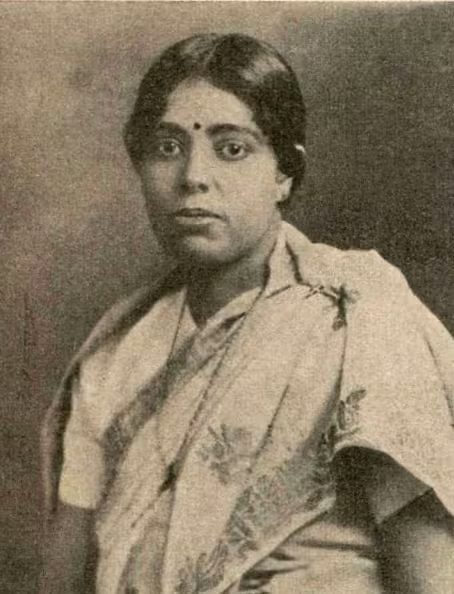
E.K. Janaki Ammal: The Botanist Who Sweetened a Nation and Saved a Forest
In the annals of Indian science, the name Edavalath Kakkat Janaki Ammal stands as a testament to quiet resolve, intellectual brilliance, and a profound connection to the natural world. In an era when the laboratories and lecture halls of science were almost exclusively male domains, Janaki Ammal carved a path of her own, not with loud pronouncements, but with meticulous research that reshaped Indian agriculture and a fierce, science-backed advocacy that helped preserve one of the nation's most precious ecological treasures. She was a cytogeneticist who manipulated the very building blocks of plant life to create a sweeter future for India and an ethnobotanist who revered the ancient wisdom of its indigenous communities. Her life was a journey from the lush coast of Kerala to the most prestigious academic institutions in the world, and back again, in service of her homeland.
Early Life & A Thirst for Knowledge
Janaki Ammal was born on November 4, 1897, in Tellicherry (now Thalassery), a coastal town in the Malabar district of the Madras Presidency. She belonged to the Thiyya community, a group within Kerala's complex social fabric. Her father, Diwan Bahadur E.K. Krishnan, was a sub-judge in the provincial civil service, a man of considerable standing. Significantly, he was also an amateur naturalist who maintained a large garden and authored a book on the birds of North Malabar. It was in this environment, surrounded by her father's books and the rich biodiversity of the Malabar coast, that a young Janaki's fascination with the plant world first took root.
In early 20th-century India, a formal, advanced education for women was a rarity. However, the matrilineal traditions prevalent in parts of Kerala, combined with her family's progressive outlook, allowed Janaki to pursue an academic path denied to most of her contemporaries. After her initial schooling in Tellicherry, she moved to Madras (now Chennai) to continue her education.
She enrolled at Queen Mary's College and later attended the prestigious Presidency College, from where she earned an Honours degree in Botany in 1921. This was a remarkable achievement in itself, but for Janaki, it was merely the beginning. She took up a teaching position at the Women's Christian College in Madras, but her ambition for deeper scientific inquiry was insatiable. Her opportunity came in the form of the Barbour Scholarship, a prestigious award from the University of Michigan in the United States, created to support exceptional women from Asia.
In 1924, she sailed for America. At the University of Michigan, she delved into the world of cytogenetics—the study of chromosomes and their role in heredity. She earned her Master of Science degree in 1925 and returned briefly to India to teach. But the pull of advanced research was too strong. She went back to Michigan as an Oriental Barbour Fellow and, in 1931, earned her D.Sc. (Doctor of Science), one of the first Indian women to be awarded a doctorate in the botanical sciences. Her doctoral thesis, a detailed study of chromosome behavior in the Eggplant (Brinjal), was a complex piece of work that signaled the arrival of a formidable scientific mind.
A Career Forged in Science and Conviction
Janaki Ammal's return to India coincided with a period of growing national consciousness, where self-reliance, particularly in agriculture, was a key priority. Her highly specialized skills in cytogenetics were exactly what the country needed.
The Sugarcane Revolution
In 1934, she joined the Sugarcane Breeding Institute in Coimbatore, Tamil Nadu, as a geneticist. At the time, India was a major importer of sugar. Its indigenous sugarcane varieties were thin, fibrous, and had low sucrose content. The institute's goal was to create a robust, high-yielding sugarcane variety suited to the subcontinent's diverse climates.
This is where Janaki Ammal made her most celebrated contribution. She became a master of "sugarcane cytology." Through painstaking laboratory work, she analyzed the chromosome numbers and structures of countless sugarcane varieties from around the world. Her genius lay in hybridization—crossing different species and even different genera to combine their most desirable traits.
She successfully created a series of high-yielding hybrids by crossing the noble sugarcane (Saccharum officinarum) with wild relatives like Saccharum spontaneum and other related grasses. These new varieties, which became part of the famous 'Coimbatore Canes' series, were not only sweeter and thicker but also more resilient to disease and drought. Her work laid the genetic foundation for India's sugar industry, transforming the nation from a net importer to a self-sufficient producer, and eventually, a major exporter. It was a scientific breakthrough with a direct and massive economic impact.
Years Abroad and a Monumental Atlas
Despite her success, Janaki Ammal faced challenges within the male-dominated hierarchy of the scientific establishment. In 1940, she moved to England to continue her research. She first worked as an assistant cytologist at the John Innes Horticultural Institution in London. Then, from 1945 to 1951, she served as a cytologist at the Royal Horticultural Society at Wisley.
During this period, she collaborated with the eminent geneticist C.D. Darlington on a work of monumental importance: The Chromosome Atlas of Cultivated Plants. Published in 1945, this book was a comprehensive catalogue of the chromosome numbers of thousands of plant species. It became an essential reference for plant breeders and geneticists worldwide, a foundational text that organized a vast and chaotic field of knowledge. Her work on the Atlas cemented her international reputation as a leading figure in plant science.
A Return to Serve India
In 1951, Janaki Ammal's expertise was sought by the highest authority in her homeland. Prime Minister Jawaharlal Nehru, who championed a scientific temper for the new nation, personally invited her to return and help reorganize the Botanical Survey of India (BSI), a colonial-era institution that had fallen into neglect.
She accepted the call, returning to India as the Officer on Special Duty for the BSI. She was later appointed its first Director-General, a position from which she systematically revived the organization, setting up regional centers and initiating surveys to catalogue India's immense plant diversity. Her vision was clear: to create a comprehensive inventory of India's botanical wealth, not just for academic purposes, but for its potential use in medicine, agriculture, and industry.
Championing Ethnobotany and Conservation
In her later career, Janaki Ammal's focus expanded from the laboratory to the field. She became a pioneer of ethnobotany in India, the study of how indigenous communities use local plants. She conducted arduous expeditions into some of the most remote parts of the country, from the high-altitude valleys of Kashmir to the dense rainforests of Kerala.
She spent time with tribal communities, meticulously documenting their traditional knowledge of medicinal and edible plants. She believed that this ancient wisdom, passed down through generations, held invaluable secrets that modern science could not afford to ignore. Her work helped to legitimize ethnobotany as a serious scientific discipline in India.
Her deep understanding of ecosystems also made her a passionate and effective conservationist. Her most famous environmental intervention came in the late 1970s when the Kerala government proposed to build a hydroelectric dam across the Kunthipuzha river, which would have submerged the pristine, biodiverse Silent Valley. Janaki Ammal, then in her eighties, became a powerful voice against the project. She used her immense scientific credibility to argue that the Silent Valley was a unique and irreplaceable evolutionary treasure. Her detailed botanical surveys and reports provided the scientific backbone for the massive public movement to "Save Silent Valley." The campaign was ultimately successful, and in 1984, the area was declared a national park, a victory for which Janaki Ammal's advocacy was crucial.
Legacy & Enduring Influence
E.K. Janaki Ammal passed away on February 7, 1984, in Madras, leaving behind a legacy that is as diverse as the plants she studied. She lived a simple, ascetic life, remaining single and wholly dedicated to her scientific pursuits—a radical choice for a woman of her generation.
Her impact is felt across multiple domains:
For Indian Agriculture: Her cytogenetic work on sugarcane was a cornerstone of India's journey towards food self-sufficiency, a direct contribution to nation-building.
For Global Botany: The Chromosome Atlas of Cultivated Plants remains a landmark publication, a testament to her meticulous scholarship.
For Indian Science: As a pioneering woman who reached the pinnacle of her field through sheer merit, she shattered countless glass ceilings and became an inspiration for generations of women in STEM.
For Environmental Conservation: Her role in saving the Silent Valley demonstrated the power of scientific evidence in environmental policy and set a precedent for science-led conservation movements in India.
In 1977, the Government of India recognized her immense contributions by awarding her the Padma Shri, one of the country's highest civilian honors. Today, her legacy is commemorated through the Janaki Ammal National Award for Taxonomy, and a delicate white variety of the magnolia flower, Magnolia kobus 'Janaki Ammal', bred at Wisley, carries her name.
E.K. Janaki Ammal was more than just a scientist. She was a quiet revolutionary who saw in the chromosomes of a sugarcane stalk the potential for national prosperity, and in the canopy of a rainforest, a heritage worth fighting for. Her life's work reminds us that the quest for knowledge and the preservation of nature are two of the most profound ways to serve a nation.