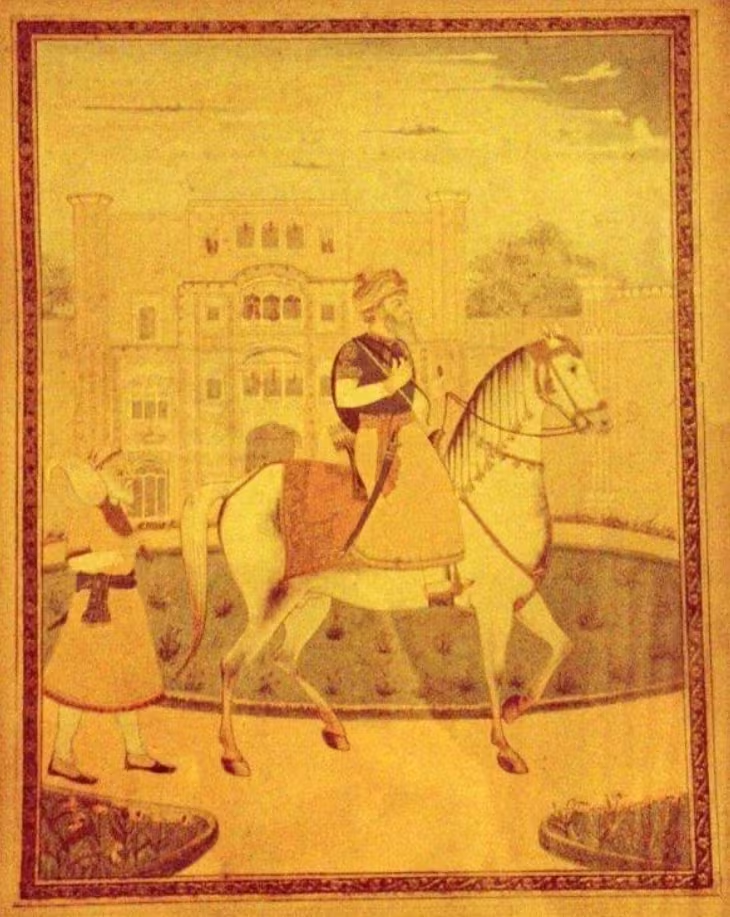
Sultan-ul-Qaum Jassa Singh Ahluwalia: The Architect of Sikh Sovereignty
In the turbulent theatre of 18th-century Punjab, a landscape scarred by the crumbling Mughal empire and the brutal incursions of Afghan invaders, a leader of immense stature and vision arose. He was a warrior, a unifier, and a statesman who would guide the Sikh people from the brink of annihilation to the pinnacle of political power. This was Jassa Singh Ahluwalia, the supreme commander (Jathedar) of the Dal Khalsa, the founder of the Kapurthala state, and a man so revered by his people that they bestowed upon him the title Sultan-ul-Qaum—the King of the Nation.
His life was a saga of relentless struggle, strategic genius, and unwavering faith. He transformed a persecuted community of warrior-saints into a sovereign power, capturing the great Mughal capital of Lahore and laying the foundation for a Sikh empire. His story is not just one of military victories; it is the story of Sikh resilience, identity, and the forging of a nation.
Early Life & Background
Jassa Singh was born on May 3, 1718, in the village of Ahlu, near Lahore, into a Kalal (traditionally brewers and distillers) family. His father was Sardar Badar Singh. The world he entered was one of profound uncertainty. The Khalsa, forged by Guru Gobind Singh, was engaged in a desperate fight for survival against the oppressive Mughal governors of Punjab. Tragedy struck early when his father passed away in 1723, leaving the five-year-old Jassa Singh in the care of his mother.
Seeking solace and protection, his mother took him to Delhi to the revered Mata Sundari, the widow of Guru Gobind Singh. The young boy’s melodious voice and deep devotion while reciting Gurbani (Sikh hymns) captured Mata Sundari’s heart. She saw a spark of greatness in him and took him under her wing, treating him like a son.
This period in Delhi was formative. It was here that he came into contact with a pivotal figure who would shape his destiny: Nawab Kapur Singh, the venerated leader of the burgeoning Sikh confederacy, the Dal Khalsa. Impressed by the boy's potential and guided by Mata Sundari's wishes, Nawab Kapur Singh took Jassa Singh under his personal mentorship. For years, Jassa Singh served the Khalsa with humility and diligence, performing tasks like tending to the community's horses, all the while absorbing the lessons of Sikh theology, statecraft, and guerrilla warfare from his master.
Nawab Kapur Singh, recognizing the exceptional character and leadership qualities in his protégé, formally adopted him as his successor. In 1748, at a gathering of the Sarbat Khalsa (the biannual Sikh assembly) in Amritsar, the Dal Khalsa was reorganized into eleven distinct misls (confederacies). Jassa Singh was appointed the commander of his own unit, the Ahluwalia Misl, named after his ancestral village. This was the first step in his inexorable rise to preeminence.
Career & Major Contributions
Jassa Singh Ahluwalia’s career was defined by his unparalleled military leadership and his ability to unite the fiercely independent Sikh misls into a cohesive fighting force.
Supreme Commander of the Dal Khalsa
Upon Nawab Kapur Singh’s passing in 1753, the mantle of leadership of the entire Dal Khalsa fell upon Jassa Singh Ahluwalia. It was a unanimous decision, a testament to the universal respect he commanded. As the supreme commander, he was now responsible for directing the collective military strategy of the Sikhs against two formidable foes: the decaying but still dangerous Mughal administration and the powerful Afghan invader, Ahmad Shah Abdali.
He refined the Sikh military tactics, perfecting the hit-and-run strategies that wore down larger, more conventional armies. Under his command, the Dal Khalsa became the de facto ruler of vast swathes of Punjab, collecting revenue and administering justice, effectively creating a state within a state.
The Capture of Lahore (1761)
A watershed moment in Sikh history came in 1761. Ahmad Shah Abdali had just crushed the Maratha confederacy at the Third Battle of Panipat. As he withdrew from India, laden with spoils, he left a weakened administration in Punjab. Jassa Singh seized the opportunity. He led the Dal Khalsa in a swift and decisive assault on Lahore, the provincial capital.
The Afghan governor was routed, and the Sikhs marched triumphantly into the city. It was a victory of immense symbolic power. To declare their sovereignty, they struck their own coin at the Lahore mint. The coin, issued in the name of the Gurus, bore the inscription:
“Degh O Tegh O Fateh O Nusrat Bedirang, Yaft Az Nanak Guru Gobind Singh.” (The kettle for charity, the sword for defence, and victory and unqualified patronage have been obtained from Guru Nanak and Guru Gobind Singh.)
In the flush of this historic victory, the grateful Khalsa gathered and collectively bestowed upon Jassa Singh Ahluwalia the title of Sultan-ul-Qaum. Though he humbly attributed all success to the Gurus, the title stuck, cementing his position as the chosen leader of the Sikh nation.
The Vadda Ghalughara (The Great Holocaust, 1762)
The rise of Sikh power was an intolerable challenge to Ahmad Shah Abdali. Enraged by the capture of Lahore, he returned in 1762 with a vengeance, determined to exterminate the Sikhs. This campaign led to the darkest chapter in Sikh history: the Vadda Ghalughara.
On February 5, 1762, near the village of Kup, Abdali’s forces surprised a massive, slow-moving caravan of Sikhs. This was not just an army; it was a moving population of over 40,000, including women, children, and the elderly, who were migrating to the safety of the Malwa region. The Dal Khalsa, led by Jassa Singh Ahluwalia, was vastly outnumbered but immediately formed a protective ring around the non-combatants.
A desperate, running battle ensued that lasted the entire day. The Sikhs fought with unimaginable courage, but the odds were insurmountable. By nightfall, an estimated 25,000 to 30,000 Sikhs, a significant portion of their total population, had been massacred. Jassa Singh Ahluwalia fought at the forefront, sustaining over twenty wounds to his body. It was a catastrophic defeat that could have broken the back of any other community.
But for the Sikhs, it became a baptism by fire. Their resolve hardened, and their thirst for retribution became unquenchable.
Resurrection and Retribution
Jassa Singh Ahluwalia's leadership was never more crucial than in the aftermath of the Ghalughara. Wounded but unvanquished, he rallied the survivors. Within months, the Dal Khalsa was re-formed and back in the field, striking at Afghan outposts with renewed ferocity.
In 1764, the Sikhs achieved their great revenge. They marched on the accursed city of Sirhind, the seat of the Mughal governor Wazir Khan, who had ordered the execution of Guru Gobind Singh's two young sons. The Afghan governor, Zain Khan, was killed in battle, and the city was razed to the ground, fulfilling a long-held Sikh prophecy. This victory not only avenged past atrocities but also firmly established Sikh control over the entire region between the Sutlej and Yamuna rivers.
Liberator of Captives
Beyond his military prowess, Jassa Singh was celebrated for his chivalry. One of his most famous exploits occurred after the Battle of Panipat in 1761. As Ahmad Shah Abdali was returning to Afghanistan, his caravan included over 2,000 Hindu women being taken as war captives. When word reached the Dal Khalsa, Jassa Singh led a daring raid on the Afghan column, overwhelming the guards and liberating every single captive. He arranged for their safe return to their homes, an act that earned him the title Bandi Chhor (The Liberator) and cemented his reputation as a protector of the innocent, regardless of their faith.
Rebuilding the Harmandir Sahib
Ahmad Shah Abdali repeatedly desecrated the holiest Sikh shrine, the Harmandir Sahib (the Golden Temple) in Amritsar, blowing it up with gunpowder in 1762. For Jassa Singh and the Khalsa, its restoration was a sacred duty. After securing Punjab, he dedicated immense resources to its reconstruction. In 1764, he personally laid the foundation stone of the new structure, the one that stands today, ensuring that the spiritual center of the Sikh faith would rise again, more magnificent than before.
Legacy & Influence
Jassa Singh Ahluwalia passed away in Amritsar on October 20, 1783. His legacy is monumental and multifaceted.
Architect of Sikh Sovereignty: More than any other single individual, Jassa Singh Ahluwalia was the architect of Sikh political power in the 18th century. He inherited a scattered and persecuted movement and molded it into a sovereign entity that controlled Punjab. His capture of Lahore and the minting of the Sikh coin were definitive statements of independence that paved the way for the Sikh Empire under Maharaja Ranjit Singh.
A Unifying Force: The Sikh misls were notorious for their internal rivalries. Jassa Singh’s authority, wisdom, and personal charisma provided the central leadership needed to bind them together as the Dal Khalsa. He presided over the Sarbat Khalsa with impartiality, ensuring that collective action was possible against common enemies.
Symbol of Indomitable Spirit: His leadership during and after the Vadda Ghalughara is the ultimate symbol of Sikh resilience. He led his people through their darkest hour, refusing to be broken by a catastrophe that would have shattered other nations. His ability to rally the Khalsa from the ashes of defeat to glorious victory is a cornerstone of Sikh inspiration.
Founder of Kapurthala State: The territory he acquired became the powerful Ahluwalia Misl, with its capital at Kapurthala. This later evolved into the princely state of Kapurthala, which maintained its status through the Sikh Empire, the British Raj, and up to the independence of India.
Today, Sultan-ul-Qaum Jassa Singh Ahluwalia is remembered as one of the greatest heroes in Sikh history. He is revered not just as a conqueror, but as a unifier, a rebuilder, and the embodiment of the Khalsa ideal of the warrior-saint. His life serves as a powerful testament to the idea that with unwavering faith, courage, and unity, a people can rise from the depths of oppression to shape their own sovereign destiny.