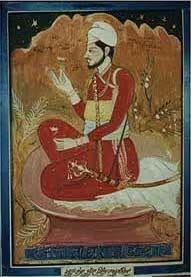
Jassa Singh Ramgarhia: The Warrior-Artisan of the Khalsa
In the tumultuous landscape of 18th-century Punjab—a land scarred by the decay of the Mughal Empire and the brutal invasions of Afghan warlords—a new power was rising. Forged in persecution and tempered by faith, the Sikh Misls emerged as a formidable force. Among the chieftains who carved out sovereignty from this chaos, few embodied the unique spirit of the Khalsa as completely as Sardar Jassa Singh Ramgarhia (1723-1803). He was not merely a warrior, but a builder; not just a conqueror, but a master artisan. His life was a testament to Sikh resilience, a story of a carpenter's son who rose to command one of the most powerful confederacies, defended the holy city of Amritsar, and humbled the mighty Mughal empire by storming its symbolic heart, the Red Fort of Delhi.
Early Life & Background
Jassa Singh was born in 1723 in the village of Ichogil, near the grand city of Lahore. His family belonged to the Tarkhan (carpenter) community, a background that would profoundly shape his destiny. He inherited not only the skills of a craftsman—an expert in wood and stone—but also a deep-seated legacy of Sikh devotion. His grandfather, Hardas Singh, had been initiated into the Khalsa by the tenth master, Guru Gobind Singh himself. This direct spiritual lineage instilled in the family a fierce commitment to the Sikh path.
His formative years were spent under the shadow of intense Mughal persecution. The governor of Lahore, Zakariya Khan, had unleashed a brutal campaign to exterminate the Sikhs, placing a price on every Sikh head. Young Jassa Singh grew up amidst stories of martyrdom and survival, learning the arts of warfare alongside the skills of his trade. He and his father, Giani Bhagwan Singh, fought in the army of the legendary Banda Singh Bahadur, witnessing firsthand the brief but glorious establishment of the first Khalsa Raj.
After Banda Singh's capture and execution in 1716, the Sikhs were scattered, forced to live as outlaws in the forests and hills of Punjab. It was in these harsh environs that Jassa Singh’s character was forged. He learned to be resourceful, resilient, and unwavering in his faith, mastering the hit-and-run guerilla tactics that would become the hallmark of the Dal Khalsa, the collective Sikh army.
Career & Major Contributions
Jassa Singh's ascent from a skilled warrior to a powerful chieftain was marked by pivotal moments of loyalty, bravery, and strategic genius.
The Siege of Ram Rauni and the Birth of a Name
In 1748, the Sikhs constructed a simple mud fortress near Amritsar, naming it Ram Rauni (Fort of God) to serve as a defensive outpost. The new Mughal governor of Lahore, Mir Mannu, saw this as a direct challenge to his authority and laid siege to the fort with a massive army. At this time, Jassa Singh and his two brothers were in the service of Adina Beg Khan, the ambitious faujdar of the Jalandhar Doab, who was allied with the Mughals.
Forced to fight against his own brethren, Jassa Singh faced a crisis of conscience. As the siege dragged on and the 500 Sikhs inside the fort faced starvation, a Sikh woman is said to have taunted him and his comrades, questioning their loyalty to the Panth. Roused by the call of his faith, Jassa Singh made a dramatic decision. He deserted the Mughal camp, joined the besieged Sikhs inside Ram Rauni, and fought valiantly to defend it. Though wounded, his timely intervention and bravery helped save the garrison.
This act of profound loyalty earned him immense respect within the Dal Khalsa. He was entrusted with the command of the fort, which he rebuilt and strengthened with formidable brick walls and ramparts. In honour of the fourth Sikh Guru, Guru Ram Das, the founder of Amritsar, the fortress was renamed Ramgarh (Fort of the Guru). From that day forward, Jassa Singh became known as Jassa Singh Ramgarhia, and the military contingent under his command became the Ramgarhia Misl.
Forging a Misl
The Ramgarh fort became the headquarters of his Misl and the primary defensive bastion for the holy city of Amritsar. Jassa Singh Ramgarhia methodically expanded his influence, bringing territories in the Bari and Jalandhar Doabs under his control. His Misl grew to include thousands of warriors, and its territories, including Batala, Kalanaur, and Qadian, became prosperous centres of trade and craftsmanship, reflecting his own artisan roots.
He was a key leader within the Sarbat Khalsa (the Sikh collective assembly) and a respected commander in the Dal Khalsa. He fought in nearly every major Sikh campaign against the Mughals and the recurring invasions of the Afghan king, Ahmad Shah Abdali. In 1764, he was part of the triumvirate of Sikh chiefs, alongside Lehna Singh Bhangi and Gujjar Singh Bhangi, that triumphantly captured Lahore, the provincial capital. They partitioned the city's revenue, a powerful declaration of the end of foreign rule and the dawn of Sikh sovereignty in Punjab.
Conquest Across the Yamuna
The complex web of alliances and rivalries among the Sikh Misls led to a temporary setback for Jassa Singh. A powerful coalition of chiefs, including Jai Singh Kanhaiya and Jassa Singh Ahluwalia, conspired against him and drove him out of his territories in Punjab.
Lesser men would have been broken, but Ramgarhia’s spirit was indomitable. Instead of fading into obscurity, he led his forces east, across the Yamuna River, and into the heart of Mughal territory. For several years, he carved out a new domain in the Gangetic plains, capturing key towns like Meerut and Hissar. His reputation as an unstoppable commander grew, and his coffers filled with the spoils of his conquests.
The Legendary Raid on Delhi (1783)
His most audacious and symbolic achievement came in March 1783. As part of a large Sikh army that swept into the crumbling Mughal capital, Jassa Singh Ramgarhia and his men stormed the Red Fort, the sanctum sanctorum of Mughal power. They fought their way into the Diwan-i-Aam (Hall of Public Audience), where for centuries Mughal emperors had held court.
In an act of breathtaking defiance, Jassa Singh Ramgarhia dislodged the large stone slab on which the Mughal emperors were crowned. His intention was to take this ultimate symbol of imperial authority to Amritsar and place it at the Harimandir Sahib as a trophy of the Khalsa's victory. A dispute arose with the other Sikh chiefs, but a compromise was reached. Jassa Singh Ramgarhia was allowed to take the slab, along with four captured Mughal cannons, back to Amritsar. He placed this historic slab in the Ramgarhia Bunga, a watchtower and headquarters he had built adjacent to the Golden Temple, where it remains to this day—a silent, powerful testament to the day the Sikhs conquered Delhi.
Legacy & Influence
Sardar Jassa Singh Ramgarhia passed away in 1803 at the age of 80, leaving behind a legacy that was as unique as it was enduring.
The Ramgarhia Identity: He gave a name, an identity, and a powerful sense of pride to the Sikh artisan communities. Before him, the Tarkhans, Lohars (blacksmiths), and Rajs (masons) were vital to the Sikh Panth but lacked a unified political identity. By naming his Misl after the Ramgarh fort—a structure built with skill and defended with courage—he elevated the status of the artisan to that of a warrior-chief. Today, the term Ramgarhia is proudly used by millions of Sikhs worldwide who trace their lineage to these communities, celebrating a heritage of skill, industry, and martial valour.
Guardian of Amritsar: For decades, his Ramgarh fort and the Ramgarhia Bunga stood as the guardians of Amritsar. The Bunga, with its two towering minarets, served as a watchtower to protect the sacred Sarovar and the Harimandir Sahib from attack. It was a military headquarters, a court of justice, and a symbol of the Misl's devotion to the spiritual centre of Sikhism.
A Symbol of Sikh Sovereignty: Jassa Singh’s life mirrored the journey of the Sikh nation in the 18th century. He rose from persecution, established sovereignty through military struggle, and demonstrated the Khalsa's power by challenging and defeating the old empires. His raid on the Red Fort was not merely for plunder; it was a profound political statement that announced the arrival of a new power on the Indian subcontinent.
He is remembered today as one of the great heroes of the Misl era. He was a brilliant military strategist, a skilled administrator, and a master builder. His life proved that in the meritocratic society of the Khalsa, leadership was earned not by birth, but by courage, skill, and unwavering devotion to the Guru. The forts he built have crumbled, but the identity he forged and the legacy of defiance he left behind remain as solid as the Delhi slab he carried home to Amritsar.