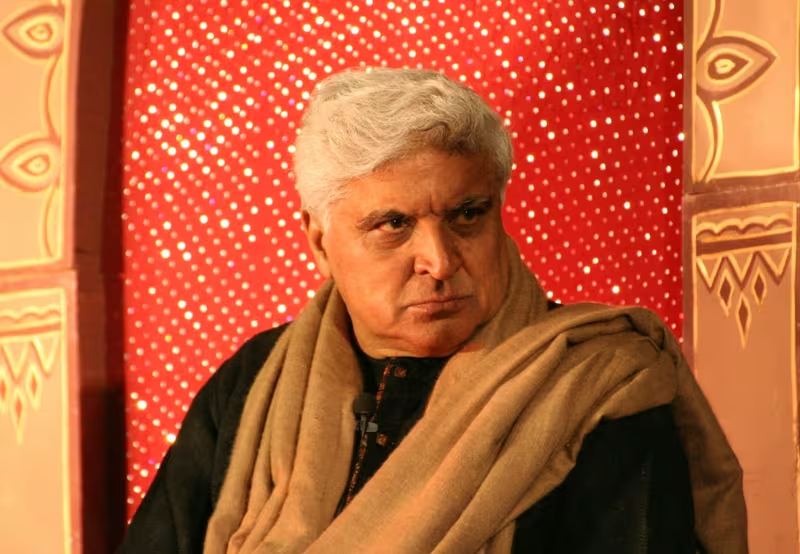
Javed Akhtar - Renowned Indian Poet and Screenwriter
In the grand tapestry of modern Indian culture, few threads are as vibrant, enduring, and influential as the words of Javed Akhtar. He is a poet whose verses capture the subtle cadences of the human heart, a lyricist whose songs form the soundtrack of a nation's collective memory, and a screenwriter who, with his partner Salim Khan, redefined the very grammar of Hindi cinema. From the gritty, rain-swept streets of 1970s Bombay to the tender landscapes of romantic ballads, Akhtar's pen has crafted narratives that are not just stories but sociological touchstones. His journey from a homeless dreamer to a celebrated public intellectual is a testament to the power of words and the resilience of a spirit steeped in a rich literary heritage.
Early Life & Background
Javed Akhtar was born Jadoo Akhtar on January 17, 1945, in the historic city of Gwalior. The name 'Jadoo' was taken from a line in a poem written by his father: "Lamha, lamha kisi jadoo ka fasana hoga" (Every moment will be a tale of some magic). He was born into a lineage of wordsmiths, a family whose intellectual and poetic legacy stretches back generations. His father, Jan Nisar Akhtar, was a highly respected Urdu poet and a prominent Bollywood lyricist. His mother, Safia Akhtar, was a writer and singer. His family tree includes other literary giants like his grandfather, Muztar Khairabadi, and his great-great-grandfather, Fazl-e-Haq Khairabadi, a scholar and key figure in the 1857 Indian Rebellion.
This literary inheritance, however, did not shield him from a turbulent childhood. His early years were marked by profound loss and displacement. The death of his mother, Safia, from cancer when he was a young boy left an indelible void. He spent his formative years shuttling between relatives in Lucknow and Aligarh, an experience that instilled in him a sense of being an outsider, a theme that would later resonate powerfully in the iconic characters he would create.
He received his schooling at Colvin Taluqdars' College in Lucknow and later pursued his graduation at Saifiya College in Bhopal. These years were crucial in shaping his worldview, honing his intellect, and deepening his connection with the Urdu language and its poetic traditions. But the ultimate destination for his ambitions lay elsewhere.
On October 4, 1964, a 19-year-old Javed Akhtar arrived in Bombay with little more than dreams in his pockets. His initial years in the city were a crucible of hardship. Without a place to live, he slept on the benches of Jogeshwari station, under trees, or on the verandas of film studios. He survived on the periphery of the film industry, a vast and unforgiving world, his spirit undimmed by the daily struggle for survival.
Career & Major Contributions
Akhtar's career can be viewed in two distinct, yet equally brilliant, phases: his monumental partnership with Salim Khan that revolutionized screenwriting, and his subsequent emergence as one of India's most beloved lyricists and poets.
The Rise of Salim-Javed
In the corridors of the film industry, Javed Akhtar met Salim Khan, another aspiring writer. Their meeting was serendipitous, a confluence of two sharp, ambitious minds who shared a vision for a new kind of cinema. They began as script doctors, unofficially rewriting and polishing the work of other writers, infusing weak plots with sharp dialogue and narrative tension. Their first official credit came with Haathi Mere Saathi (1971), a massive commercial success that established their credentials.
But their true revolution began with Zanjeer (1973). The film industry at the time was dominated by romantic heroes and family dramas. Salim-Javed introduced a new protagonist: the 'angry young man'. Inspector Vijay Khanna, played with smoldering intensity by a then-struggling Amitabh Bachchan, was a brooding, cynical, and incorruptible force against a corrupt system. He was a reflection of the national mood—a time of economic stagnation, political unrest, and growing disillusionment among the youth. Zanjeer was a cultural explosion, and Salim-Javed, along with Amitabh Bachchan, became the architects of a new cinematic era.
Over the next decade, the Salim-Javed brand became a guarantee of cinematic excellence and box-office success. They delivered a string of iconic films that are now considered classics:
Deewaar (1975): A masterclass in screenwriting, Deewaar presented a powerful moral drama about two brothers on opposite sides of the law. Its dialogues—"Mere paas maa hai" (I have mother)—transcended the screen to become a part of Indian folklore. The film was a stark, compelling commentary on societal divides and individual morality.
Sholay (1975): More than a film, Sholay is a cultural phenomenon. A curry Western with unforgettable characters like Jai, Veeru, Thakur, and the menacing Gabbar Singh, its script was a perfect blend of action, comedy, and drama. Every line of dialogue became a national catchphrase, and the film remains the gold standard for popular Indian cinema.
Trishul (1978), Don (1978), and Shakti (1982): These films further cemented their legacy, showcasing their mastery over tight plotting, character development, and dialogue that was both poetic and punchy.
The Salim-Javed partnership was transformative. They were the first screenwriters in Hindi cinema to become stars in their own right. They fought for and received prominence in film credits, their names often displayed on posters alongside the director and lead actors, and commanded fees that reflected their immense contribution. After a string of unparalleled successes, the legendary duo parted ways in 1982, leaving behind a legacy that had irrevocably altered the landscape of Indian storytelling.
A New Chapter: The Lyricist and Poet
Following the split, Javed Akhtar pivoted, channeling his literary prowess into lyricism and solo screenwriting. While he had penned lyrics before, most notably for Yash Chopra's Silsila (1981), he now dedicated himself to the craft, quickly establishing a new identity as one of the finest songwriters of his generation.
His lyrics were a departure from the prevailing norms. They combined the intricate beauty of Urdu poetry with a simple, accessible vocabulary that resonated with the common person. His work was marked by its emotional depth, philosophical insight, and remarkable versatility.
1942: A Love Story (1994): The song "Ek Ladki Ko Dekha Toh Aisa Laga" became an anthem of romance. Its beauty lay in its simplicity—comparing the beloved to a blooming rose, a playing deer, or a morning prayer—and it re-established a gentler, more poetic form of expression in film music.
Border (1997): With "Sandese Aate Hain," Akhtar captured the soul of a soldier. The sprawling, poignant ballad about letters from home became deeply embedded in the national consciousness, a powerful tribute to the armed forces that brings a lump to the throat even today.
The Modern Era: Akhtar seamlessly adapted to the changing soundscape of the 21st century. In Dil Chahta Hai (2001), he crafted lyrics that were cool, urban, and conversational, perfectly matching the film's modern sensibilities. For Lagaan (2001), he wrote songs steeped in folk traditions, like the playful "Radha Kaise Na Jale." In Kal Ho Naa Ho (2003), the title track offered a profound meditation on life, love, and living in the moment.
Beyond his film work, Akhtar also cemented his reputation as a serious poet. His first collection of Urdu poetry, Tarkash (Quiver), was published in 1995. Presented in both Urdu and Devanagari scripts, it brought his non-film poetry to a wider audience, becoming a bestseller. His poems, often recited in his deep, resonant voice, explore themes of social justice, secularism, love, and existential angst.
Legacy & Influence
Javed Akhtar's influence on Indian culture is profound and multi-layered. His most significant legacy, alongside Salim Khan, was the elevation of the screenwriter from a backroom technician to a celebrated artist. They professionalized the craft, giving writers the power and respect they deserved.
The 'angry young man' archetype they created was not just a filmic device; it was a cultural phenomenon that gave voice to the frustrations of an entire generation and continues to influence character arcs in Indian cinema.
As a lyricist, Akhtar has enriched Hindi film music with a rare literary grace. He has consistently proven that popular music can be intelligent, poetic, and deeply meaningful. His ability to move effortlessly between the raw power of cinematic dialogue and the delicate nuance of a love song marks him as a true master of the written word.
In recent decades, Javed Akhtar has also emerged as a vital public intellectual. A staunch rationalist and an unwavering advocate for secularism and freedom of expression, he uses his platform to engage in critical national debates. His tenure as a Member of Parliament in the Rajya Sabha was marked by eloquent and impassioned speeches that championed reason and constitutional values. For his immense contributions to art and literature, he has been honored with India's highest civilian awards, the Padma Shri in 1999 and the Padma Bhushan in 2007, alongside numerous National and Filmfare Awards for his screenplays and lyrics.
Today, Javed Akhtar stands as an elder statesman of Indian arts and letters. His journey from the pavements of Bombay to the parliament of India is a powerful narrative of talent, perseverance, and intellectual integrity. His words, whether shouted in anger by a hero on screen, whispered in a lover's ear through a song, or delivered as a reasoned argument for a better society, continue to shape, challenge, and inspire the heart of India.