Jiddu Krishnamurti: The Reluctant Messiah and the Pathless Land
In the grand tapestry of India's spiritual and philosophical history, few threads are as unique and paradoxical as that of Jiddu Krishnamurti. He was a man groomed from boyhood to be a messiah, a World Teacher who would guide humanity into a new era. Yet, at the height of his influence, he walked away from it all, dismantling the very organization built around him and declaring that truth was a “pathless land.” For the next half-century, he became one of the 20th century's most profound and challenging speakers on the nature of the mind, consciousness, and freedom, leaving behind not a religion or a philosophy, but a mirror for humanity to look into itself.
Early Life & Theosophical Discovery
Krishnamurti’s story began in the small town of Madanapalle, in the Chittoor district of Andhra Pradesh, British India. Born on May 11, 1895, he was the eighth child of Jiddu Narayaniah, a Tehsildar in the colonial administration, and Sanjeevamma. His family was of Telugu-speaking Brahmin heritage. From his early years, Krishnamurti was not an ordinary child. He was often described as dreamy, vague, and intellectually slow, a stark contrast to his bright and lively younger brother, Nityananda (Nitya), to whom he was deeply attached.
A profound tragedy struck the family when Krishnamurti was just ten years old; his mother Sanjeevamma passed away in 1905. The loss of his mother, who had held a deep conviction that he was a special child, left a lasting mark on the sensitive boy.
The trajectory of his life was irrevocably altered in 1909. His father, a member of the Theosophical Society, had moved the family to Adyar, near Madras (now Chennai), to be close to the society's international headquarters. It was here, on the banks of the Adyar River, that a fateful encounter took place. Charles Webster Leadbeater, a prominent and clairvoyant Theosophist, spotted the 14-year-old Krishnamurti and was struck by what he described as the boy's “wonderfully pure aura,” an aura he claimed was entirely devoid of selfishness. Leadbeater became convinced that this unassuming boy was the vessel, the chosen vehicle for the coming World Teacher—a messianic entity known as the Lord Maitreya, whose advent the Theosophists had long prophesied.
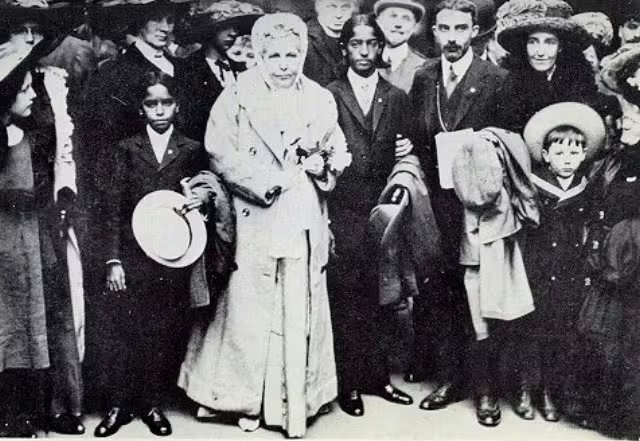
Annie Besant, the influential President of the Theosophical Society, shared Leadbeater’s conviction. She took Krishnamurti and his brother Nitya under her wing, eventually becoming their legal guardian after a custody battle with their father. The two boys were removed from their familiar Indian surroundings and thrust into a world of intense spiritual and intellectual grooming. They were privately tutored, taken to England for a sophisticated European education, and prepared to assume their monumental roles on the world stage.
The Order of the Star and the Great Dissolution
To prepare humanity for the arrival of the World Teacher, the Theosophical Society established a new global organization in 1911: the Order of the Star in the East (OSE). The young Krishnamurti was appointed its official Head. The OSE grew at a phenomenal rate, attracting tens of thousands of followers and vast sums of money, with properties and centers established across the globe. For years, Krishnamurti played his part, travelling the world, giving talks prepared with the help of his mentors, and being revered as a near-divine figure.
Beneath the surface, however, a profound inner transformation was taking place. Throughout the 1920s, Krishnamurti experienced intense, often agonizing, psychological and spiritual states that he simply called “the process.” These experiences, combined with his growing intellectual independence, began to sow seeds of doubt about the role that had been assigned to him.
The definitive turning point came in November 1925 with a devastating personal tragedy. His beloved brother Nitya, who had suffered from tuberculosis for years, passed away in Ojai, California. Krishnamurti was shattered. The Theosophical leadership, including Besant and Leadbeater, had repeatedly assured him that the spiritual Masters they served would protect Nitya. His death not only plunged Krishnamurti into deep grief but also completely destroyed his faith in the Theosophical hierarchy and the authority figures he had trusted his entire life. This event catalyzed his final break from the path laid out for him.
That break came in one of the most dramatic public announcements of the 20th century. On August 3, 1929, at the annual Star Camp in Ommen, Netherlands, Krishnamurti stood before 3,000 members of the Order, including a frail Annie Besant. Instead of delivering an expected spiritual address, he delivered a bombshell. He was dissolving the Order of the Star in the East.
His words that day have echoed through the decades: “I maintain that Truth is a pathless land, and you cannot approach it by any path whatsoever, by any religion, by any sect... I do not want followers, and I mean this. The moment you follow someone you cease to follow Truth.”
He declared that his only concern was to “set man absolutely, unconditionally free.” He renounced the titles, the wealth, the properties, and the very structure of belief that had been built around him for nearly two decades. This singular act of renunciation was not a rejection of spirituality, but a rejection of the cages that organized belief systems create. It was an astonishing assertion of individual freedom and a radical departure from the guru-disciple tradition.
A Life of Independent Teaching
Freed from the mantle of the messiah, Krishnamurti spent the next 57 years, until his death in 1986, as a completely independent public speaker and philosopher. He belonged to no organization, espoused no creed, and held no nationality, travelling the world tirelessly to engage in a relentless exploration of the human condition.
He gave public talks in cities from London and Paris to Mumbai and New York, and held smaller dialogues and discussions in places like Saanen, Switzerland; Ojai, California; and Brockwood Park in England. His talks were not sermons but a process of thinking aloud, an invitation for the listener to investigate the workings of their own mind in real-time. His core inquiries revolved around a few central themes:
Freedom from the Known: Krishnamurti argued that the human mind is conditioned by its past—its memories, experiences, traditions, and knowledge. This conditioning, which he called “the known,” prevents us from seeing reality as it is. True psychological freedom, he said, lies in understanding and moving beyond this conditioning.
Choiceless Awareness: He proposed a state of pure observation—watching one’s own thoughts, emotions, and reactions as they arise, without judgment, condemnation, or justification. This “choiceless awareness,” he insisted, is not a technique but an art of perception that in itself brings about a radical mutation in the mind.
The Observer is the Observed: One of his most profound psychological insights was the idea that the perceived separation between the “thinker” and the “thought,” or the “observer” and what is being “observed,” is an illusion. The thinker is the thought. Realizing this non-duality, he explained, is the key to ending all internal conflict.
Education: Krishnamurti was deeply passionate about education, believing that modern schooling focused on accumulating information rather than cultivating integrated, intelligent, and fearless human beings. He founded several schools in India (such as Rishi Valley School in his native Andhra Pradesh and Rajghat Besant School in Varanasi), England (Brockwood Park School), and the USA (Oak Grove School). These institutions were designed to foster an environment of free inquiry, a love of nature, and a psychological atmosphere free from fear, comparison, and authority.
Legacy & Influence
Jiddu Krishnamurti died in Ojai, California, on February 17, 1986, at the age of 90. He left behind a legacy that is deliberately difficult to categorize. He was not a guru, for he rejected followers. He did not found a religion, for he saw belief as a barrier to truth. He offered no method, no system, no mantras, and no promises of enlightenment.
His influence, however, has been quiet but immense. He engaged in deep dialogues with leading figures of his time, including physicist David Bohm, writer Aldous Huxley, and biologist Rupert Sheldrake. His relentless questioning and penetrating psychological insights have inspired countless individuals—artists, scientists, educators, and spiritual seekers—who were tired of organized dogma and sought a more direct, unmediated understanding of life.
To ensure his teachings remained pristine and uncorrupted by interpretation, he established several Krishnamurti Foundations in India, the UK, the USA, and Spain. Their sole purpose is not to promote a belief system but to preserve and make available his vast body of work—thousands of recorded talks, dialogues, and writings—in its original form.
Today, Jiddu Krishnamurti is remembered not as a messiah who fulfilled a prophecy, but as a revolutionary thinker who dared to dismantle it. He stands as a unique figure in modern Indian history—a man born into ancient spiritual traditions who used the language of modern psychological inquiry to point towards a freedom that lay beyond both. His legacy is not a set of answers but a persistent, vital question: can the human mind, conditioned by millennia of fear, conflict, and sorrow, unburden itself and become a light unto itself?