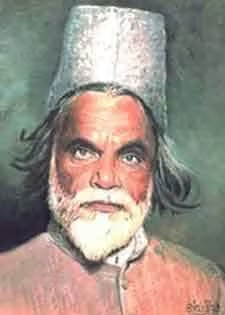
Jigar Moradabadi: The Heart's Fire in Urdu Ghazal
In the grand tapestry of 20th-century Indian literature, few threads shine with the incandescent glow of Ali Sikandar, known to the world by his evocative takhallus (pen name), Jigar Moradabadi. A poet whose life was as tumultuous and passionate as his verse, Jigar was not merely a writer but a phenomenon. He was the undisputed king of the mushaira (poetic symposium), a wordsmith who could hold thousands in thrall with the sheer melody of his recitation and the profound depth of his ghazals. His journey from a troubled youth to becoming a spiritual and literary icon is a story of redemption, artistry, and the enduring power of the poetic word. Jigar Morad-abadi stands as a vital bridge between the classical grandeur of Urdu poetry and the complex sensibilities of the modern era.
Early Life & Background
Ali Sikandar was born on April 6, 1890, in the city of Moradabad, Uttar Pradesh, a place that would forever be attached to his name. Poetry was in his very bloodline; his father, Maulvi Ali Nazar, was a poet himself, providing the young Ali Sikandar with his first exposure to the intricate world of rhyme, meter, and metaphor. He received a traditional education at a local maktab, where he gained proficiency in Urdu, Persian, and Arabic—the foundational languages of the subcontinent's rich literary heritage.
However, his formal schooling was brief. A restless and spirited youth, he did not proceed to higher education, a fact that makes his later scholarly command over poetic forms all the more remarkable. His early life was marked by a certain bohemian drift, and he struggled for years with a deep-seated addiction to alcohol. This personal battle would become a central, recurring motif in his poetry, lending his verses a raw, confessional honesty that resonated deeply with his audience.
His life took a decisive turn when he moved to Gonda. It was here that he came under the tutelage of the distinguished poet Asghar Gondvi. In the hallowed ustad-shaagird (master-disciple) tradition, Jigar found not just a poetic guide but a spiritual mentor. Asghar's influence was profound; he helped refine Jigar's craft, steering him from purely romantic themes towards a more mystical and philosophical path. This relationship was further cemented when Jigar married Asghar's wife's sister, formally becoming part of his mentor's family. Asghar's guidance provided the anchor that Jigar’s restless soul had been seeking, setting him on a course toward literary greatness and personal salvation.
Career & Major Contributions
Jigar Moradabadi's career was forged in the fiery arena of the mushaira. In an age before mass media, these poetic gatherings were the primary stage for a poet's talent. Jigar was a born performer. With a melodious voice and a charismatic, almost theatrical, style of recitation, he captivated audiences across India. When Jigar stood up to recite, a hush would fall over the crowd. His ghazals, which spoke of love's exquisite pain, the intoxication of wine, and the yearning for the divine, struck a universal chord. He was not just reciting poetry; he was laying bare the human heart.
His poetic journey can be seen through his major collections, each marking a distinct phase in his evolution:
Daagh-e-Jigar (The Blemish of the Heart): This early collection showcases his initial style, steeped in the traditions of romantic ghazal (ishq-e-majazi, or worldly love). The verses are passionate, sometimes hedonistic, reflecting the turbulence of his youth and his struggles with love and addiction.
Shola-e-Toor (The Flame of Mount Sinai): In this work, a clear shift is visible. The title itself, an allusion to the divine fire witnessed by the Prophet Moses, signals a turn towards mysticism. Under Asghar Gondvi's influence, Jigar began exploring themes of ishq-e-haqiqi (divine love). The earthly beloved and the tavern's wine become metaphors for the Divine and spiritual ecstasy. The passion remains, but it is now channeled towards a higher, more profound quest for meaning.
Aatish-e-Gul (The Fire of the Rose): Published in 1958, this collection is widely considered his magnum opus. It represents the pinnacle of his art, a perfect synthesis of classical form and modern feeling, of romanticism and mysticism. The work is a testament to a life lived to the fullest and a spirit that had found its peace. For Aatish-e-Gul, Jigar Moradabadi was bestowed with the prestigious Sahitya Akademi Award in 1958, the highest literary honor in India. This national recognition cemented his status as a master poet of his generation.
Jigar's unique contribution was his ability to rejuvenate the ghazal. He was a classicist at heart, never abandoning the strict metrical and rhyming schemes of the form. Yet, he infused it with a fresh, lyrical simplicity and a deeply personal emotional intensity. While poets like Ghalib were known for their dense philosophical complexity, Jigar's genius lay in his ability to express profound ideas in deceptively simple, melodious language. He made the ghazal accessible and intensely relatable to the common person without ever compromising its artistic integrity.
Legacy & Influence
Jigar Moradabadi passed away on September 9, 1960, in Gonda, but his voice continues to echo through the corridors of Urdu literature. His legacy is multifaceted and profound.
A Bridge Across Eras: Jigar stands as a crucial transitional figure. He upheld the aesthetic elegance of the classical masters while speaking in a voice that was distinctly modern. He kept the ghazal form vibrant and relevant through a period of immense change in India, including the independence struggle and Partition. While not an overtly political poet like Faiz Ahmed Faiz, his work captured the inner, existential concerns of a society in flux.
The Soul of the Mushaira: He remains the gold standard for mushaira recitation. His performances transformed these gatherings from staid literary events into electrifying public spectacles. He demonstrated that poetry could be a powerful, communal experience, a legacy that influenced generations of poets who followed him on the stage.
A Voice for the Ages: Jigar’s ghazals have transcended the printed page and found a permanent home in the world of music. Legendary singers such as Begum Akhtar, Talat Mahmood, and later Jagjit Singh and Ghulam Ali have lent their voices to his immortal words. Ghazals like "Hum ko mita sake yeh zamane mein dum nahin" (This world does not have the power to erase me) and "Ek lafz-e-mohabbat ka adna yeh fasana hai" (The briefest tale is this single word of love) have become iconic, ensuring his poetry reaches audiences far beyond literary circles.
Academic and Institutional Recognition: Beyond the Sahitya Akademi Award, his contributions were recognized with an honorary Doctor of Letters degree from Aligarh Muslim University in 1953, a testament to the respect he commanded in academic spheres despite his own lack of formal higher education.
Today, Jigar Moradabadi is remembered as the Shaayar-e-Fitrat (Poet of Nature) and Shaayar-e-Husn (Poet of Beauty). His life story—a journey from the depths of personal despair to the heights of spiritual and artistic achievement—serves as an inspiration. He proved that the most powerful poetry often comes from a life lived with intense passion and vulnerability. Jigar did not just write ghazals; he lived them. And in his verses, the fire of a truly poetic heart continues to burn brightly.