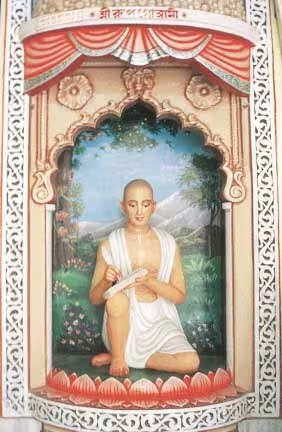
Jiva Goswami: The Intellectual Architect of Gaudiya Vaishnavism
In the vibrant tapestry of 16th-century India, a period of profound spiritual awakening and philosophical creativity, few figures cast as long a shadow as Jiva Goswami. While the Bhakti movement swept across the subcontinent, championing emotional devotion over rigid ritual, it was in the sacred town of Vrindavan that this devotional fervor was forged into a sophisticated and enduring philosophical system. At the heart of this intellectual enterprise was Jiva Goswami, the youngest of the legendary Six Goswamis of Vrindavan, yet arguably its most formidable mind and prolific author. He was not merely a saint or a devotee; he was the master synthesizer, the scholastic giant who gave the Gaudiya Vaishnava tradition its theological backbone, ensuring its legacy for centuries to come.
Early Life & Formative Years
Jiva was born in 1513 in the village of Ramakeli in Bengal, a region humming with the devotional energy of Chaitanya Mahaprabhu (1486-1534), the charismatic founder of the Gaudiya Vaishnava movement. His lineage was distinguished not by wealth, but by piety and intellectual brilliance. He was the nephew of Rupa Goswami and Sanatana Goswami, two brothers who had renounced their high-ranking ministerial positions at the court of Sultan Alauddin Husain Shah to become ascetic followers of Chaitanya.
Jiva's father, Anupama (also known as Vallabha), was their younger brother and also a devout follower. Growing up in this environment, Jiva was immersed in an atmosphere of intense spirituality and scholarship from his earliest days. Tradition holds that as a young child, he had a brief but deeply impactful meeting with Chaitanya Mahaprabhu himself, an encounter that is said to have sealed his destiny.
From a young age, Jiva displayed a prodigious intellect. He quickly mastered Sanskrit, excelling in grammar (vyakarana), poetics (kavya), and rhetoric (alankara). His formal education took place in Navadvipa, the renowned center of logic and learning in Bengal. However, his life took a decisive turn following the passing of his father. With the blessings of his family, the young scholar renounced worldly life and embarked on a journey to Vrindavan, the pastoral land in northern India associated with the life of Krishna, which his uncles were transforming into the spiritual capital of their burgeoning movement.
His journey was not direct. He first traveled to the ancient city of Varanasi (Kashi), a bastion of traditional Brahmanical learning. There, he undertook a rigorous study of Vedanta under the tutelage of Madhusudana Sarasvati, one of the most celebrated scholars of the Advaita Vedanta school. This period of study was crucial; it armed Jiva with a comprehensive understanding of competing philosophical systems, enabling him to later articulate and defend the unique doctrines of Gaudiya Vaishnavism with unparalleled precision and depth.
The Master Synthesizer of Vrindavan
Upon his arrival in Vrindavan, Jiva placed himself under the guidance of his esteemed uncles, Rupa and Sanatana. He served them with profound humility, assisting them in their monumental task of rediscovering Krishna's lost pastime places, establishing temples, and composing the foundational literature of the faith. While Rupa focused on the aesthetics of devotion (rasa) and Sanatana on doctrinal principles and devotional practice (siddhanta and sadhana), Jiva absorbed their teachings and prepared to build upon them.
After the passing of his uncles, Jiva Goswami emerged as the undisputed leader and foremost authority for the Gaudiya Vaishnavas. It was during this period that his most significant contributions were made. He was an astonishingly prolific writer, and his works became the cornerstone of the tradition's philosophical library.
The Sat-sandarbhas: A Theological Magnum Opus
Jiva Goswami's most monumental achievement is the Sat-sandarbhas, or Six Treatises. This colossal work is a systematic and comprehensive exposition of Gaudiya Vaishnava philosophy, drawing primarily from the Srimad Bhagavatam (also known as the Bhagavata Purana), which the school considers the most authoritative scripture. The Sat-sandarbhas provided the movement with a robust and coherent theological framework, capable of standing alongside the great philosophical systems of India. The six parts are:
- Tattva-sandarbha: Establishes the epistemology of the school, arguing that the Srimad Bhagavatam is the highest and most flawless form of evidence (pramana) for understanding ultimate reality.
- Bhagavata-sandarbha: Discusses the nature of the Absolute Truth, identifying it as Bhagavan (the personal God), who is non-different from Brahman (the impersonal Absolute) and Paramatma (the indwelling Supersoul).
- Paramatma-sandarbha: Delves into the nature of Paramatma and its relationship with the material world and the individual souls (jivas).
- Krishna-sandarbha: The theological heart of the work, this treatise unequivocally establishes Krishna as Svayam Bhagavan—the original, supreme personality of Godhead, the source of all other incarnations and divine manifestations.
- Bhakti-sandarbha: Provides a detailed analysis of the theory and practice of bhakti (devotion), explaining the stages of devotional service from initial faith to the ultimate attainment of pure love of God.
- Priti-sandarbha: Explores the highest state of devotion, prema-bhakti (divine love), analyzing its various moods (rasas) and culminating in the supreme love exemplified by Krishna's consort, Radha.
Through this work, Jiva Goswami meticulously articulated the central doctrine of Acintya-bheda-abheda-tattva—the 'inconceivable, simultaneous oneness and difference' between God and His energies. This doctrine resolved the age-old philosophical debate between dualism and non-dualism by proposing that the soul and the world are simultaneously one with God (as His intrinsic energies) and different from Him (as dependent, finite manifestations). It was Jiva's genius that gave this subtle concept its most thorough and compelling philosophical defense.
Other Major Works
Beyond his magnum opus, Jiva's literary output was vast. His Gopala Champu is a magnificent poetic work that narrates the eternal pastimes of Krishna in Vrindavan in a rich and elaborate style. To make the study of Sanskrit accessible and spiritually engaging, he composed the Hari-namamrita-vyakarana, a complete grammar where every rule and example is drawn from the names and activities of Krishna.
Furthermore, he wrote indispensable commentaries on the seminal works of his uncle, Rupa Goswami, including the Bhakti-rasamrita-sindhu and Ujjvala-nilamani, clarifying and expanding upon their intricate analyses of devotional aesthetics. His commentary on the ancient Brahma-samhita also became a standard text within the tradition.
As the leader of the community, Jiva established the iconic Radha Damodara Temple in Vrindavan, which became a vital center for worship and advanced theological study. He also took on the role of a mentor, training the next generation of leaders. In a pivotal historical event, he entrusted three of his most brilliant students—Srinivasa Acharya, Narottama Dasa Thakura, and Syamananda Pandita—with the mission of transporting the precious manuscripts of the Six Goswamis from Vrindavan to Bengal and Orissa, thereby ensuring the widespread dissemination of their teachings.
Legacy and Enduring Influence
Jiva Goswami passed away in 1598, leaving behind a legacy that is impossible to overstate. If Chaitanya Mahaprabhu was the heart of the Gaudiya Vaishnava movement, and Rupa and Sanatana were its soul, then Jiva Goswami was unquestionably its mind. He transformed a movement of ecstatic devotion into a complete and formidable school of Indian philosophy.
His lasting impact can be summarized in three key areas:
Systematization: He organized the teachings of Chaitanya and the early Goswamis into a logical, coherent, and comprehensive system. Without the Sat-sandarbhas, Gaudiya Vaishnavism might have remained a regional devotional movement; with them, it became a major philosophical tradition.
Intellectual Legitimacy: By engaging with and refuting other philosophical schools using their own rigorous standards of logic and scriptural exegesis, Jiva established Gaudiya Vaishnavism as a powerful intellectual force. His works gave the tradition the vocabulary and structure to defend its tenets in the wider Indian philosophical arena.
Educational Foundation: His writings became the curriculum for Gaudiya Vaishnava scholarship for all subsequent generations. To this day, serious students within the tradition, including modern international movements like ISKCON, engage in deep study of Jiva Goswami's texts to understand the nuances of their faith.
Jiva Goswami is remembered not as a remote intellectual, but as the ideal acharya (teacher) who perfectly balanced profound scholarship (jnana) with profound humility and devotion (bhakti). His life serves as an exemplar of how the keenest intellect can be placed in the service of divine love. Today, his samadhi (tomb) at the Radha Damodara temple remains a sacred pilgrimage site, a quiet tribute to the brilliant philosopher-saint who gave the song of divine love its timeless grammar.