Sant Dnyaneshwar: The Luminous Soul of Marathi Heritage
In the grand tapestry of Indian spiritual history, few threads shine with the brilliance and enduring influence of Sant Dnyaneshwar. Living a life that was tragically short yet profoundly impactful, from 1275 to 1296, he emerged as a philosopher, poet, and saint who would forever alter the spiritual and literary landscape of Maharashtra. In just twenty-one years, Dnyaneshwar authored philosophical treatises of breathtaking depth and composed devotional poetry that continues to echo in the hearts of millions. As a foundational pillar of the Varkari Sampradaya (tradition), he championed a path of devotion that was accessible to all, irrespective of caste or social standing, leaving behind a legacy that is as much literary as it is divine.
Early Life & Background
Sant Dnyaneshwar was born in 1275 in Apegaon, a village nestled on the serene banks of the Godavari River near Paithan, a historic center of learning in Maharashtra. He was the second of four children born to Vithalpant and Rukminibai. His siblings—Nivruttinath (the eldest), Sopandev, and Muktabai—were not merely family but fellow travelers on a shared spiritual journey, each a saintly figure in their own right.
The family's early life was overshadowed by social ostracism. Vithalpant, their father, had taken the vows of sannyasa (monastic renunciation) but later returned to familial life on the instruction of his guru. This act, a reversal of the traditional life stages, was considered a grave transgression by the orthodox Brahmin community of the time. Consequently, the family was excommunicated, and the children were denied the sacred thread ceremony (upanayana), a rite of passage essential for their formal education and social acceptance within the Brahminical order. This painful experience of being outcasts profoundly shaped their worldview, fostering in them a deep empathy for the marginalized and a conviction that divinity could not be confined by rigid social structures.
Following their parents' tragic demise, the four orphaned siblings embarked on a journey for spiritual and social sanction. Their education was largely overseen by the eldest, Nivruttinath, who had himself been initiated into the Nath Yogi tradition by his guru, Gahininath. Nivruttinath became the spiritual guide for his younger siblings, imparting to them the profound wisdom of Vedanta and the esoteric practices of Yoga. It was under his tutelage that the prodigious intellect of Dnyaneshwar blossomed.
The siblings' quest for legitimacy brought them to Paithan, where they sought a certificate of purification (shuddhipatra) from the learned Brahmins. It is here that one of the most cherished legends of Dnyaneshwar's life is said to have occurred. When the priests questioned the children's right to study the Vedas, Dnyaneshwar, with serene confidence, approached a water buffalo and, placing his hand upon its head, caused the animal to chant Vedic hymns. This miraculous event, whether literal or allegorical, symbolized Dnyaneshwar's core teaching: that the divine spark of knowledge resides in all beings and cannot be monopolized by a privileged few.
Career & Major Contributions
Despite his youth, Dnyaneshwar's spiritual and intellectual contributions were monumental. His works were not mere academic exercises but living expressions of his profound spiritual experience, composed with a revolutionary purpose: to bring the highest spiritual truths to the common person in their own language.
The Dnyaneshwari (Bhavarthadipika)
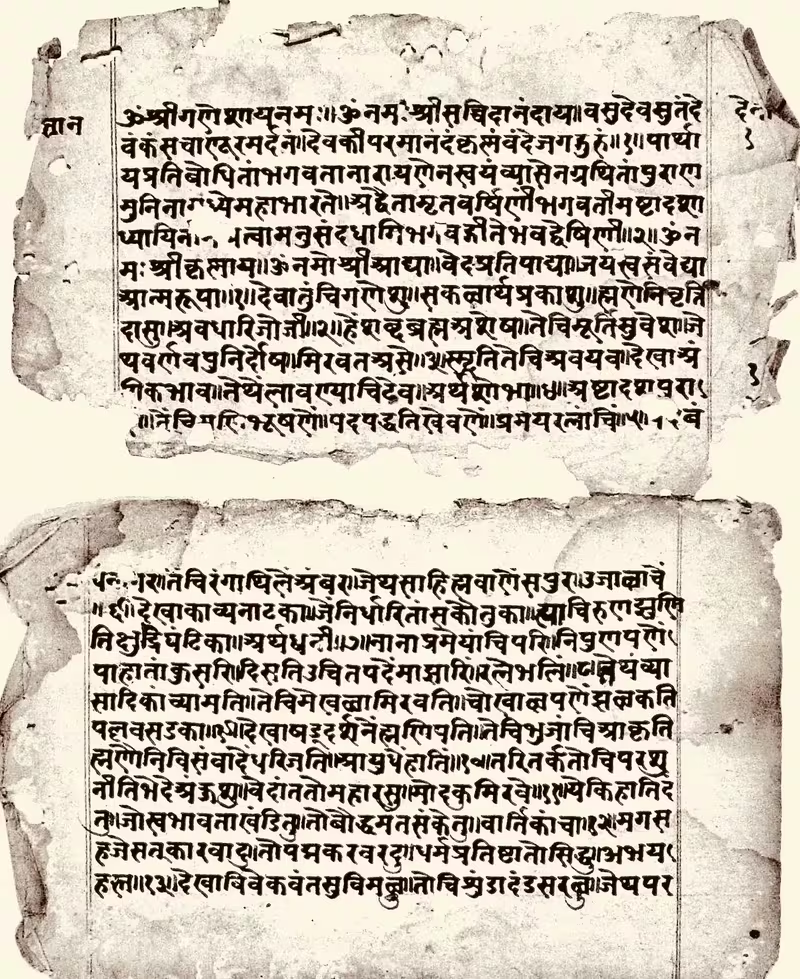
At the tender age of fifteen, around 1290 CE, Dnyaneshwar composed his magnum opus, the Bhavarthadipika, popularly known as the Dnyaneshwari. Seated before a pillar in a temple in Nevasa, he dictated this sublime commentary on the Bhagavad Gita to his scribe, Sacchidananda Baba. This act was nothing short of a cultural and spiritual revolution. Until then, seminal scriptures like the Gita were accessible only to the Sanskrit-literate elite.
Dnyaneshwar chose to write in Marathi, the vernacular language of the people. This decision was a deliberate act of democratizing knowledge. He believed that the path to liberation should not be a guarded secret but a sunlit road open to everyone. The Dnyaneshwari is far more than a simple translation. It is an expansive, philosophical, and poetic discourse that uses the ovi meter, a lyrical four-line stanza, to brilliant effect. Dnyaneshwar employed a wealth of metaphors and similes drawn from everyday life—nature, farming, family, and village crafts—to illuminate the most complex concepts of Advaita Vedanta philosophy. He made the abstract tangible, the esoteric accessible, and the divine personal. The work is celebrated for its spiritual insight, its psychological depth, and its unparalleled literary beauty, effectively establishing Marathi as a language capable of sophisticated philosophical expression.
Amrutanubhav (The Nectar of Experience)
After completing the Dnyaneshwari, Dnyaneshwar, on the advice of his guru Nivruttinath, penned an independent philosophical treatise, the Amrutanubhav. If the Dnyaneshwari was an exposition of existing scripture, the Amrutanubhav was a direct articulation of his own mystical experience. It is a dense, profound, and highly original work that explores the non-dualistic nature of reality. Drawing from the principles of Shaivism and Advaita Vedanta, it delves into the metaphysical union of Shiva (consciousness) and Shakti (energy), presenting a vision of the universe as a seamless play of the one Absolute Reality. It remains a challenging but deeply rewarding text for advanced spiritual seekers and is considered a masterpiece of Indian philosophy.
Changdev Pasashti and Devotional Abhangas
Dnyaneshwar's wisdom was matched by his humility. His Changdev Pasashti is a collection of 65 verses addressed to Changdev, a powerful yogi who, after living for a purported 1400 years, was filled with spiritual pride. Unsure how to address the young Dnyaneshwar, Changdev sent him a blank piece of paper. In response, Dnyaneshwar composed these verses, which gently dismantled the yogi's ego by explaining the true nature of Self-realization. The work is a masterclass in compassionate teaching.
Alongside these major works, Dnyaneshwar composed numerous abhangas—lyrical devotional poems. His collection, known as the Haripath, extols the practice of Namasmarana, the constant chanting of God's name, as the simplest and most effective spiritual path in the current age (Kali Yuga). These abhangas, filled with love and longing for the divine, became the very soul of the Varkari tradition, sung by millions of pilgrims (varkaris) on their annual pilgrimage to the shrine of Lord Vithoba in Pandharpur.
Legacy & Influence
In 1296, at the age of just 21, having fulfilled his life's purpose, Sant Dnyaneshwar made the conscious decision to leave his mortal body. In the town of Alandi, near modern-day Pune, in the presence of his siblings and countless devotees, he entered a state of Sanjeevan Samadhi—a yogic practice of entombing oneself while in a deep meditative state. His tomb in Alandi has since become one of the most sacred pilgrimage sites in Maharashtra.
His departure did not end his influence; it immortalized it. Dnyaneshwar's legacy is vast and multifaceted:
Father of Marathi Literature: By choosing to write his most profound works in Marathi, Dnyaneshwar elevated the language from a regional dialect to a powerful literary and philosophical medium. The Dnyaneshwari is considered the foundational text of Marathi literature, revered for its poetic genius and linguistic richness.
Architect of the Varkari Tradition: Along with Sant Namdev, Dnyaneshwar laid the philosophical and devotional cornerstone of the Varkari Sampradaya. He synthesized the intellectual rigor of Vedanta, the discipline of Nath Yoga, and the heartfelt emotion of Bhakti into a cohesive and inclusive spiritual path. This tradition continues to thrive today, with the annual wari pilgrimage to Pandharpur standing as a testament to his enduring vision of egalitarian devotion.
A Social and Spiritual Reformer: Dnyaneshwar's life and teachings were a powerful challenge to the rigidities of the caste system and religious orthodoxy. By asserting that direct experience of the divine was available to all through devotion and self-knowledge, he empowered the common person and fostered a more democratic spiritual ethos.
Today, Sant Dnyaneshwar is affectionately known as Mauli—a reverential term meaning 'Mother'—by his devotees. This title reflects the deep love and nurturing wisdom that pervades his work. His abhangas are sung in homes and temples, his philosophy is studied by scholars, and his life story continues to inspire millions. In a world often divided by dogma and hierarchy, the voice of Dnyaneshwar rings out as a timeless call for unity, compassion, and the simple, profound truth that the divine resides within the heart of every being.