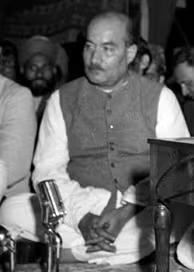
The Roar of a Lion: Shabbir Hasan Khan 'Josh' Malihabadi
In an era when India’s soul was forged in the crucible of rebellion, when the air crackled with the demand for azaadi (freedom), one voice rose above the din, not with a whisper, but with a thunderous roar. This was the voice of Shabbir Hasan Khan, a man better known by his electrifying takhallus (pen name), 'Josh'—meaning passion or excitement. Hailed as the Shaayar-e-Inquilab (Poet of Revolution), Josh Malihabadi was more than a poet; he was a phenomenon. His verses were not mere couplets but cannons, firing salvoes against the British Raj, challenging orthodoxy, and awakening a generation to the promise of a new dawn. His life, like his poetry, was a tempest of passion, conviction, glory, and profound tragedy, a story that charts the tumultuous course of the Indian subcontinent in the 20th century.
Early Life: A Legacy of Words
Josh was born on December 5, 1898, in the historic town of Malihabad, near Lucknow, in what was then the United Provinces of Agra and Oudh. He was not born into a vacuum of literary talent; poetry was in his very bloodline. He hailed from an affluent Afridi Pathan family that boasted a formidable poetic lineage. His great-grandfather, Nawab Faqir Muhammad Khan 'Goya', his grandfather, Nawab Muhammad Ahmad Khan 'Ahmad', and his own father, Basheer Ahmed Khan 'Basheer', were all accomplished poets. The family estate was a cradle of culture, where the cadence of Persian and Urdu verse was as common as the scent of the famous Malihabadi mangoes.
This privileged upbringing provided him with an impeccable education. He was tutored at home in the classical languages of Arabic and Persian, mastering the foundations of Islamic and Oriental literature. This traditional grounding gave his later, revolutionary work an unshakeable classical structure. He later attended St. Peter's College in Agra and passed the Senior Cambridge examination from Aligarh in 1914. For a brief but formative period, he also studied at Visva-Bharati in Santiniketan, the university founded by the great Rabindranath Tagore. Though his stay was short, the exposure to Tagore’s humanistic and syncretic vision left an indelible mark on his worldview.
But the world outside his cloistered, literary upbringing was in flames. The early 20th century was a period of intense political awakening in India. The Jallianwala Bagh massacre of 1919 sent shockwaves of horror and rage across the nation, and the growing Non-Cooperation Movement galvanized millions. For a young man named 'Josh', whose very essence was passion, this charged atmosphere was not just a backdrop; it was a calling.
Career: The Pen as a Sword
Josh's professional journey began in 1925 with a position as a supervisor of translation work at Osmania University in the princely state of Hyderabad. This period allowed him to immerse himself in a vibrant intellectual environment. However, his rebellious spirit could not be contained by academic confines. He penned a fiery nazm (thematic poem) criticizing the autocratic rule of the Nizam of Hyderabad. The poem, a direct challenge to authority, resulted in his swift exile from the state—a pattern of defiance that would define his life.
Returning to northern India, he fully embraced his role as the Shaayar-e-Inquilab. He founded the journal Kaleem (The Speaker), using its pages to publish fiercely anti-British poetry and prose. His voice, rich with a powerful, almost martial vocabulary, resonated deeply with the youth of the independence movement. He became a star of the mushaira circuit, where his dramatic recitations could hold thousands spellbound. When Josh took the stage, it was not merely a poetry reading; it was a political event. His poem, East India Company ke Farzandon se Khitab (An Address to the Sons of the East India Company), was a direct, blistering indictment of colonial rule, its verses echoing in rallies and protests.
One of his most celebrated works, Hussain aur Inquilab (Hussain and Revolution), masterfully connected the 7th-century martyrdom of Imam Hussain at Karbala—a potent symbol of resistance against tyranny in Islamic tradition—to the contemporary struggle against British imperialism. He wrote:
“Insaan ko bedaar toh ho lene do, Har qaum pukaregi hamare hain Hussain.” (Let humanity awaken, Every nation will claim Hussain as their own.)
Through such verses, he universalized the struggle for justice, making it a timeless human cause.
Beyond poetry, Josh's command of the language led him to other avenues. He worked for a time in the Hindi film industry in Bombay as a lyricist and dialogue writer, contributing to films like Man Ki Jeet (1944). After India gained independence in 1947, his friend and admirer, Prime Minister Jawaharlal Nehru, appointed him as the editor of the prestigious literary journal Aaj Kal, published by the government's Publications Division.
His magnum opus, however, is arguably his autobiography, Yaadon ki Baaraat (The Procession of Memories). Written with searing honesty and a flair for the dramatic, it is a monumental work that provides an unfiltered look into his life, his loves, his literary rivalries, and his political convictions. Its frankness on personal matters shocked the literary establishment of his time, but it remains an invaluable document of an extraordinary life lived through extraordinary times.
The Tragic Migration
In 1954, the Government of India honored Josh with the Padma Bhushan, the nation's third-highest civilian award, a testament to his immense contribution to literature and the freedom struggle. He was a celebrated national figure, a friend to the Prime Minister, and a living legend of Urdu poetry. Yet, just two years later, in 1956, he made a decision that would haunt him for the rest of his life: he migrated to Pakistan.
The reasons behind this move are complex and debated. Josh himself expressed concerns about the future of the Urdu language in India, fearing it would be marginalized. He was also reportedly persuaded by some Pakistani contemporaries who promised him a position of great prestige. Despite fervent appeals from Nehru, who personally asked him to stay, Josh departed.
His life in Pakistan, however, was a bitter disappointment. The revolutionary, secular, and fiercely independent poet found himself at odds with the conservative and bureaucratic state machinery of the new nation. He was viewed with suspicion by the establishment. The promised accolades never fully materialized, and he was often relegated to the margins, facing financial hardship and a deep sense of alienation. He was a lion of India, but in Pakistan, he felt caged. He famously lamented his decision, seeing it as a profound error that uprooted him from the soil that had nourished his soul and his art. The Poet of Revolution found himself in a land that was, in his view, inhospitable to true revolution.
He passed away in Islamabad on February 22, 1982, a man spiritually adrift, forever yearning for the Ganga-Jamuni culture of the land he had left behind.
Legacy: A Voice That Endures
Josh Malihabadi's legacy is as vast and complex as his life. He is remembered, first and foremost, as the Shaayar-e-Inquilab. His poetry provided the soundtrack to a revolution, and his words gave courage to millions. He wielded the Urdu language like a master swordsman, his command over its rich vocabulary—both Persianized and colloquial—was unparalleled. He revitalized the nazm, freeing it from its traditional constraints and turning it into a powerful vehicle for social and political commentary.
Beyond his revolutionary fervor, he was also the Shaayar-e-Shabaab (Poet of Youth), a romantic whose verses captured the intensity of love and the beauty of nature with equal passion. His work spanned the entire spectrum of human emotion, from fiery rage to tender romance, from philosophical introspection to scathing satire.
Today, Josh's influence persists on both sides of the border he tragically crossed. In India, he is revered as a national poet, a freedom fighter whose pen was his weapon. In Pakistan, after years of official neglect, he is increasingly recognized as one of the greatest Urdu poets of all time; in 2013, the government posthumously awarded him the Hilal-e-Imtiaz, its second-highest civilian honor.
Shabbir Hasan Khan 'Josh' Malihabadi was a colossus of literature, a man whose life was a testament to the power of words. He was a poet of grand passions and profound contradictions, a rebel who challenged empires and orthodoxies alike. His roar may have been silenced by death, but his verses continue to echo, reminding us of a time when poetry was not just an art form, but a declaration of war for the soul of a nation.