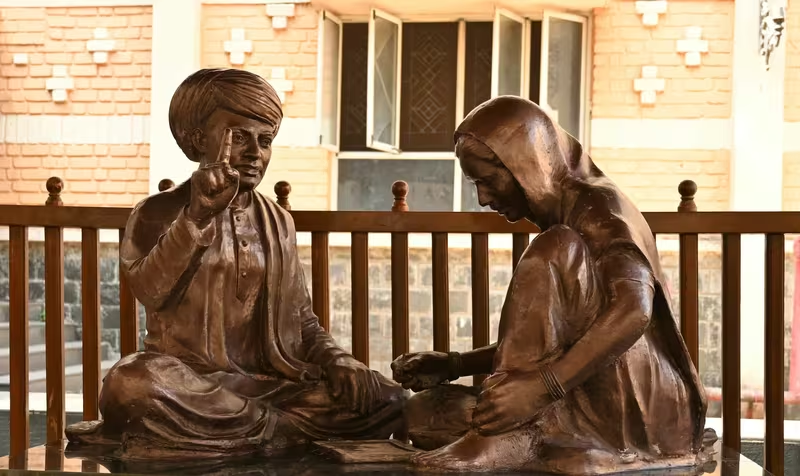
Jyotirao Phule: Architect of India's Social Revolution
In the stratified society of 19th-century India, where tradition was law and hierarchy was divine, one man dared to imagine a world built on equality and reason. He was not a king, a general, or a wealthy merchant. He was the son of a vegetable vendor from the Mali (gardener) community, a caste deemed 'Shudra' in the rigid Brahminical order. His name was Jyotirao Govindrao Phule, and he would become a 'Mahatma'—a great soul—who took a hammer to the foundations of caste and patriarchy, igniting a social revolution whose flames continue to light the path for modern India.
His life, spanning from 1827 to 1890, was a testament to the power of a single, determined individual to challenge centuries of oppression. Long before the terms 'feminism' and 'Dalit rights' entered the common lexicon, Phule was their fiercest advocate, wielding his most potent weapon: education.
Early Life & The Awakening of a Rebel
Jyotirao Phule was born on April 11, 1827, in Poona (now Pune), the cultural and political heart of the erstwhile Peshwa-ruled Maratha confederacy, which had recently come under British rule. His family belonged to the Mali caste, traditionally occupied with horticulture. His father, Govindrao, and mother, Chimnabai, named him Jyotirao. The family surname, originally Gorhe, was replaced with Phule, a nod to their ancestral trade of selling flowers (phul).
Tragedy struck early when his mother passed away while he was just an infant. Raised by a paternal aunt, young Jyotirao showed a remarkable intellect. He attended a primary school for a few years, but social pressures of the time dictated that a boy of his caste should not pursue formal education. He was withdrawn from school to work on the family farm. However, the spark of his curiosity had been lit. His intellectual brilliance did not go unnoticed. A Christian missionary, Leggit Thomas, and a Muslim teacher, Ghaffar Baig Munshi, who were his neighbours, recognized the boy's potential and convinced his father to allow him to resume his studies.
In 1841, at the age of 14, Jyotirao was enrolled in the Scottish Mission's High School in Poona. This was a transformative experience. The Western curriculum exposed him to the ideas of liberty, equality, and rationalism. He avidly read Thomas Paine's seminal work, The Rights of Man, which profoundly shaped his worldview. It armed him with the intellectual framework to question the inherent injustices he saw around him—the dehumanizing caste system and the complete subjugation of women.
A pivotal, and deeply humiliating, incident in 1848 solidified his resolve. He was invited to attend the wedding of a Brahmin friend. As he joined the marriage procession, he was accosted and insulted by his friend's relatives for the audacity of a Shudra walking alongside Brahmins. He was told his place and forced to leave the procession. The incident cut him to the quick. He went home and questioned his father about the incident, who could only explain that this was the dictate of the caste system. This personal sting of discrimination was the catalyst that turned a thoughtful young man into a lifelong revolutionary.
He understood then that the chains of social slavery were more insidious and deeply entrenched than political subjugation. The liberation of his people, he concluded, could not come from a change of rulers, but from a fundamental annihilation of the caste system and the emancipation of the mind through education.
A Revolution Begins: Education for All
Jyotirao understood that knowledge was power, and for centuries, this power had been deliberately withheld from the lower castes and women to ensure their perpetual servitude. His first act of rebellion was deeply personal and profoundly strategic: in 1840, he had been married to a young girl named Savitribai. Now, he began teaching his wife to read and write at home, grooming her to be his partner in the monumental task ahead.
Pioneering Women's Education
In 1848, a year after completing his own education, Jyotirao and Savitribai Phule opened India's first school for girls in Bhide Wada, Pune. It was an act of radical defiance. The orthodox elements of society were enraged. The idea that a girl, especially from a non-Brahmin caste, could be educated was seen as a violation of scripture and tradition. The couple faced immense hostility. As Savitribai walked to the school, she was regularly assaulted with stones, mud, and cow dung. Undeterred, she would carry a spare sari with her, change into it at the school, and carry on with her lessons.
The Phules established several more schools for girls, and crucially, for children from the so-called 'untouchable' castes—the Mahars and Mangs—who were denied entry everywhere else. They refused to be intimidated, even when Jyotirao's own father, under immense social pressure, asked the couple to leave his home. They found shelter with a friend, Usman Sheikh, whose sister, Fatima Sheikh, became a close aide and is now recognized as India's first Muslim woman teacher.
The Satyashodhak Samaj: A Quest for Truth
Phule's mission was not just to educate, but to dismantle the entire ideological structure that justified inequality. On September 24, 1873, he founded the Satya Shodhak Samaj (Society of Truth Seekers). This was not merely an organization; it was a socio-spiritual movement for the liberation of the Shudras, Ati-Shudras (Dalits), and women.
The Samaj's core philosophy was a complete rejection of Brahminical supremacy, idol worship, and the need for priestly intermediaries. It promoted rational thought, human equality, and social justice. Its motto was simple: to free people from the mental slavery imposed by religious scriptures and rituals that were designed to exploit them. The Samaj conducted simple, inexpensive, and priest-less marriage ceremonies, encouraged inter-caste unions, and worked tirelessly to instill a sense of dignity and self-respect among the masses.
Champion of the Oppressed
Phule's activism went beyond education and ideology; it was rooted in profound human compassion. Two acts, in particular, stand out:
Opening the Water Tank (1868): In a society where 'untouchables' were forbidden from using public wells and water sources, Jyotirao and Savitribai opened the water tank in their own home to everyone, regardless of caste. It was a simple yet revolutionary gesture, a direct challenge to the inhuman practice of untouchability.
The Home for Widows and their Children (1863): Phule was deeply moved by the plight of upper-caste widows, who were often sexually exploited and, if they became pregnant, were left with the desperate choice of suicide or infanticide. In 1863, he established the Balhatya Pratibandhak Griha (Infanticide Prevention Home), a safe haven where widows could give birth and leave their children to be cared for. The Phules, who were childless, later adopted one of these children, Yashwantrao, and raised him as their own.
The Power of the Pen: Phule's Literary Legacy
Jyotirao Phule was a prolific writer who used his pen as a weapon to dissect and demolish social hierarchies. His language was direct, powerful, and accessible to the common person.
His most celebrated work, Gulamgiri (Slavery), published in 1873, is a blistering critique of the caste system. Written in the form of a dialogue, it systematically deconstructs Brahminical myths and exposes the system as a form of brutal enslavement. In a remarkable act of international solidarity, Phule dedicated the book to the good people of the United States for their role in the abolition of slavery, drawing a direct parallel between the plight of African Americans and that of the Shudras and Ati-Shudras in India.
Other significant works include:
- Tritiya Ratna (1855): A play exposing Brahminical exploitation.
- Shetkaryacha Asud (Cultivator's Whipcord, 1881): A treatise detailing the exploitation of the peasant masses by the government, moneylenders, and the priestly class.
- Sarvajanik Satya Dharma Pustak (The Book of the True Religion, 1891): Published posthumously, this work outlines his vision for a universal religion based on truth, equality, and fraternity, free from rituals and intermediaries.
Through his writings, Phule became the first Indian intellectual to articulate a cohesive and powerful critique of caste from the perspective of the oppressed, laying the ideological groundwork for future anti-caste movements.
Legacy & Enduring Influence
On November 28, 1890, after suffering a stroke, Jyotirao Phule passed away. But his revolution had just begun. In 1888, two years before his death, the social reformer Vithalrao Krishnaji Vandekar publicly bestowed upon him the title of 'Mahatma' (Great Soul), a recognition of his selfless and tireless service to humanity.
His legacy is monumental and multi-faceted:
Father of the Indian Social Revolution: Phule's work fundamentally altered the discourse on social reform in India. He shifted the focus from peripheral issues like widow remarriage within upper castes to the central, structural problem of the caste system itself.
Inspiration for Dr. B.R. Ambedkar: Phule's life and philosophy had a profound impact on Dr. B.R. Ambedkar, the chief architect of the Indian Constitution. Ambedkar considered Phule one of his three great gurus, alongside Gautama Buddha and Sant Kabir. He saw Phule's work as the foundation upon which he built his own lifelong struggle for the annihilation of caste and the empowerment of Dalits.
Pioneer of Women's Emancipation: The schools started by Jyotirao and Savitribai Phule were the first drops that started a flood of educational opportunities for women in India. Their partnership stands as an enduring symbol of gender equality and collaborative struggle.
Champion of the Farmer: Through works like Shetkaryacha Asud, he was one of the first leaders to articulate the grievances of the Indian farmer, connecting their economic exploitation to the social structures of caste.
Today, Mahatma Jyotirao Phule is remembered not just as a historical figure but as a guiding star for all who fight for social justice, equality, and human dignity. His insistence that social democracy is the prerequisite for political democracy remains as relevant as ever. In the story of modern India, a story of an ongoing struggle for liberty and equality, the chapter written by the boy from the Mali community who dared to dream of a world without chains remains its most powerful and inspiring beginning.