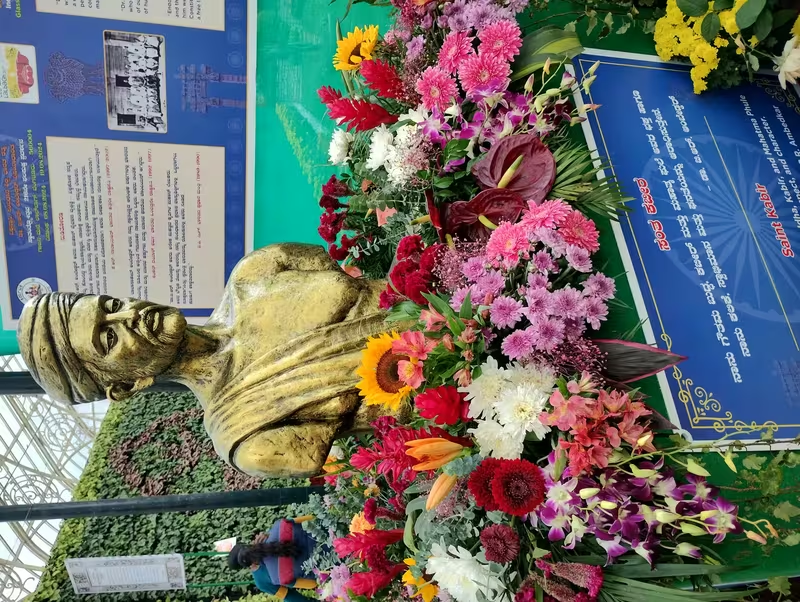
Kabir Das: The Weaver of Truth
In the vibrant, chaotic, and spiritually charged landscape of 15th-century North India, a voice arose from the humble weaver's quarter of Varanasi. It was a voice that belonged to no single creed but spoke to all, a voice that was at once earthy and sublime, caustic and compassionate. This was the voice of Kabir Das, a mystic poet and Sant whose revolutionary verses wove a new fabric of spiritual understanding, challenging the very foundations of religious orthodoxy and social hierarchy. Revered by Hindus, Muslims, and Sikhs alike, Kabir's legacy is not one of temples or empires, but of timeless words that continue to echo through the heart of India, urging humanity towards a truth that lies beyond ritual and division.
Early Life & Background: A Lotus in the Mud
The precise details of Kabir's birth are shrouded in the mists of legend, a fitting beginning for a man who spent his life insisting on the irrelevance of lineage and creed. Tradition places his life between the years 1398 and 1518, a remarkable lifespan that saw the decline of the Delhi Sultanate and the stirrings of new political and cultural formations. The most enduring story of his birth tells of him being found as an infant, resting on a lotus leaf in the Lahar Tara tank, a large pond near Varanasi. He was discovered and raised by a devout, childless Muslim weaver couple, Niru and Nima.
While this origin story is hagiographic, the verifiable core of his identity is his upbringing in a community of Julahas, or weavers, in the holy city of Varanasi (then known as Kashi). This context is crucial to understanding his life and work. Varanasi in the 15th century was a crucible of religious thought—the epicenter of orthodox Brahminical Hinduism, yet also a place with a significant Muslim population and a vibrant undercurrent of Sufi mysticism and heterodox yogic traditions. Kabir grew up in this melting pot, absorbing its myriad influences while belonging fully to none. His profession as a weaver was not merely a livelihood; it became the central metaphor for his philosophy—the act of taking disparate threads and weaving them into a single, cohesive whole.
Kabir's spiritual education did not come from formal schooling or scriptures; he was likely illiterate. Instead, his wisdom was forged in the loom of life, through keen observation and profound inner reflection. The most significant documented influence on his spiritual journey was the Vaishnava Bhakti saint, Swami Ramananda. According to tradition, the low-caste Kabir, yearning for initiation, devised a plan. He lay on the steps of the ghats where Ramananda came for his pre-dawn bath. In the darkness, the guru accidentally stepped on him and cried out, "Ram! Ram!" Kabir took this utterance as his mantra and Ramananda as his guru. This story, whether literal or allegorical, highlights the Bhakti ideal of devotion transcending the rigid barriers of caste.
Career & Major Contributions: The Fearless Voice
Kabir was not a court poet or a secluded ascetic. He was a householder and a working man whose spiritual practice was integrated into his daily life. His 'career' was his fearless, uncompromising articulation of a radical spiritual path that rejected all external authority in favor of direct, personal experience.
A Scathing Critique of Orthodoxy
The cornerstone of Kabir's teaching was a relentless attack on what he saw as the hypocrisy and emptiness of organized religion. With biting wit and profound simplicity, he exposed the folly of blind ritualism, whether Hindu or Islamic. He questioned the efficacy of pilgrimages, idol worship, and ceremonial purification. One of his famous dohas (couplets) declares:
Pahan puje hari mile, to main puju pahar (If by worshipping stones one can find God, I would worship a mountain)
He was equally critical of Islamic practices, mocking the loud call to prayer (azaan) and the ritual of pilgrimage to Mecca. For Kabir, God was not confined to a temple in Kashi or the Kaaba in Mecca; the divine was an indwelling presence, accessible to all, everywhere. He berated the religious gatekeepers—the Brahmin pandits and the Muslim mullahs—for creating divisions and exploiting the common people with complex doctrines and empty rituals.
The Path of the Formless (Nirguna Bhakti)
Kabir was a foremost exponent of the Nirguna school of the Bhakti movement, which conceived of God as formless, attributeless, and transcendent. He used various names for this ultimate reality—Ram, Hari, Allah, Sahib—but emphasized that these were mere labels for the one, ineffable truth. His 'Ram' was not the mythological king of Ayodhya, but the all-pervading divine consciousness. This syncretic approach sought to dissolve the distinctions between Hindu and Islamic conceptions of God, pointing towards a universal spirituality.
The Primacy of the Guru
In a world of confusing doctrines and competing faiths, Kabir placed immense importance on the role of the Satguru, the true teacher. The Guru was not a divine intermediary but a guide who had realized the truth and could help the seeker remove the veil of ignorance. For Kabir, the Guru was greater than any scripture or holy place, for it was the Guru who could illuminate the path to inner realization.
Literary Legacy: The Bijak and the Oral Tradition
As an oral poet, Kabir's verses were composed and sung in the vernacular Hindi of his region—a potent mixture of Awadhi, Braj, and Bhojpuri. This made his message accessible to the masses, unlike the Sanskrit of the elite. His compositions were passed down through generations of disciples and folk singers.
Three major collections of his work exist today, compiled after his death:
- The Bijak ('The Seedling'): This is the most sacred text of the Kabir Panth, the community that follows his teachings. It is a powerful, often enigmatic compilation of his philosophy, divided into sections like Sakhis (witness poems or couplets), Shabdas (songs), and Ramainis (doctrinal poems).
- The Kabir Granthavali: This collection was preserved by the Dadupanthi tradition in Rajasthan and contains a vast number of his verses.
- The Guru Granth Sahib: Perhaps the most significant testament to Kabir's widespread influence is the inclusion of over 500 of his verses in the holy scripture of Sikhism. Guru Arjan Dev, who compiled the Adi Granth in 1604, recognized the universality of Kabir's message, placing his compositions alongside those of the Sikh Gurus and other saints. This act cemented Kabir's status as a pivotal figure in the spiritual heritage of North India.
Legacy & Influence: An Enduring Weave
Kabir's death, like his birth, is the subject of a powerful legend that encapsulates his life's message. It is said that upon his death in Magahar—a place believed to condemn one to a donkey's life in the next birth, a choice he made to defy superstition—his Hindu and Muslim followers disputed over the rites for his body. The Hindus wished to cremate him, the Muslims to bury him. When they lifted the shroud, they found not a corpse, but a pile of fresh flowers. The legend says the two communities divided the flowers, each performing the last rites according to their own tradition. This story serves as the final, perfect metaphor for a life spent trying to unite two faiths.
The Kabir Panth
Kabir's most direct legacy is the Kabir Panth, a vibrant religious community that sees him as its founder and spiritual master. With centers across India and beyond, particularly in Uttar Pradesh and Bihar, the Panthis preserve his teachings, primarily through the Bijak, and continue his mission of promoting a casteless society and a path of inner truth.
Influence on Sikhism and the Bhakti Movement
Kabir's influence extends far beyond his own sect. His ideas of a formless God, the importance of the Guru, the critique of caste, and the emphasis on inner experience deeply resonated with Guru Nanak, the founder of Sikhism. The substantial presence of Kabir's bani (verses) in the Guru Granth Sahib is a testament to this profound philosophical alignment. He stands as a pillar of the Sant Mat tradition and a towering figure of the Bhakti movement, whose radical, non-sectarian approach inspired countless later poets and social reformers.
A Timeless Modern Voice
Centuries after he walked the lanes of Varanasi, Kabir's voice remains startlingly modern. His fierce advocacy for social equality and his condemnation of religious hypocrisy are as relevant today as they were in the 15th century. His verses are not just historical artifacts; they are a living tradition. They are sung by classical and folk musicians, quoted by social activists, and studied by scholars. Rabindranath Tagore was so moved by his poetry that he translated one hundred of Kabir's poems into English in 1915, introducing his powerful message to the wider world.
Kabir Das was more than a poet; he was a social and spiritual revolutionary. He was the weaver who saw the divine thread running through all of existence and challenged everyone to see it too. His life and work are a powerful reminder that the path to truth is not paved with elaborate rituals or dogmatic beliefs, but with courage, love, and the simple, profound act of looking within.