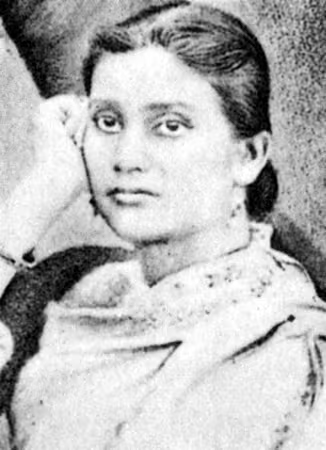
Kadambini Ganguly: The Unflinching Pioneer of Indian Medicine
In the late 19th century, in the bustling, intellectually charged heart of Calcutta, the capital of British India, a woman’s world was largely confined to the four walls of her home. Her purpose was preordained: marriage, motherhood, and domesticity. In this rigid, patriarchal landscape, the very idea of a woman attending university, let alone dissecting a human body to study medicine, was not just radical—it was considered a scandalous affront to tradition. Yet, it was precisely in this era that Kadambini Bose Ganguly (1861-1923) emerged, a woman of indomitable will who would not only breach the highest bastions of male-dominated education but also become India's first female physician to practice modern Western medicine, carving a path for generations of women to follow.
Her story is not merely one of a 'first'; it is a powerful saga of relentless struggle, intellectual brilliance, and a deep-seated commitment to social reform that reshaped the role of women in Indian public life.
Early Life & The Seeds of Rebellion
Kadambini was born on July 18, 1861, in Bhagalpur, Bihar, into a society bound by convention. However, her destiny was shaped by an extraordinary influence: her father, Braja Kishore Basu. A headmaster by profession, he was a passionate advocate for social reform and a prominent leader of the Brahmo Samaj, a progressive spiritual and social movement that championed the abolition of caste, idol worship, and, most critically, the emancipation and education of women. For Braja Kishore, educating his daughter was not a concession but a moral imperative. He had co-founded the Bhagalpur Mahila Samiti in 1863, one of India's earliest women's organizations, demonstrating a commitment to female upliftment that was far ahead of his time.
This progressive upbringing instilled in young Kadambini a fierce intellectual curiosity and an unshakeable belief in her own potential. When the family moved to Calcutta, she was enrolled in the Hindu Mahila Vidyalaya, which later merged with the Bethune School. Here, her academic prowess shone, but she soon encountered her first major institutional barrier.
Upon completing her schooling, she set her sights on an unprecedented goal: a university degree. Calcutta University, the premier institution of higher learning in the British Empire, did not admit female candidates. The notion was preposterous to the colonial and native patriarchy alike. But Kadambini was not alone in her fight. Her cause was championed by a formidable group of Brahmo reformers, including her teacher and future husband, Dwarkanath Ganguly.
Dwarkanath, a fiery journalist, teacher, and social activist, launched a relentless public campaign. Through his influential journal, Abalabandhab (Friend of Women), and in tireless public forums, he and his colleagues argued, debated, and shamed the university senate. Their persistence paid off. In 1878, Calcutta University amended its policies, and Kadambini Bose became the first woman to pass its entrance examination. In 1883, she and Chandramukhi Basu made history together, becoming the first female graduates of Calcutta University, and by extension, the entire British Empire. It was a monumental victory that sent shockwaves through society.
Storming the Citadel of Medicine
A Bachelor of Arts degree was a revolutionary achievement, but for Kadambini, it was only a stepping stone. Her true ambition lay in a field even more fiercely guarded by men: medicine. Her motivation was both intellectual and deeply compassionate. She was acutely aware of the suffering of women in the zenanas (secluded women's quarters), who, due to the constraints of purdah, often endured illness and death rather than be examined by a male doctor. She saw medicine as a calling—a direct way to serve her countrywomen.
Once again, the doors were slammed shut. The Calcutta Medical College (CMC), the most prestigious medical institution in Asia, flatly refused her admission. The resistance was immense. Conservative society was horrified by the prospect of a respectable woman handling cadavers. But Dwarkanath, whom she had married in 1883 in a progressive Brahmo ceremony, once again took up the mantle. He waged a public battle, highlighting the hypocrisy of a system that denied medical care to half its population. The pressure mounted, and finally, in 1883, the authorities at CMC relented. Kadambini Bose Ganguly walked through its gates, the first Indian woman ever to do so.
Her time at CMC was fraught with hostility. She was the sole woman in a sea of men, facing daily ostracism from her peers and outright prejudice from some of her professors. One conservative professor, Dr. Rajendra Chandra Chandra, was so offended by her presence that he deliberately failed her in a final practical paper, thereby denying her the coveted MB (Bachelor of Medicine) degree. Despite this act of malice, her performance was so strong in all other subjects that the college was compelled to award her the Graduate of Medical College of Bengal (GMCB) diploma in 1886. This license gave her the full authority to practice medicine.
In that same year, Anandi Gopal Joshi also graduated as a doctor from the Woman's Medical College of Pennsylvania. Tragically, Joshi contracted tuberculosis and died a year later before she could establish a practice. It was Kadambini who went on to have a long, distinguished career, solidifying her place as India’s first practicing female physician with a degree in Western medicine.
A Career of Service, Activism, and Dignity
Armed with her degree, Kadambini was appointed to the Lady Dufferin Women's Hospital in Calcutta. However, she continued to face skepticism from a society—and a British medical establishment—that viewed a female doctor as an anomaly. The conservative Bengali press was particularly vicious. In 1891, the magazine Bangabasi published a deeply misogynistic cartoon, branding her a 'whore' and implying that her professional life was a cover for immoral behavior. It was a direct attack on her character, designed to shame her back into domesticity.
But the Gangulys were not a couple to be intimidated. In a move that was as courageous as it was unprecedented, Dwarkanath sued the magazine's editor, Mahesh Pal, for libel. The ensuing court case was a public spectacle, but they persevered. Dwarkanath won, and the editor was sentenced to six months in prison. The verdict was a landmark victory for the dignity of professional women across India.
Determined to silence any remaining doubts about her qualifications, Kadambini sailed to the United Kingdom in 1892. In an astonishingly short period, she obtained three advanced diplomas: the LRCP (Licentiate of the Royal College of Physicians) from Edinburgh, the LRCS (Licentiate of the Royal College of Surgeons) from Glasgow, and the LFPS (Licentiate of the Faculty of Physicians and Surgeons) from Dublin. She returned to India not just as a doctor, but as a physician with qualifications that surpassed many of her male, British counterparts.
Upon her return, her career flourished. She maintained her position at the Lady Dufferin Hospital and built a thriving private practice. She became the trusted physician for women from all strata of society, from the most orthodox Hindu families to the royal family of Nepal, who often summoned her for consultations.
Kadambini’s life, however, was never confined to medicine. She was a mother to eight children (including her five stepchildren from Dwarkanath’s first marriage), expertly balancing a demanding career with a large family. And her vision for a better India extended far beyond the clinic. Deeply influenced by the nationalist ferment of the era, she became an active participant in the country’s political awakening.
In 1889, she and five other women attended the fifth session of the Indian National Congress as delegates, breaking a long-standing male monopoly. It was Kadambini who was chosen to deliver the vote of thanks from the podium, a symbolic act that announced the arrival of women on India’s political stage. During the tumultuous years of the Partition of Bengal, she was a fierce critic of British policy. In 1906, she organized and presided over the Women's Conference in Calcutta, mobilizing women in the Swadeshi movement. Her compassion knew no bounds; deeply moved by the horrific, slave-like conditions of indentured tea-plantation workers in Assam, she personally travelled to the region to investigate and became a powerful voice advocating for their rights. She also actively supported Mahatma Gandhi's Satyagraha movement in South Africa, helping to raise funds for the cause.
Legacy & The Enduring Light
Kadambini Ganguly remained a dedicated physician until her last breath. On October 3, 1923, at the age of 62, she passed away shortly after successfully performing a critical operation. She worked until the very end, a testament to the passion that had driven her throughout her life.
Her legacy is monumental. She was not just a doctor; she was a revolution in a sari. In an age when women were invisible, she made herself seen and heard. In an age when women were told their minds were inferior, she proved herself to be an intellectual giant. She demonstrated that a woman could be a wife, a mother, a consummate professional, and a national leader, all at once.
Kadambini Ganguly pried open the doors of education and medicine, and through the breach she created, millions of Indian women have followed. Her life serves as a powerful reminder that the path to progress is often forged by the courage of individuals who refuse to accept the world as it is, and instead, dare to build the world as it should be. She was a physician who healed not just bodies, but a society sick with prejudice, and her unflinching spirit continues to inspire.