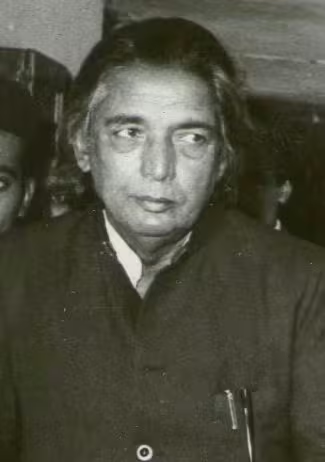
Kaifi Azmi: The Poet of Revolution and Romance
In the grand tapestry of 20th-century Indian literature, few threads shine with the fierce, vibrant, and multifaceted brilliance of Kaifi Azmi. Born Athar Husain Rizvi on 14 January 1919, in the small village of Mijwan in Uttar Pradesh's Azamgarh district, he was a man who contained multitudes. To the world, he was Kaifi, the revolutionary poet whose ink bled for the oppressed. He was the peerless film lyricist who gave voice to the deepest human emotions, from existential angst to romantic yearning. And he was the tireless activist who believed that a poem was not complete until it sparked action. His life, spanning a tumultuous and transformative period of Indian history, was a testament to the power of the written word to challenge, console, and change the world.
Early Life & The Forging of a Rebel
Kaifi Azmi's journey began in a traditional, land-owning Shia Muslim family. His father, a tehsildar, envisioned a modern education for his son, but familial pressure led the young Athar to the Sultan-ul-Madaris, a renowned seminary in Lucknow. It was here, amidst the rigorous study of theology and classical languages, that the seeds of rebellion were sown. The cloistered environment failed to contain his restless spirit. He organized a students' union, leading strikes and demanding reforms within the institution. This early taste of activism, which led to his expulsion, was a formative experience, shaping the defiant, anti-establishment voice that would define his later work.
Even more profound was his precocious poetic talent. At the tender age of eleven, he composed his first ghazal, a couplet that astonished seasoned poets with its maturity and depth:
“Itna toh zindagi mein kisi ki khalal pade, Hansne se ho sukoon na rone se kal pade.” (May someone’s presence so disrupt my life, That neither laughter brings peace, nor tears find respite.)
This early work hinted at the emotional complexity that would become his hallmark. Forsaking formal religious education, he immersed himself in the works of Marx and Gandhi, finding his true calling in the fervent political and literary climate of the 1940s. The Quit India Movement of 1942 was a crucible for his generation, and Kaifi, now a dedicated member of the Communist Party of India (CPI), answered its call. In 1943, he left his home and education behind, moving first to Kanpur and then to the bustling metropolis of Bombay to work as a full-time party activist and writer for its Urdu journal, Qaumi Jung.
Bombay was a melting pot of art, ideas, and revolution. It was here that Kaifi Azmi became a central figure in the Progressive Writers' Association (PWA), a movement that sought to align literature with the cause of social justice. Alongside contemporaries like Faiz Ahmed Faiz, Ali Sardar Jafri, and Ismat Chughtai, he championed a new kind of poetry—one that spoke not of mythical beloveds in secluded gardens, but of the factory worker, the landless farmer, and the subjugated woman.
A Career of Conscience and Creativity
Kaifi Azmi’s career can be seen as a powerful trilogy: his revolutionary poetry, his iconic work in Hindi cinema, and his lifelong social activism.
The Poet of the People
Kaifi’s poetry was his primary weapon against injustice. His verses were direct, potent, and charged with a revolutionary fire. He wielded the traditional forms of the ghazal and nazm to articulate modern, radical ideas. His first collection, Jhankar (1943), announced the arrival of a powerful new voice.
Perhaps his most celebrated poem is “Aurat” (Woman), a clarion call for gender equality that remains a feminist anthem to this day. In it, he rejects the pedestal of passive divinity that society places women upon, urging them to break free from their chains and join the march of progress as equals:
“Uth meri jaan, mere saath hi chalna hai tujhe.” (Arise, my love, you have to walk with me.)
Another seminal work, “Makaan” (House), is a scathing critique of class disparity. It tells the story of a construction worker who toils under the scorching sun to build a magnificent mansion, only to be shooed away from its gate once it is complete. The poem's final, haunting lines are a warning of an impending revolution, where the hands that built the structure will one day claim it for themselves.
The Lyricist of Hindi Cinema
While his heart belonged to revolutionary poetry, the financial realities of life in Bombay and his commitment to funding the Communist Party led Kaifi Azmi to the world of Hindi cinema. He entered the film industry not as a commercial artist, but as an idealist who believed that even popular art could carry a message.
His breakthrough came with Guru Dutt’s cinematic masterpiece, Kaagaz Ke Phool (1959). The song “Waqt Ne Kiya Kya Haseen Sitam” captured the film’s soul-stirring melancholy with a philosophical depth rarely seen in film lyrics. This marked the beginning of an illustrious career that would see him pen some of the most enduring songs in Indian cinema.
His collaboration with director Chetan Anand on the 1964 war film Haqeeqat produced an anthem for a nation. “Kar Chale Hum Fida Jaan-o-Tan Saathiyon” became synonymous with patriotism and sacrifice, a song that echoes across India to this day. Yet, in the same film, he penned the heart-wrenching “Ho Ke Majboor Mujhe Usne Bhulaya Hoga,” proving his ability to capture both national sentiment and intensely personal sorrow.
His versatility was his genius. In Heer Raanjha (1970), he achieved a cinematic first by writing the entire film's script and dialogue in rhyming verse, a monumental feat that blended folk tradition with cinematic storytelling. For Mahesh Bhatt's Arth (1982), his ghazals “Jhuki Jhuki Si Nazar” and “Tum Itna Jo Muskura Rahe Ho” explored the complexities of love and betrayal with a quiet, devastating elegance.
The Screenwriter and Activist
Kaifi’s contribution to cinema went beyond lyrics. He co-wrote the screenplay for M.S. Sathyu’s Garm Hava (1973) with Shama Zaidi. The film, a poignant and unflinching look at the identity crisis of an Indian Muslim family that chooses to remain in India after Partition, is considered a landmark of Indian cinema. His powerful, empathetic writing earned him a National Film Award and a Filmfare Award.
Throughout his fame and success, Kaifi never abandoned his roots or his ideals. His life was a seamless blend of art and activism. He remained a committed communist, a champion of secularism, and a voice for the marginalized. His anguish over the demolition of the Babri Masjid in 1992 was poured into his poem “Doosra Banwas” (The Second Exile), which mourned Lord Ram’s symbolic exile from the hearts of those who destroyed a place of worship in his name.
Legacy & Enduring Influence
Kaifi Azmi passed away on 10 May 2002, but his legacy is as vibrant and relevant as ever. He was a bridge between the classical traditions of Urdu poetry and the urgent demands of a modern, changing India. He proved that art for art’s sake was a hollow pursuit in a country grappling with poverty, inequality, and injustice. For him, art had to be for life’s sake.
His lasting impact is threefold:
Literary Influence: He redefined the purpose of Urdu poetry, infusing it with social consciousness and making it a powerful tool for change. His work continues to be studied and recited, inspiring new generations of poets and activists.
Cinematic Benchmark: He elevated the standard of film lyrics, demonstrating that they could be profound literature. His songs are not just melodies; they are poems set to music, cherished for their lyrical beauty, emotional depth, and philosophical weight.
A Legacy of Action: Perhaps his most enduring legacy lies in his village, Mijwan. In the later years of his life, he returned to the place of his birth and dedicated himself to its upliftment. He founded the Mijwan Welfare Society (MWS), an NGO focused on empowering rural girls through education and employment, particularly by reviving the traditional art of chikankari embroidery. Today, carried forward by his daughter, the renowned actress and activist Shabana Azmi, MWS is a thriving organization that has transformed the lives of thousands of women, a living monument to Kaifi’s belief that change must begin at the grassroots.
Honored with the Padma Shri, the Sahitya Akademi Award, and numerous other accolades, Kaifi Azmi’s true measure lies not in awards but in the hearts he touched. He is remembered as a shayar-e-awaam—a poet of the people—whose life was a powerful poem written in the ink of courage, compassion, and an unwavering commitment to a more just and beautiful world.