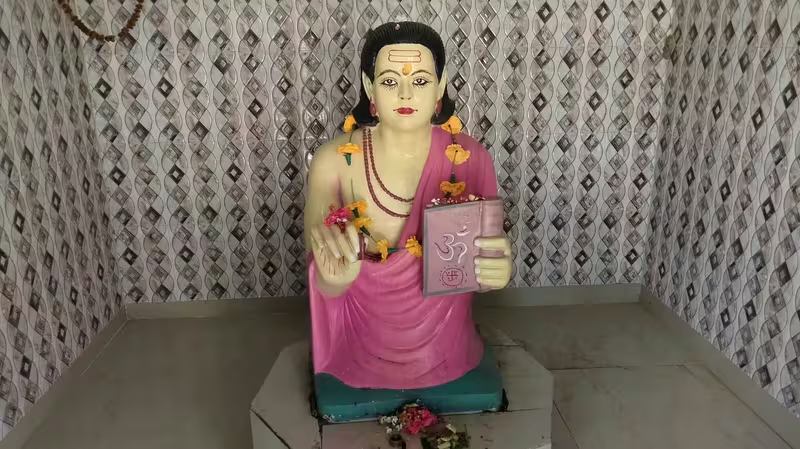
The Poet of a Golden Age
In the grand tapestry of world literature, few names shine with the enduring brilliance of Kalidasa. Hailed as the Mahakavi (Great Poet), he stands as the unrivaled master of classical Sanskrit, a playwright and poet whose works represent the artistic pinnacle of ancient India. Living during the Gupta Empire, a period often celebrated as India's Golden Age, Kalidasa’s creations were not merely entertainment; they were a mirror to a sophisticated, prosperous, and intellectually vibrant civilization. His words, filled with profound emotional depth, exquisite imagery, and unparalleled linguistic grace, have transcended centuries, continuing to captivate audiences from the banks of the Ganga to the stages of Berlin.
His legacy is a testament to the power of art to capture the essence of a culture. Through his epic poems, lyrical verses, and timeless plays, Kalidasa did more than tell stories—he defined an aesthetic, perfected a literary form, and gave voice to the deepest human emotions of love, loss, duty, and redemption.
The Enigma of a Life
The man himself, however, remains an enigma, a figure shrouded in the mists of time. Unlike the detailed chronicles of many Western historical figures, virtually no verifiable biographical information about Kalidasa exists. His name, which translates to “Servant of Kali,” offers a tantalizing but unconfirmed clue about his religious devotion. We do not know for certain when or where he was born, who his parents were, or what his formal education entailed. His life story is a canvas onto which centuries of legends have been painted, each more fanciful than the last, depicting him as an unlettered shepherd blessed by the goddess Kali, transforming him into a genius overnight.
While these tales are culturally significant, historical scholarship relies on textual evidence. Scholars, through meticulous analysis of his works and the historical context they evoke, have placed Kalidasa most plausibly in the 4th or 5th century CE. This timeline aligns with the reign of the Gupta emperor Chandragupta II Vikramaditya, a renowned patron of the arts and sciences. The opulence, stability, and cultural refinement of the Gupta court are vividly reflected in Kalidasa's writing, suggesting he was intimately familiar with its workings.
Furthermore, his works betray a deep affection for the city of Ujjain, in modern-day Madhya Pradesh. His lyrical poem Meghaduta (The Cloud Messenger) contains such a passionate and detailed description of Ujjain's beauty and grandeur that many scholars believe it was his home, or at least a city he knew and loved intimately. His knowledge appears encyclopedic, spanning philosophy (especially Vedanta and Samkhya), law (Dharmashastra), astronomy, and the fine arts. This suggests a man of immense learning, whose genius was nurtured in the fertile intellectual environment of the Gupta era, even if the specific details of his life remain lost to history.
The Pillars of a Literary Legacy: Major Works
Kalidasa’s surviving works, seven in total, are traditionally categorized into three genres: plays (Natakas), epic poems (Mahakavyas), and lyrical poems (Khandakavyas). Each one is a masterpiece, demonstrating his versatile command over language and form.
The Plays (Natakas)
Kalidasa’s three plays are the cornerstone of his fame, blending romance, humour, and profound drama with courtly elegance.
Abhijnanashakuntalam (The Recognition of Shakuntala): Widely regarded as his magnum opus and one of the greatest works in world literature, this play tells the story of the forest-dwelling maiden Shakuntala and King Dushyanta. Their love blossoms in the hermitage, leading to a secret marriage. The king departs, leaving his signet ring as a token of remembrance. However, a powerful sage, Durvasa, feeling slighted by a lovesick Shakuntala, places a curse upon her: her beloved will not remember her until he sees the ring. When a pregnant Shakuntala travels to the king's court, she loses the ring in a river, and the amnesiac Dushyanta rejects her. It is only when a fisherman discovers the ring inside a fish and returns it that the king’s memory is restored, leading to a celestial reunion. The play is celebrated for its perfect structure, its delicate portrayal of emotions, and its seamless fusion of the human and natural worlds. It was one of the first Indian literary works to be translated into English (by Sir William Jones in 1789), and its German translation famously moved Johann Wolfgang von Goethe to write:
“Wouldst thou the young year's blossoms and the fruits of its decline, And all by which the soul is charmed, enraptured, feasted, fed, Wouldst thou the earth and heaven itself in one sole name combine? I name thee, O Shakuntala! and all at once is said.”
Malavikagnimitram (Malavika and Agnimitra): Believed to be Kalidasa's first play, this work is a tale of courtly love and political intrigue set during the Sunga dynasty. It revolves around the romance between King Agnimitra and Malavika, an exiled princess serving as a handmaiden in his court. The play is lighter in tone than Shakuntala but showcases Kalidasa's emerging skill in crafting witty dialogue, complex plots, and memorable characters.
Vikramorvashiyam (Urvashi Won by Valour): This play draws from Vedic lore, narrating the love story of the mortal king Pururavas and the celestial nymph (Apsara) Urvashi. Their love is fraught with challenges, as Urvashi must navigate the realms of both heaven and earth. The play is known for its lyrical beauty and its exploration of the tension between divine duty and mortal love.
The Epic Poems (Mahakavyas)
Kalidasa’s two epic poems are grand in scale, demonstrating his ability to handle vast historical and mythological narratives with poetic grace.
Raghuvamsha (The Dynasty of Raghu): A monumental work of 19 cantos, this epic chronicles the lineage of the Raghu dynasty, which includes the celebrated King Rama. It begins with King Dilipa and traces the fortunes of his successors—Raghu, Aja, Dasharatha, Rama, and his descendants—portraying their triumphs, virtues, and eventual decline. The poem is a masterclass in narrative poetry, admired for its majestic scope and its portrayal of the ideal king and the principles of dharma (righteous duty).
Kumarasambhavam (The Birth of Kumara): This epic narrates the mythological tale of the courtship of the god Shiva and the goddess Parvati. Parvati, the daughter of the Himalayas, undergoes severe penance to win the heart of the ascetic Shiva. Their divine union is essential, as their son, Kumara (also known as Kartikeya or Skanda), is destined to defeat the demon Taraka, who threatens the gods. The poem is celebrated for its lush, sensual descriptions of nature and its profound depiction of divine love and cosmic purpose.
The Lyrical Poems (Khandakavyas)
These shorter poems showcase Kalidasa’s intimate and deeply personal style, focusing on a single, powerful emotion.
Meghaduta (The Cloud Messenger): A jewel of world literature, this poem is a work of breathtaking originality. It tells the story of a Yaksha (a nature spirit), exiled for a year to a mountain in central India for neglecting his duties. Pining for his beloved wife in the distant city of Alaka in the Himalayas, he spots a passing cloud. In a stroke of poetic genius, he asks the cloud to be his messenger, giving it detailed instructions on the route it must take. The journey of the cloud becomes a panoramic tour of the Indian subcontinent, described with unparalleled geographical and emotional precision. The poem is a masterpiece of longing (viraha), transforming a simple message of love into an epic celebration of nature and memory.
Ritusamhara (The Exposition on the Seasons): This early work is a lyrical tribute to the six Indian seasons—Grishma (Summer), Varsha (Monsoon), Sharad (Autumn), Hemanta (Cool), Shishira (Winter), and Vasanta (Spring). Each season is described through its impact on the landscape, flora, fauna, and, most importantly, on lovers. It is a vibrant, sensuous poem that captures the cyclical rhythm of nature and human emotion.
Legacy and Enduring Influence
Kalidasa's influence on Indian culture is immeasurable. He is not just a poet; he is a cultural touchstone, a benchmark against which all subsequent Sanskrit literature is measured. The phrase Upama Kalidasasya (“Kalidasa owns the simile”) became a proverb in Sanskrit literary criticism, acknowledging his unparalleled mastery of metaphorical language. His ability to draw perfect, surprising, and deeply resonant comparisons set a standard for centuries.
A Cultural Icon of the Gupta Age: Kalidasa’s works are the most eloquent expression of the Gupta period's cultural zenith. His characters embody the era’s ideals of refinement, duty, and aesthetic sensibility (rasa). His detailed descriptions of court life, art, music, and social customs provide an invaluable, if idealized, window into the world of ancient India's classical age.
Influence on Arts and Literature: His stories and characters have been a perennial source of inspiration. The tale of Shakuntala, in particular, has been retold in countless forms—from the masterful paintings of Raja Ravi Varma to classical dance forms like Kathakali and Bharatanatyam, and numerous theatrical and cinematic adaptations. His works became foundational texts, studied and emulated by generations of poets and writers across the Indian subcontinent and Southeast Asia.
A Bridge to the World: With the translation of Abhijnanashakuntalam in the late 18th century, Kalidasa became India's first cultural ambassador to the modern West. His work shattered the colonial-era perception of India as a land solely of esoteric philosophy, revealing a rich tradition of secular art and drama that could stand alongside Shakespeare and Sophocles. He sparked a wave of interest in Indian studies and inspired leading figures of the European Romantic movement.
Today, Mahakavi Kalidasa is remembered as the voice of a civilization at its peak. His name is synonymous with artistic perfection, emotional depth, and a profound connection to the natural world. Though the man remains a mystery, his work is a radiant and immortal legacy, a river of poetry that continues to flow from the heart of ancient India, nourishing the soul of the world.