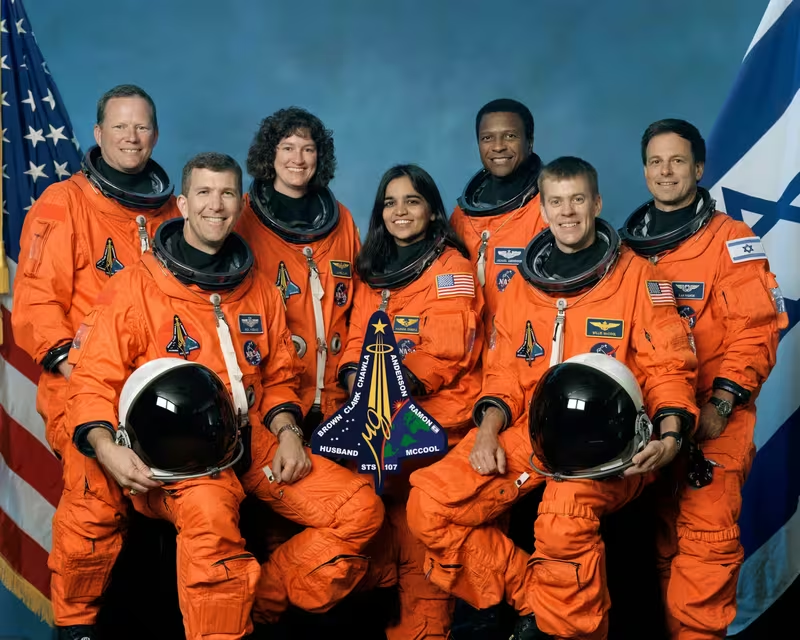
Kalpana Chawla - First Indian Woman in Space
The Girl from Karnal Who Reached for the Stars
In the small, bustling city of Karnal in Haryana, a young girl named Kalpana Chawla would lie on the rooftop at night, her eyes fixed on the boundless, star-dusted canvas above. While other children played with dolls, she was captivated by the aeroplanes that roared overhead from the local flying club. This early fascination was not a fleeting childhood fancy; it was the genesis of a dream that would eventually carry her beyond the Earth's atmosphere and into the annals of history.
Born on March 17, 1962, Kalpana was the youngest of four children in a family that had endured the hardships of the Partition of India. Her father, Banarsi Lal Chawla, was a self-made man who encouraged his children's education, while her mother, Sanyogita, was a supportive homemaker. From a young age, Kalpana displayed a fiercely independent and determined spirit. In a well-known family anecdote, she refused her given name, Monto, and chose her own: Kalpana, meaning “imagination” or “idea” in Sanskrit. It was a name that would prove prophetic.
Her formal education began at the Tagore Baal Niketan Senior Secondary School in Karnal, where she was a diligent and inquisitive student. Her passion for flight only grew stronger. She built model aeroplanes and was fascinated by the mechanics of flight, a subject few girls in her town pursued. This unwavering focus led her to the prestigious Punjab Engineering College in Chandigarh, where she enrolled in the aeronautical engineering program—the first woman to do so at the institution. Despite initial resistance from some faculty who tried to steer her towards more “suitable” engineering fields, Kalpana stood her ground, her resolve as unshakeable as her ambition.
In 1982, with a Bachelor of Engineering degree in hand, she looked westward. The dream of space, of working for an organization like NASA, was an audacious one for a young woman from Karnal, but for Kalpana, it was the only logical next step.
The American Dream and the Path to NASA
In the fall of 1982, Kalpana Chawla arrived in the United States, a world away from the familiar streets of Haryana. She enrolled at the University of Texas at Arlington, where she earned a Master of Science degree in Aerospace Engineering just two years later, in 1984. Her academic journey was far from over. Driven by a thirst for deeper knowledge, she moved to the University of Colorado Boulder, obtaining a second Master's in 1986 and finally, a Doctorate in Aerospace Engineering in 1988.
Her doctoral thesis focused on the complex field of computational fluid dynamics (CFD), specifically on the vertical and short take-off and landing (V/STOL) of aircraft. This highly specialized work immediately secured her a position at the NASA Ames Research Center in California. Here, she was no longer just a student dreaming of the stars; she was a scientist actively contributing to the future of aerospace technology.
In 1991, Kalpana became a naturalized U.S. citizen, a crucial step that made her eligible to apply for the coveted NASA Astronaut Corps. She applied without hesitation. After a rigorous selection process involving intense physical and psychological evaluations, in December 1994, she received the call that would change her life. She was selected as an astronaut candidate in NASA's 15th group. When she reported to the Johnson Space Center in Houston, Texas, in March 1995, she was not just Kalpana Chawla, the engineer; she was on her way to becoming Kalpana Chawla, the astronaut.
Touching the Void: Two Journeys into Space
After a year of demanding training and evaluation, Kalpana was assigned to her first spaceflight. On November 19, 1997, she launched aboard the Space Shuttle Columbia on mission STS-87. As the shuttle broke free from Earth’s gravity and ascended into the blackness of space, Kalpana Chawla officially became the first woman of Indian origin to leave the planet.
During the 16-day mission, she served as a mission specialist and the primary operator of the shuttle's sophisticated robotic arm. The crew conducted a series of experiments focused on how the weightless environment of space affects various physical processes. The mission was not without its challenges. A crucial scientific satellite, the Spartan, malfunctioned after being deployed by the robotic arm. Two of her fellow astronauts had to conduct a spacewalk to retrieve it manually. A subsequent NASA investigation, however, exonerated Chawla completely, attributing the failure to software glitches and procedural errors. Her performance was deemed exemplary.
Upon returning to Earth, having orbited the planet 252 times and traveled 10.4 million miles, she reflected on the profound experience. In a press briefing, she shared a perspective that transcended national boundaries: “When you look at the stars and the galaxy, you feel that you are not just from any particular piece ofland, but from the solar system.”
Her expertise and calm demeanor earned her great respect within NASA. After her first flight, she was assigned to technical roles in the Astronaut Office. In 2001, her dream was realized once more when she was selected for a second space mission, STS-107, again aboard the Space Shuttle Columbia.
After numerous delays, STS-107 finally launched on January 16, 2003. It was a dedicated science mission, a testament to international collaboration, carrying a host of experiments from researchers around the globe. For 16 days, Kalpana and her six crewmates worked tirelessly, conducting over 80 experiments in fields ranging from astronaut health to material science. It was an immensely successful and productive mission, and the crew was in high spirits as they prepared for their return journey home.
A Star That Fell to Earth: The Columbia Tragedy
On the morning of February 1, 2003, the world watched the skies, awaiting the return of Columbia. As the shuttle streaked across the pre-dawn sky over the southern United States, it was just minutes from its scheduled landing at the Kennedy Space Center in Florida. But it would never arrive.
At 9:00 a.m. EST, as it flew over Texas, the shuttle violently broke apart. The seven astronauts aboard, including Kalpana Chawla, were lost in an instant. The tragedy stunned the world and plunged both India and the United States into deep mourning.
An exhaustive investigation later revealed the catastrophic cause. During the launch 16 days earlier, a piece of insulating foam from the external fuel tank had broken off and struck the leading edge of the shuttle's left wing. The impact created a breach in the wing's heat-shielding system. Upon re-entry into the Earth's atmosphere, superheated gases penetrated the wing, melting its internal structure and causing the shuttle to lose control and disintegrate.
The Enduring Legacy of a Trailblazer
In her 40 years, Kalpana Chawla lived a life of extraordinary purpose. Her death was a profound loss, but her legacy is one of triumph, not tragedy. For India, she became a national hero, a modern-day icon whose journey from a small town to the cosmos embodied the nation's highest aspirations. She proved that with courage, intellect, and relentless hard work, no dream is too distant, no star too far.
Her influence is particularly powerful for young women in India, for whom she shattered the ultimate glass ceiling. She became a symbol of what was possible, inspiring a generation to pursue careers in science, technology, engineering, and mathematics (STEM).
Honors and tributes poured in from around the world. The United States posthumously awarded her the Congressional Space Medal of Honor. NASA named a supercomputer at its Ames Research Center “Kalpana.” An asteroid, 51826 Kalpanachawla, was named in her memory, ensuring her name would forever be etched among the celestial bodies she so loved. In India, the government renamed its first meteorological satellite of the “MetSat” series to “Kalpana-1.” Her alma maters have established scholarships and named buildings in her honor, including Kalpana Chawla Hall at the University of Texas at Arlington.
More than the awards and accolades, Kalpana Chawla's legacy lives on in the spirit of exploration she embodied. She was a quiet, focused individual who let her achievements speak for themselves. She bridged two worlds—the ancient land of her birth and the technological frontier of her adopted home—and in doing so, created a universal story of human potential. Her life serves as a timeless reminder that our origins do not define our destiny, and that the quest for knowledge is a journey without borders.