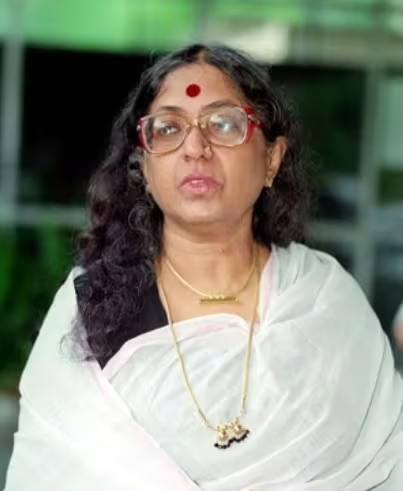
A Voice Unbound: The Life and Legacy of Kamala Surayya
In the landscape of 20th-century Indian literature, few figures stand as tall or as defiantly as Kamala Surayya. Known to the English-speaking world as the confessional poet Kamala Das, and to her Malayali readers as the beloved storyteller Madhavikutty, she was a literary force who dismantled the traditional boundaries of womanhood with her pen. With unflinching honesty, she wrote about love, desire, betrayal, and the deep, often-conflicted inner world of women, cracking open the polished veneer of a conservative society. Her life was a testament to a relentless search for identity and love, and her work remains a powerful legacy of courage and artistic rebellion.
Early Life & Background
Kamala was born on March 31, 1934, in Punnayurkulam, part of the Malabar District of British India (present-day Thrissur district, Kerala). She was born not just into a family, but into a literary dynasty. Her mother, Balamani Amma, was one of Kerala’s most revered poets, often called the “poetess of motherhood” for her tender and insightful verses. Her father, V. M. Nair, was the managing editor of the influential Malayalam daily Mathrubhumi. Her great-uncle was Nalapat Narayana Menon, a towering figure in Malayalam literature as a writer, poet, and philosopher.
This immersion in literature was the very air she breathed. Her childhood was split between two contrasting worlds that would deeply shape her creative consciousness. There was the ancestral home, Nalapat, in the lush, green village of Punnayurkulam, a place steeped in tradition, matrilineal customs, and languid rhythms. Then there was the bustling, colonial metropolis of Calcutta (now Kolkata), where her father worked. This duality—the nostalgic pull of a rural Keralan past and the sophisticated, often lonely, reality of urban life—became a central, recurring theme in her writing.
Her education was largely unconventional. Instead of formal schooling for most of her early years, she was educated at home by tutors. This environment, free from the rigid structures of a school, allowed her independent mind to flourish, nurtured by the vast library at her disposal and the literary conversations that filled her home. At the tender age of 15, in 1949, she was married to Madhava Das, a bank officer who, despite the complexities of their relationship which she would later explore in her work, recognized her prodigious talent and encouraged her to write.
Career & Major Contributions
Kamala Surayya’s literary career was remarkable for its bilingual mastery. She navigated two languages and two literary personas with extraordinary skill, creating distinct but interconnected bodies of work.
The Poet: Kamala Das
In English, writing as Kamala Das, she carved a niche as India’s foremost confessional poet. Her arrival on the literary scene in the 1960s was a seismic event. At a time when Indian poetry in English was often formal and detached, her voice was raw, intimate, and startlingly direct. She laid bare her personal experiences, transforming them into universal meditations on love, lust, the suffocation of domesticity, and the quest for an identity untethered from societal roles.
Her debut collection, Summer in Calcutta (1965), was a revelation. Poems like the titular “Summer in Calcutta” and the fiercely defiant “An Introduction” established her as a voice that could not be ignored. In “An Introduction,” she famously wrote:
“...I am an Indian, very brown, born in Malabar, I speak three languages, write in Two, dream in one. Don't write in English, they said, English is not your mother-tongue... The language I speak Becomes mine, its distortions, its queernesses All mine, mine alone.”
This was a declaration of artistic independence. Her subsequent collections, including The Descendants (1967) and The Old Playhouse and Other Poems (1973), continued to explore these themes with a passion and vulnerability that resonated with readers across the world. Her work drew comparisons to Western confessional poets like Sylvia Plath and Anne Sexton, yet it was distinctly Indian, rooted in her unique experiences as a woman navigating a patriarchal society. Her profound contribution to poetry was recognized when she was nominated for the Nobel Prize in Literature in 1984.
The Storyteller: Madhavikutty
In her mother tongue, Malayalam, she was Madhavikutty, a beloved and prolific short story writer and novelist. Here, her prose was lyrical and evocative, filled with a deep sense of nostalgia and psychological insight. She wrote about the subtle complexities of human relationships, the loneliness of women trapped in loveless marriages, and the ache for a lost, idyllic childhood. Her stories, published widely in Malayalam periodicals, made her a household name in Kerala.
One of her most cherished works in Malayalam is Neermathalam Pootha Kalam (1993), a nostalgic memoir of her childhood at Nalapat. The book, which translates to “The Time When the Neermathalam Tree Bloomed,” is a poignant and beautifully rendered account of a bygone era. For this masterpiece of memory and prose, she was awarded the prestigious Vayalar Award in 1997.
The Scandal and Sensation: My Story
No account of Kamala Surayya’s career is complete without mentioning her explosive autobiography, Ente Katha (My Story). First serialized in a Malayalam weekly in 1973 and later published in English in 1976, the book was a cultural firestorm. With unprecedented candor, she wrote about her unhappy marriage, her sexual awakenings, and her extramarital affairs. It was a direct assault on the hypocrisy of a society that demanded female purity while turning a blind eye to male infidelity.
My Story was condemned by conservatives as scandalous and obscene, but it was also embraced by a new generation of women who saw their own unspoken feelings reflected in its pages. It became an instant bestseller and a landmark text of Indian feminist literature. Years later, Kamala would playfully add another layer of complexity to the work, stating that much of it was fiction. This deliberate blurring of the line between fact and imagination only enhanced its power, making it a profound commentary on the nature of self-representation and truth.
Legacy & Influence
Kamala Surayya’s life was as defiant and unconventional as her writing. In 1999, at the age of 65, in another act that stunned the public, she converted to Islam and adopted the name Kamala Surayya. This decision, she explained, was the culmination of a lifelong search for unconditional love—a theme that had dominated her poetry and prose for decades. It was yet another assertion of her personal freedom, a final, powerful chapter in a life lived entirely on her own terms.
She passed away in Pune on May 31, 2009, at the age of 75. Her body was flown to her home state of Kerala, where she was buried with full state honors at the Palayam Juma Masjid in Thiruvananthapuram. The outpouring of grief was a testament to the deep connection she had forged with her readers.
Her legacy is monumental. Kamala Surayya gave voice to the Indian woman’s interior world in a way no one had before. She made it permissible to speak of desire, to question institutions, and to demand a life of emotional and intellectual fulfillment. For generations of writers, especially women, she remains a guiding star—a symbol of artistic integrity and fearless self-expression.
Today, she is remembered as the rebel poet Kamala Das, the nostalgic storyteller Madhavikutty, and the seeker Kamala Surayya. She was all of these and more. Through her words, she built a world where a woman’s soul, in all its complexity and contradiction, could finally, and gloriously, know how to sing.