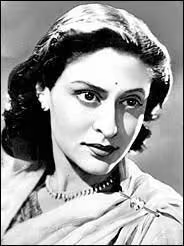
Kamala Markandaya: The Voice of a Changing India
In the nascent years of India's independence, as a new nation grappled with its identity, a chorus of literary voices emerged to chronicle its tumultuous birth. Among them, alongside figures like R.K. Narayan and Mulk Raj Anand, stood a powerful and poignant female voice: Kamala Markandaya. Born Kamala Purnaiya in 1924, she became one of the first Indian women novelists to achieve widespread international acclaim in the English language. Through her deeply empathetic and beautifully crafted narratives, Markandaya gave the world an intimate glimpse into the soul of a nation caught between the ancient rhythms of village life and the relentless march of modernity, between the deep-rooted traditions of the East and the encroaching influence of the West.
Early Life & Background: A Brahmin Daughter in a Colonial World
Kamala Purnaiya was born on January 1, 1924, in Shimoga, a town in the princely state of Mysore (present-day Karnataka). She was born into a Madhwa Brahmin family, a background that steeped her in the intellectual and cultural traditions of Hindu society. Her father, Dewan Purnaiya, was a transport officer in the Indian Railways, a position that likely afforded the family a degree of mobility and exposure to the machinery of the British Raj. This upbringing placed her at a unique intersection: rooted in ancient Indian tradition yet educated within a modern, Westernised system.
Her formative years were spent absorbing the complex realities of India in the final, turbulent decades of British rule. She pursued higher education at the prestigious University of Madras, where she majored in history. She graduated in 1947, a year of monumental significance for the subcontinent. As she completed her studies, the nation was cleaved in two by Partition, and the tricolour was hoisted over an independent, yet wounded, India. The air was thick with hope, uncertainty, and the profound human drama of a society in flux—a drama that would become the central preoccupation of her literary career.
Before dedicating herself to fiction, Markandaya had a brief but impactful career. She worked for a short period as a journalist and also served in the Indian Army during World War II. These experiences provided her with a wider lens on the social and political currents sweeping through the country. However, the most pivotal event of her personal life occurred in 1948, just a year after independence. She married an English journalist, Bertrand Taylor, and moved with him to Britain. This move would define her identity as a writer. For the rest of her life, she would write about India from a distance, becoming a key figure in the Indian diaspora. This expatriate position gave her a unique dual perspective—that of an insider who intimately understood the cultural nuances of her homeland, and an outsider who could observe its transformations with a critical, discerning eye.
Career & Major Contributions: A Chronicle of Conflict and Compassion
Kamala Markandaya burst onto the global literary scene in 1954 with her debut novel, Nectar in a Sieve. The book was an immediate and resounding success. Published in New York by John Day Company, it became a main selection for the prestigious Book-of-the-Month Club and a bestseller, introducing a vast Western audience to the stark realities of Indian agrarian life.
The novel tells the story of Rukmani, a young woman from a village in southern India. Written in a simple, lyrical first-person narrative, it chronicles her arranged marriage to a tenant farmer, Nathan, and their subsequent life of unceasing struggle against the whims of nature and man. They face floods, droughts, and the encroaching forces of industrialisation in the form of a large tannery built in their village. The tannery offers employment but also destroys their traditional way of life, polluting the land and corrupting social norms. Nectar in a Sieve is a heartbreaking testament to human resilience in the face of overwhelming poverty and loss. Its power lies in its quiet dignity; it is not a political treatise but a deeply human story that gave a face and a voice to the millions of anonymous peasants weathering the storms of change in post-colonial India.
With her debut, Markandaya established the major themes that would dominate her oeuvre:
- Tradition vs. Modernity: The destructive and sometimes seductive power of modern industry and urban values clashing with the pastoral, tradition-bound life of the Indian village.
- The East-West Encounter: The complex, often fraught, relationship between Indians and Europeans, exploring themes of colonialism, neo-colonialism, and the search for a hybrid identity.
- The Plight of the Individual: A deep focus on how large-scale historical and economic forces impact the lives of ordinary people, particularly women.
Her second novel, Some Inner Fury (1955), tackled the East-West conflict more directly. Set against the incendiary backdrop of the 1942 Quit India Movement, it portrays the tragic love affair between Mirabai, an educated Indian woman, and Richard, a British civil servant. Their personal relationship becomes a microcosm of the larger political conflict, torn apart by the irreconcilable forces of nationalism and colonialism. The novel masterfully captures the divided loyalties of the Western-educated Indian elite, caught between their love for their country and their affinity for English culture.
Over the next two decades, Markandaya continued to explore these themes with remarkable versatility:
Possession (1963): This novel is a sharp allegory for colonial exploitation. It tells the story of Lady Caroline Bell, a wealthy Englishwoman who "discovers" a gifted but impoverished young Indian artist, Valmiki, in a village. She takes him to London, promotes his career, and treats him as her personal possession, seeking to control not just his art but his very soul. The novel is a biting critique of the West's tendency to exoticize and appropriate Eastern culture.
A Handful of Rice (1966): Here, Markandaya shifted her focus from the village to the city. The protagonist, Ravi, flees the poverty of his village for the metropolis of Madras (now Chennai), hoping for a better life. Instead, he finds himself trapped in the brutal, dehumanizing world of urban squalor. The novel is a grim depiction of the struggles of the urban poor, showing that the promise of modernity often leads to a different, more corrosive kind of despair than that found in the countryside.
The Coffer Dams (1969): This work examines the theme of neo-colonialism in independent India. A British engineering firm is contracted to build a massive dam in a remote tribal region. The narrative contrasts the British engineers' technological arrogance and focus on deadlines with the local community's deep respect for nature and tradition. The central conflict is embodied in the relationship between Helen, the wife of the lead British engineer, and Bashiam, a tribal crane operator, who form a bond that transcends cultural barriers.
The Nowhere Man (1972): Perhaps one of her most powerful and prescient novels, The Nowhere Man delves into the immigrant experience. It tells the story of Srinivas, an elderly Brahmin who has lived in a South London suburb for decades. As racial tensions rise in post-war Britain, he and his family become targets of prejudice and violence. The novel is a devastating exploration of racism, alienation, and the painful search for belonging in an adopted land that refuses to fully accept you.
Legacy & Influence: A Bridge Between Worlds
Kamala Markandaya's legacy is that of a pioneer. She was at the forefront of the first wave of post-independence Indian writers who chose English as their medium. Her work provided a crucial bridge, interpreting the complexities of Indian life for a global readership while simultaneously helping to forge a new path for Indian English literature. Her novels are still staple texts in university courses on post-colonial and South Asian literature worldwide.
Her expatriate status, however, also made her a subject of debate. Some critics in India accused her of writing for a Western audience, arguing that her focus on poverty, spirituality, and rural suffering reinforced Orientalist stereotypes of India. They suggested that her portrayal of India was frozen in time, seen through a nostalgic and romanticized lens.
Yet, this criticism often overlooks the profound empathy and authenticity that permeate her work. Markandaya never shied away from the harshness of Indian life, but her characters are never mere victims. Rukmani in Nectar in a Sieve is a figure of immense strength and dignity. Markandaya’s focus was always on the universal human condition, using the Indian context to explore timeless struggles for survival, identity, and meaning.
Her true significance lies in her ability to capture the psychological and emotional toll of transition. Her characters are perpetually caught between worlds: village and city, India and England, past and future. She chronicled the anxieties of a nation shedding its colonial skin and stumbling into an uncertain modern future. Her themes—the environmental cost of industrialization, the challenges of globalization, the pain of displacement, and the search for identity in a multicultural world—are more relevant today than ever before.
Throughout her life, Kamala Markandaya remained a fiercely private person. She rarely gave interviews and avoided the literary limelight, preferring to let her ten novels speak for her. She continued to live in England until her death in London on May 16, 2004, at the age of 80. Her work remains a powerful and enduring monument, a testament to a writer who saw the beauty and the tragedy of her homeland with piercing clarity and wrote of its people with unwavering compassion and grace.