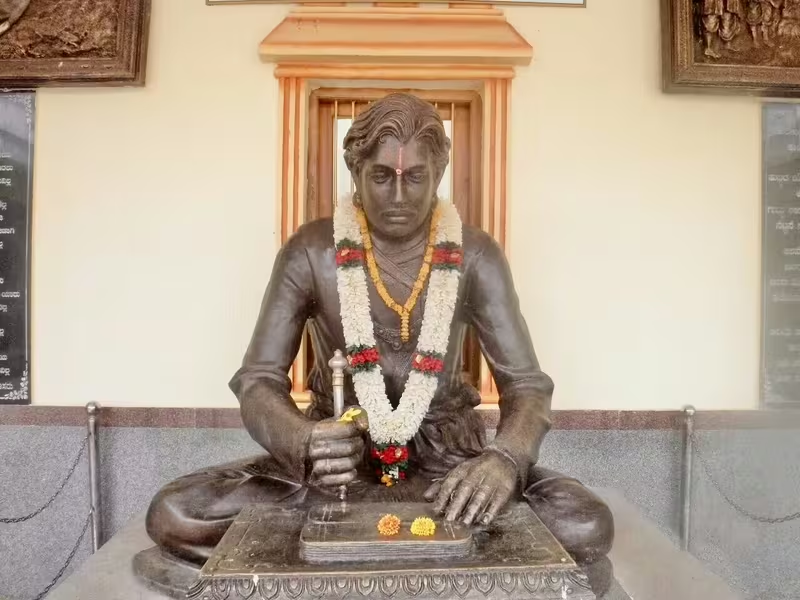
Kanaka Dasa - Haridasa Saint and Philosopher
In the vibrant tapestry of medieval Indian spirituality, few threads shine as brightly as that of Kanaka Dasa (1509-1606). He was a poet whose words were prayers, a musician whose melodies carried profound philosophy, and a social reformer whose life was a testament to the power of devotion over dogma. As a pivotal figure in the Haridasa movement of Karnataka, Kanaka Dasa emerged from a non-Brahmin background to become one of the most revered saint-composers of his era, leaving an indelible mark on Kannada literature, Carnatic music, and the very conscience of society. His journey from a warrior-chieftain to a wandering minstrel of God is a story of profound transformation, a narrative that continues to inspire millions.
Early Life & Background
Kanaka Dasa was born in 1509 in Bada, a village near Bankapura in the Haveri district of modern-day Karnataka. This region was then part of the formidable Vijayanagara Empire, a flourishing centre of art, culture, and religion. He was born into the Kuruba (shepherd) community and given the name Thimmappa Nayaka. His parents, Biregowda and Bachchamma, were influential figures; his father served as a chieftain (dandanayaka) under the Vijayanagara rulers, commanding respect and authority.
Raised in a martial tradition, Thimmappa was educated not just in Kannada literature and poetry but also in the arts of warfare. He was groomed to follow in his father's footsteps, to be a leader and a warrior, defending his land and people. For years, he dutifully fulfilled this role, earning a reputation as a brave and capable chieftain.
However, destiny had a different path for him. According to hagiographical accounts, a cataclysmic event on the battlefield served as the turning point in his life. In a fierce battle, Thimmappa was grievously wounded and left for dead. In that moment of profound crisis, he had a divine vision and was miraculously saved. This brush with mortality shattered his worldly ambitions. He saw the futility of conflict and temporal power and decided to renounce his life as a warrior. He laid down his sword and picked up the tambura, a stringed instrument symbolic of a wandering minstrel, dedicating the rest of his life to the pursuit of spiritual truth.
Legend also speaks of another event that cemented his new identity. He is said to have discovered a large cache of gold coins (kanaka). Instead of using the wealth for personal gain, he distributed it among the poor and used it to build a temple dedicated to Vishnu in his home town of Kaginele. This act of immense generosity and renunciation earned him the name Kanaka Nayaka, which later evolved into Kanaka Dasa, meaning 'Servant of God'. His spiritual quest led him to the feet of the great Dvaita philosopher and the rajaguru of the Vijayanagara Empire, Sri Vyasatirtha. Under his tutelage, Kanaka Dasa was formally initiated into the Haridasa tradition, a devotional Bhakti movement that aimed to spread the teachings of Madhvacharya's Dvaita philosophy to the common people through simple, soul-stirring songs in the Kannada language.
Career & Major Contributions
As Kanaka Dasa, he blossomed into one of the most luminous figures of the Haridasa movement, alongside his contemporary and fellow disciple of Vyasatirtha, the legendary Purandara Dasa. While Purandara Dasa is celebrated as the Pitamaha (grandfather) of Carnatic music, Kanaka Dasa carved a unique niche for himself with his penetrating philosophical insights and fearless social critique, all woven into exquisite poetry and music.
He composed hundreds of devotional songs, known as kirtanas and ugabhogas, using the pen name (ankita nama) Kaginele Adhikeshava, in honour of the deity in his hometown. His compositions were remarkable for their lyrical simplicity, emotional depth, and intellectual rigour. They explored complex themes of illusion (maya), the nature of the divine, and the path to liberation, making them accessible to everyone, from scholars to laypersons.
A Voice Against Injustice
What truly distinguished Kanaka Dasa was his unflinching challenge to the rigid caste hierarchies of his time. Coming from a lower-caste background, he had firsthand experience of social discrimination. He used his art as a powerful tool for social reform, arguing passionately that a person's worth should be judged by their character and devotion, not the circumstances of their birth. His famous kirtana, "Kula Kula Kulavendu Hodedadadiri" (Do not fight, crying 'caste, caste!'), is a powerful anthem against casteism:
"What is the caste of the soul? What is the caste of the body's elements? What is the caste of the ultimate Self that resides within? Do not squabble over caste."
This direct, questioning tone was revolutionary for its time and remains profoundly relevant today.
Major Literary Works
Beyond his individual compositions, Kanaka Dasa authored five major literary works that stand as pillars of medieval Kannada literature:
Mohanatarangini (River of Krishna): Written in the native sangatya meter, this epic poem narrates the life of Lord Krishna in Dwaraka. Beyond its devotional content, the work is a priceless historical document, offering vivid and detailed descriptions of the city of Vijayanagara (Hampi) during its golden age under Krishnadevaraya.
Nalacharitre (The Story of Nala): A masterful retelling of the famous story of King Nala and Queen Damayanti from the Mahabharata, this work explores themes of dharma, suffering, and divine will with great sensitivity.
Haribhaktisara (Essence of Devotion to Hari): This work comprises 110 poems in the six-lined shatpadi meter. It is a guide to righteous living, focusing on ethics, morality, and the cultivation of unwavering devotion.
Ramadhanya Charite (The Story of the Ragi Grain): Perhaps his most ingenious and radical work, this is a brilliant allegory on social hierarchy. The poem narrates a dispute between rice, the food of the wealthy upper castes, and ragi (finger millet), the staple of the poor lower castes, over which grain is superior. The matter is brought before Lord Rama. After placing both grains in prison for months, Rama observes that the rice has rotted while the humble ragi remains wholesome. He declares ragi the winner, symbolizing the moral and spiritual superiority of the oppressed and the humble over the privileged and the arrogant. It is a profound and subtle critique of the caste system, unparalleled in its creativity.
The Udupi Incident: Kanakana Kindi
The most celebrated event of Kanaka Dasa's life is a powerful legend that encapsulates his struggle and ultimate spiritual triumph. He journeyed to the famous Sri Krishna Matha in Udupi, a temple founded by the philosopher Madhvacharya. Upon his arrival, the orthodox priests, seeing his humble, lower-caste origins, denied him entry into the temple's inner sanctum.
Undeterred and filled with unshakeable faith, Kanaka Dasa did not protest or leave. Instead, he went to the back of the temple and began to sing heartfelt praises to his beloved Lord Krishna, pouring his soul into his music. So immense was the power of his devotion that, according to the legend, a miracle occurred. The outer western wall of the temple cracked and fell open, and the idol of Lord Krishna, which traditionally faced east, miraculously turned around to face west, granting Kanaka Dasa a direct, divine vision (darshana) through the newly formed opening.
This event shook the temple establishment to its core. In commemoration of this divine intervention, a small window, known as Kanakana Kindi (Kanaka's Window), was installed in the crack. To this day, it is a revered tradition for all devotees, regardless of their status, to first glimpse the idol of Lord Krishna through this window before entering the temple, paying homage to the supreme devotion of Kanaka Dasa that transcended all man-made barriers.
Legacy & Influence
Kanaka Dasa lived for nearly a century, passing away in 1606. His legacy, however, is immortal. He is remembered not just as a poet and musician but as a dasanayaka—a leader among God's servants—who championed spiritual egalitarianism.
His most profound impact was as a social reformer. In an age of rigid orthodoxy, he was a courageous voice for the downtrodden, using the Bhakti movement's ideals to argue for a society based on inner worth rather than birthright. His life and works provided a powerful spiritual counter-narrative to caste-based discrimination.
In the realms of literature and music, his contributions are immeasurable. He enriched the Kannada language with his simple yet profound works, demonstrating that complex philosophy could be conveyed in the vernacular of the common person. His kirtanas remain an essential part of the Carnatic music concert repertoire and are sung in homes and temples across South India.
Today, Kanaka Dasa is revered as one of Karnataka's greatest cultural and spiritual icons. His birth anniversary, Kanaka Jayanti, is celebrated as a public holiday in the state. The Government of Karnataka has also established the Kaginele Development Authority to preserve the sites associated with his life and to promote his teachings. The story of Kanakana Kindi continues to be told as a powerful parable of faith's ability to break down walls, both literal and metaphorical.
Kanaka Dasa's life was a symphony of devotion, a poem of protest, and a philosophy of love. He was a warrior who won his greatest victory by laying down his arms, a chieftain whose true kingdom was the hearts of the people, and a saint whose window to the divine remains open for all to see.