The King of Kings: Kanishka I and the Golden Age of the Kushans
In the grand tapestry of Indian history, woven with the threads of dynasties, philosophies, and epic battles, the era of the Kushan Empire stands out as a vibrant, cosmopolitan nexus. At the heart of this period, reigning over an empire that stretched from the arid steppes of Central Asia to the fertile plains of the Ganges, was a ruler of immense power and vision: Kanishka I. More than a conqueror, Kanishka was a cultural unifier, a patron of faith, and an emperor whose influence radiated outwards along the Silk Road, forever shaping the artistic and religious landscape of Asia. His reign, from approximately 127 CE to 150 CE, was not merely a chapter in a dynasty's story but a pivotal moment when disparate cultures met, mingled, and produced something entirely new.
Early Life & The Kushan Inheritance
The precise origins of Kanishka I are shrouded in the mists of history, a common fate for many figures of the ancient world. The details of his birth, parentage, and early education are not recorded in any definitive chronicle. What is known is the world he was born into. Kanishka hailed from the Kushans, a people descended from the Yuezhi, a nomadic confederation that had been driven from their ancestral lands in modern-day Northwest China centuries earlier. Migrating west, they settled in Bactria (modern Afghanistan and Tajikistan), a region deeply Hellenized since the conquests of Alexander the Great.
By the time Kanishka came to power, his predecessors, particularly Kujula Kadphises and Vima Kadphises, had already forged a formidable empire. They had unified the Yuezhi tribes, conquered the remnants of the Indo-Greek kingdoms, and pushed deep into the Indian subcontinent. Vima Kadphises had established a robust administration and introduced the first gold coinage in the region, a clear sign of the empire's burgeoning wealth and stability.
Kanishka, therefore, did not inherit a fledgling kingdom but a powerful, multi-ethnic state that was already a major player on the world stage. His challenge was to consolidate this vast territory, expand its frontiers, and give it a cohesive cultural and spiritual identity.
The Emperor and His Realm: Career & Major Contributions
Kanishka’s accession to the throne, a subject of considerable scholarly debate, is now most commonly dated to 127 CE. This date marks the beginning of the “Kanishka era,” a period of unparalleled prosperity and cultural efflorescence. From his twin capitals—the primary administrative center of Purushapura (modern Peshawar, Pakistan) and the great cultural hub of Mathura in India—he governed an empire that was a true crossroads of civilizations.
A Conqueror's Domain
Kanishka was a military commander of exceptional skill. The Rabatak inscription, a monumental discovery from Afghanistan inscribed in the Bactrian language, provides a direct window into his perception of his own empire. In it, Kanishka declares his dominion over a vast swath of northern India, including the key cities of Saketa, Kausambi, Pataliputra, and Champa. His armies pushed the boundaries of the empire, securing control over the lucrative trade routes that formed the arteries of the Silk Road.
His military ambitions even brought him into conflict with the powerful Han Dynasty of China over control of the Tarim Basin. By securing these territories, Kanishka ensured that the flow of silk from China, spices from India, and luxury goods from Rome passed through Kushan hands, filling the imperial coffers and funding his grand projects.
The Great Patron of Buddhism
While his military achievements were significant, Kanishka's most enduring legacy lies in his profound patronage of Buddhism. Like Ashoka Maurya before him, Kanishka became a champion of the faith, though his approach was distinct. His reign coincided with, and greatly fueled, the rise of Mahayana Buddhism, a new school of thought that emphasized the path of the bodhisattva and a more devotional form of practice.
His most celebrated contribution was the convening of the Fourth Buddhist Council. Held in Kashmir (or, according to some traditions, in Jalandhar), this grand assembly brought together hundreds of monks and scholars. Presided over by the learned Vasumitra, the council's primary objective was to collect, collate, and codify the sprawling Buddhist doctrines, particularly those of the influential Sarvastivada school. The resulting commentaries, known as the Mahāvibhāṣā Śāstra, were monumental works of philosophy and exegesis that would profoundly influence the development of Buddhism across Asia. By sponsoring this event, Kanishka provided the institutional and financial support necessary to give Buddhist doctrine a new, systematic foundation.
His court became a magnet for the greatest minds of the era. He patronized figures like the philosopher and poet Ashvaghosha, author of the epic Buddhacharita (The Life of Buddha), and the scholar Vasumitra. The legendary physician Charaka, one of the fathers of Ayurveda, is also traditionally associated with his court.
A Symphony in Stone: Art and Architecture
Under Kanishka's rule, the arts flourished, giving birth to one of the most remarkable artistic traditions in world history: Gandharan art. Centered in the region of Gandhara (modern-day Pakistan and Afghanistan), this school represented a breathtaking fusion of East and West. Hellenistic techniques of realism, with their focus on anatomy, drapery, and naturalistic forms, were applied to Buddhist subjects. For the first time, the Buddha was depicted in a human form that was both divine and deeply relatable—often with the wavy hair, aquiline nose, and toga-like robes characteristic of a Greek statue of Apollo. These serene, powerful images would become the standard for Buddhist iconography as it spread into China, Korea, and Japan.
Simultaneously, Kanishka's patronage extended to the Mathura school of art, which was developing a purely indigenous Indian aesthetic. Using the distinctive red sandstone of the region, Mathura artists created robust, energetic figures of Buddhas, Bodhisattvas, and Yakshas that radiated vitality. That Kanishka supported both the cosmopolitan Gandharan and the indigenous Mathura schools demonstrates his sophisticated understanding of the diverse cultures within his empire.
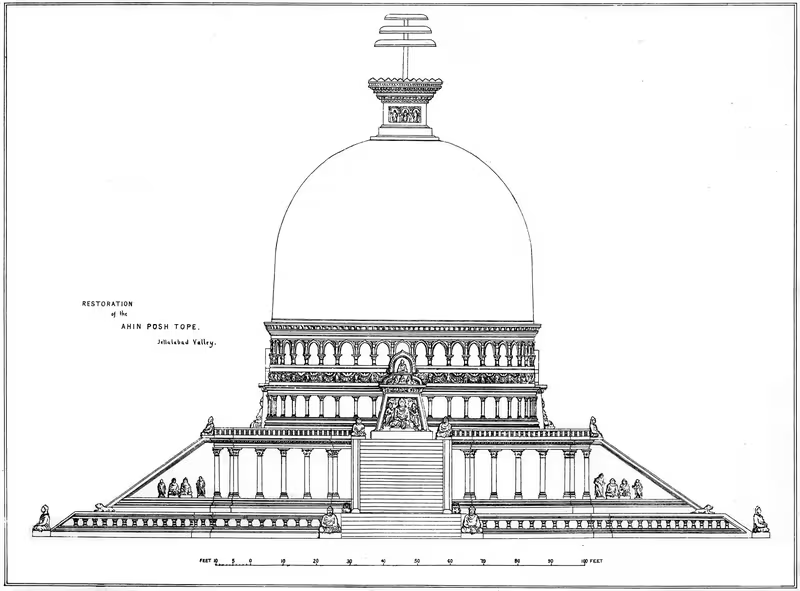
His architectural ambitions were embodied in the legendary Kanishka Stupa, built in his capital, Purushapura. According to the accounts of later Chinese pilgrims like Xuanzang, who saw its ruins centuries later, this was one of the tallest structures in the ancient world. A magnificent multi-storied tower, it was said to be richly adorned and capped with iron finials, a wonder of engineering and devotion that housed sacred relics of the Buddha.
Coinage of a Cosmopolitan King
Perhaps nothing better illustrates the syncretic nature of Kanishka's empire than his coinage. The gold and copper coins minted during his reign are a veritable pantheon of deities drawn from every corner of his realm. Alongside images of the Buddha and Maitreya, one finds Greek gods like Helios (the sun), Persian and Zoroastrian divinities like Mithra (Miiro) and Ardoxsho (goddess of fortune), and the Hindu god Shiva, referred to by his Bactrian name, Oesho. This numismatic gallery was not just currency; it was a statement of imperial policy—a message of tolerance and inclusion to the diverse peoples under his rule.
Legacy & Enduring Influence
Kanishka I was far more than a powerful monarch; he was a historical catalyst. His reign created a stable and prosperous environment where ideas, goods, and beliefs could travel and transform. He stands as one of the most significant rulers in the history of Central and South Asia, a figure whose impact is felt even today.
The Conduit of Faith and Art
Kanishka's most profound legacy was his role in the transmission of Buddhism to East Asia. The Kushan Empire, under his leadership, acted as the crucial bridge between India and China. It was during his era that Mahayana Buddhism, systematized and energized by his patronage, began its momentous journey along the Silk Road, carried by monks and merchants to the great cities of China, where it would take root and flourish.
The Greco-Buddhist art of Gandhara, which he nurtured, provided the visual language for this transmission. The serene, humanized image of the Buddha became the archetype for countless statues and paintings across the continent, from the Bamiyan Buddhas in Afghanistan to the Longmen Grottoes in China and the temples of Nara in Japan.
A Model of Pluralism
In an age often marked by conflict, Kanishka's empire was a remarkable example of religious and cultural pluralism. His personal devotion to Buddhism did not preclude a deep respect for the other faiths of his subjects, as his coinage vividly attests. He crafted a unique imperial identity that was simultaneously Bactrian, Indian, Hellenistic, and Persian, creating a cosmopolitan culture that was greater than the sum of its parts.
Today, Kanishka I is remembered as the “Second Ashoka” for his tireless promotion of the Buddhist faith. While perhaps not as widely known as the Mauryan emperor, his influence was just as pivotal. His legacy is not written in a single great edict but is etched into the faces of thousands of Gandharan sculptures housed in museums worldwide, embedded in the philosophical texts of Mahayana Buddhism, and preserved in the silent testimony of his eclectic coins. He was the quintessential Kushan emperor: a warrior from the steppes who became a philosopher-king, a pragmatic ruler who understood that the true strength of an empire lies not just in its armies, but in its ability to embrace and elevate the diverse cultures it governs.